
Fabric Protocol is not about robots or artificial intelligence. It is an attempt to rethink how robots, artificial intelligence and digital networks can work together. When I first heard about Fabric and the ROBO ecosystem I was not immediately impressed. In fact I was fairly cautious. That reaction was not really about the project itself. It was about my mindset at the time. I had spent years watching technology projects appear one after another each promising to reshape the future. After a while it becomes easy to assume that most new ideas are simply variations of the old story.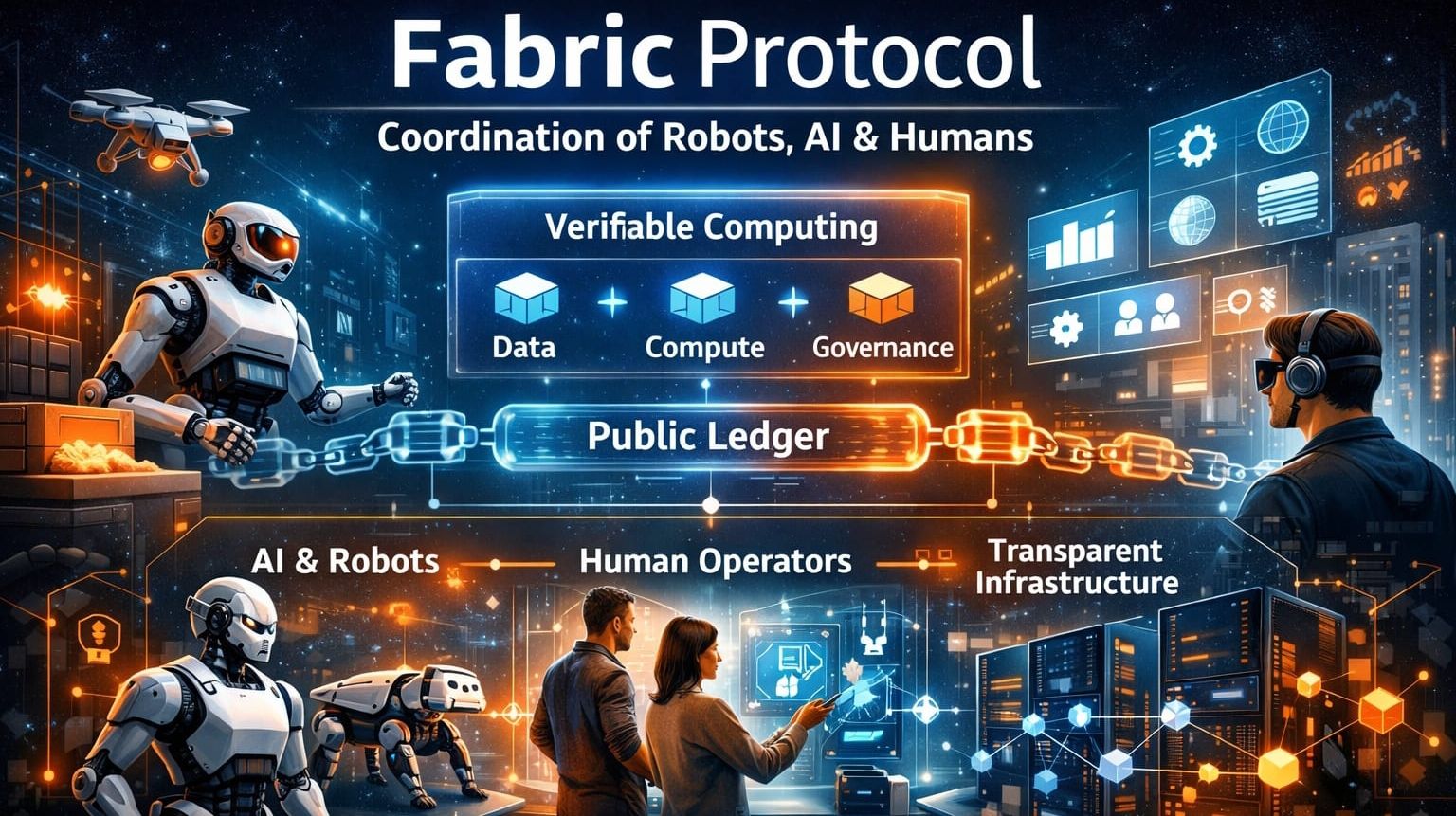
For a time my attention was focused on blockchain networks and the broader crypto ecosystem. New chains were launching constantly each promising transactions, stronger ecosystems and greater decentralization. Eventually it became difficult not to grow a little cynical. Robotics in my mind belonged to a different world. I associated robots with factories, warehouses and industrial automation. Machines designed to perform tasks not participate in digital networks.
Because of that mindset I had developed a habit of forming opinions about new projects.
When I first heard about ROBO and the Fabric Foundation my assumption was simple: this was probably another project trying to combine technologies like robotics, artificial intelligence and blockchain into a single narrative.. As I started reading more about Fabric Protocol I realized that the idea was slightly different from what I initially expected.
Of focusing on building robots themselves the project is focused on the infrastructure that would allow autonomous machines to cooperate within a trustworthy system.
That distinction matters.
Most robotics companies focus on hardware innovation. Their goal is to build faster and more intelligent machines. Meanwhile most blockchain networks are focused on systems and digital assets. They create platforms for payments, trading and decentralized finance. Fabric Protocol however asks a kind of question: what happens when autonomous machines become participants in digital networks?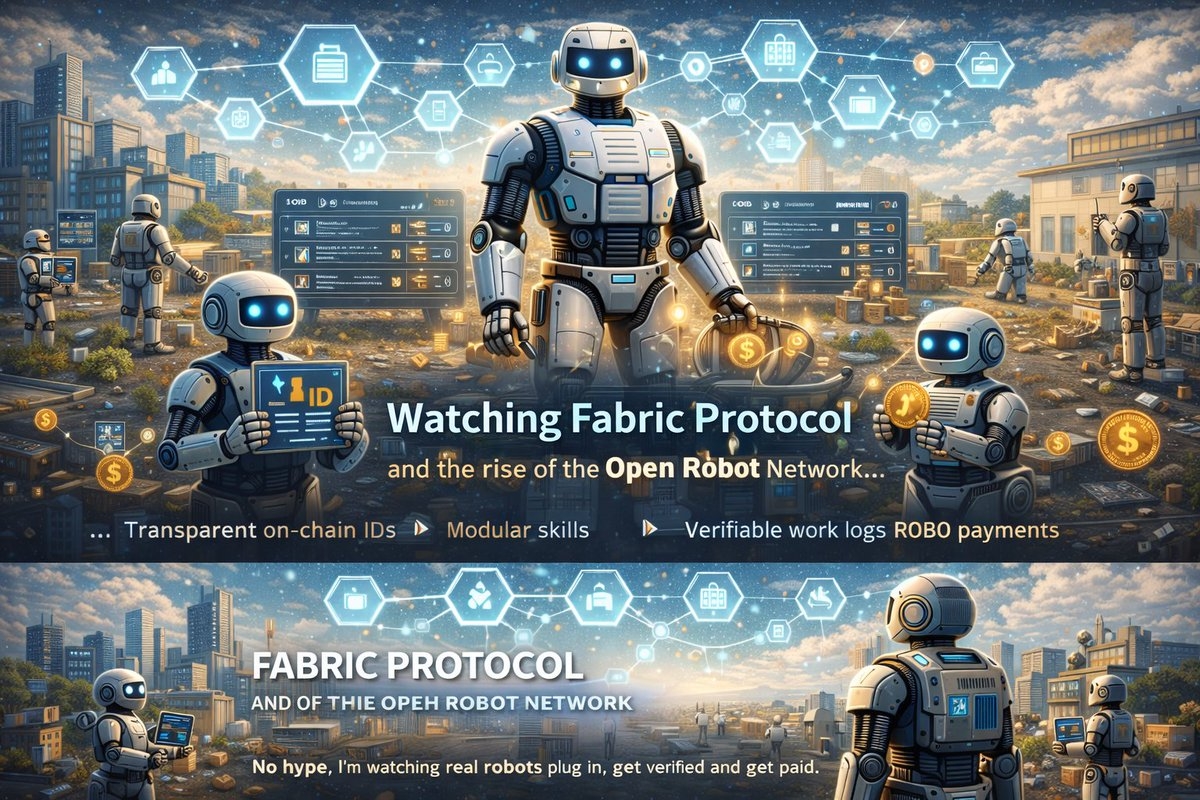
As artificial intelligence continues to improve robots are becoming increasingly capable of making their decisions. We already see this in logistics systems, automated warehouses and industrial environments.. As machines become more autonomous the issue of trust becomes unavoidable. How do we know that these machines are making the decisions? How do we verify that they are following agreed rules and processes?
This is where Fabric Protocols ideas about computing and decentralized coordination become interesting. Of simply trusting the output of an artificial intelligence system the protocol introduces mechanisms that can verify critical processes. In practice this means that autonomous machines could operate in systems where their actionsre transparent, auditable and coordinated through shared infrastructure.
While exploring this idea I naturally began comparing Fabric with technology projects I had followed.
Many blockchain platforms focus heavily on speed, scalability and token ecosystems.. Their real-world impact often remains concentrated in financial applications. Meanwhile robotics companies continue to push engineering boundaries. They frequently operate inside closed ecosystems where machines from different systems cannot easily collaborate.
Fabric appears to focus on something different: the coordination layer between machines, data and networks.
This approach suggests that the future of robotics may not be about building smarter machines but also about building the systems that allow those machines to interact safely and efficiently.
Another fascinating aspect of the Fabric vision comes from a place in internet history.
In 1995 the HTTP status code 402. "Payment Required" was introduced as part of the design of the internet. The developers who built the web imagined a future where services could automatically charge payments when accessed.. The payment infrastructure needed to support that vision never really arrived. For decades the code remained unused. An idea waiting for the technology to catch up.
Fabric Foundation has recently revived this concept through something called the x402 protocol, developed in collaboration with companies like Coinbase and Circle the issuer of USDC.
The idea is surprisingly simple but powerful: machines should be able to make payments on their own.
Through the x402 protocol, a robot running OM1, Fabrics open-source operating system can automatically pay for services. For example if a robot needs to charge its battery at a station it does not require a human to approve the payment. The robots identity on the blockchain initiates the payment process. The charging station verifies the request. The transaction is completed using USDC. All in seconds and without human involvement.
This might sound like a technical improvement but it actually represents something much bigger. It is one of the times that machine systems and payment systems have been fully integrated rather than loosely connected.
Imagine what this could mean.
A delivery drone could finish a route. Automatically pay bridge tolls, electricity costs and maintenance expenses using the revenue it earned from the job. A care robot could receive payment for its services pay for electricity and save the rest to improve its software capabilities. A robotic arm in a warehouse could rent out its capacity to other companies get paid in USDC and convert those earnings into ROBO tokens.
For the time machines could theoretically earn, spend and save money independently.
At the center of this system is ROBO, the token that powers the network. It is used for identity registration, governance participation and access to the ecosystem. Importantly part of the networks revenue model involves buying ROBO from the market meaning demand for the token could be connected to real machine activity rather than speculation.
The hardware layer is also important. Fabrics FC1000 VPU chip is designed to verify tasks using zero-knowledge proofs much more efficiently than traditional computers. These types of proofs are normally very expensive to compute. The VPU chip is optimized for this task. Can perform certain calculations about eleven times faster than conventional hardware.
That matters because verification needs to be affordable if a robot economy is going to scale. If verifying a robots work costs more than the task itself the system would not make sense.
This is likely why infrastructure builders are paying attention. Polygon Labs reportedly invested millions into VPU server infrastructure before the chips were even manufactured and pre-orders have already reached tens of millions of dollars.
The operating system behind all of this. OpenMinds OM1. Is designed to work across types of robotic hardware. Whether a robot walks on legs moves on wheels or uses arms it can run the same operating system and access a shared marketplace of skills. Tasks like laundry, inventory sorting or navigation could eventually become capabilities for machines.
Even participation in the system does not necessarily require owning a robot. People can contribute ROBO tokens into pools that help fund assets and the revenue those machines generate can be shared among contributors.
Course it is still early. Whether this entire system works at scale will depend on factors: hardware manufacturing speed, regulatory environments and the willingness of companies to adopt such infrastructure.
Fabric has built something that looks like a foundation.
The real question is whether the rest of the building will eventually rise on top of it.
For now one of the signals will be the delivery of the VPU hardware, in the coming months. If that infrastructure begins to appear at scale it may indicate that this vision of a machine economy is moving from theory toward reality.
If that happens Fabric Protocol and the ROBO ecosystem may turn out to be far more significant than many people initially expected.
#ROBO @Fabric Foundation $ROBO
