
okay so ive been going through one of the more unusual mechanisms in the $Robo design and honestly it took me a few reads to fully appreciate what theyre actually doing here 😂
most crypto networks bootstrap hardware participation through direct incentives — stake tokens, earn rewards, plug in hardware. Fabric does something genuinely different. before a robot even activates on the network — community has to coordinate around it using $ROBO.
what bugs me:
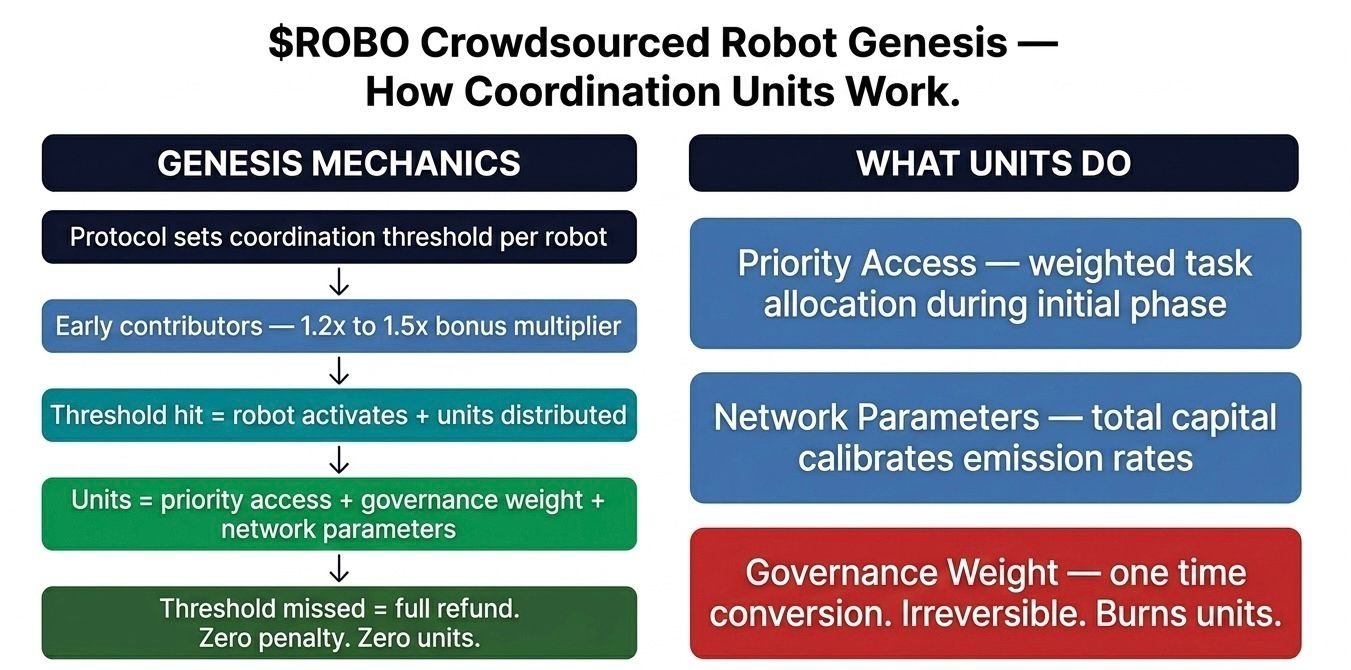
here is how it works. for each robot being deployed in the network initialization phase, the protocol defines a coordination threshold — a specific amount of $Robo that needs to be collectively staked toward that robot. participants contribute tokens to a time-bounded coordination contract. if aggregate contributions hit the threshold before the deadline — robot activates. if not — every token gets returned in full, zero penalty.
the whitepaper calls these coordination units. participants who contribute earlier get a bonus multiplier between 1.2x and 1.5x on their participation units. early contributors who bear more uncertainty get rewarded with more units. late contributors get fewer units for the same token amount.
those participation units then do three things. first — priority access weighting. during the robot’s initial operational phase, participants with more units get weighted priority for task allocation. not guaranteed access — weighted probability. second — network parameter initialization. total coordinated capital across all genesis robots calibrates initial emission rates and bonding requirements for the entire network. third — governance weight. during bootstrap period participation units can be converted to governance weight at a fixed exchange rate, one time and irreversible.
the angle that interests me:
the binary outcome structure is unusual. most crypto participation mechanisms have gradual outcomes — contribute more, earn more, proportionally. the genesis coordination mechanism has a hard threshold. hit it — robot activates, everyone who contributed gets their units. miss it — full refund, robot doesnt activate, no units created.
this creates a coordination game around each robot deployment. early contributors want the threshold to be hit because their units are worth more due to the early bonus. late contributors want to join only if they believe threshold will be hit. the protocol doesnt guarantee activation — it just creates the coordination infrastructure and lets community decide which robots actually deploy.
this means community effectively votes with $Robo on which robots enter the network. a robot concept that community doesnt believe in never hits threshold. tokens return. only robots with genuine community conviction actually activate. thats a market signal embedded in the deployment mechanism itself.
what they get right:
the full refund on failure is genuinely important. participants bear coordination risk — will this robot activate — but not investment risk — will this enterprise be profitable. the risk is binary and resolves quickly. this keeps the mechanism clean from a regulatory standpoint and lowers psychological barrier to participation. you either get your units or you get your tokens back.
the early bonus multiplier between 1.2x and 1.5x also creates natural momentum. once a coordination contract starts filling, late participants have incentive to join before deadline even at lower multiplier rather than missing out entirely. this generates organic coordination pressure without requiring any centralized push.
what worries me:
the mechanism requires genuine community conviction around specific robot deployments. early stage network with small holder base — coordination thresholds might be hard to hit for anything beyond foundation-supported genesis robots. 28,000 holders sounds like a lot until you consider how many are active participants versus passive speculators.
honestly dont know if crowdsourced robot genesis becomes a genuine community-driven deployment mechanism where $ROBO holders collectively decide which robots enter the network or if early stage participation stays too thin for coordination thresholds to get hit without foundation involvement 🤔
watching: first genesis coordination contracts published on-chain, whether thresholds get hit organically or require foundation support, early bonus multiplier utilization patterns.
what’s your take — community coordinating robot deployment through $ROBO staking is the most innovative hardware bootstrapping mechanism in crypto or thin early participation makes organic coordination nearly impossible before network reaches real scale?? 🤔