
I knew something was wrong with the way I was thinking about protection on Binance when 2 fallback actions failed in the same minute for the same reason.
The trade itself was not unusual. I had trimmed size earlier than usual. I had a stop. I had a hedge route in mind. I had funds inside the venue that I could move if I needed to. In my head, that counted as discipline. I was not relying on one exit. I had layers.
Then the market accelerated, and what I thought were separate safeguards started behaving like one crowded dependency.
The stop was one thing. The hedge was another. The transfer I might use to reinforce the position felt like a third. But when the moment arrived, all 3 depended on the same account state staying coherent, the same internal routing staying clean, and the same venue rhythm staying in sync with my timing. What I had called a backup plan turned out to be the same plan wearing different clothes.
That was the minute Binance stopped feeling like a menu of options and started feeling like a dependency surface.
For a long time, I judged defensive structure by count. If I had more than one corrective move available, I felt safer. Stop plus hedge. Hedge plus transfer. Transfer plus reduce only. The list itself became comforting. It created the sense that I was not exposed to a single point of failure.
That comfort was mostly visual.
Because on a venue like Binance, separate actions are not automatically separate protections. They may look independent in the interface while still leaning on the same underlying state. The stop still depends on the account being processed in time. The hedge still depends on the correct product context, margin treatment, and routing path. The transfer still depends on funds becoming actionable in the right place before the market moves again. If all of those rely on the same internal cleanliness, then they are not three lines of defense. They are one line seen from three angles.
A backup that dies with the first plan was never a backup.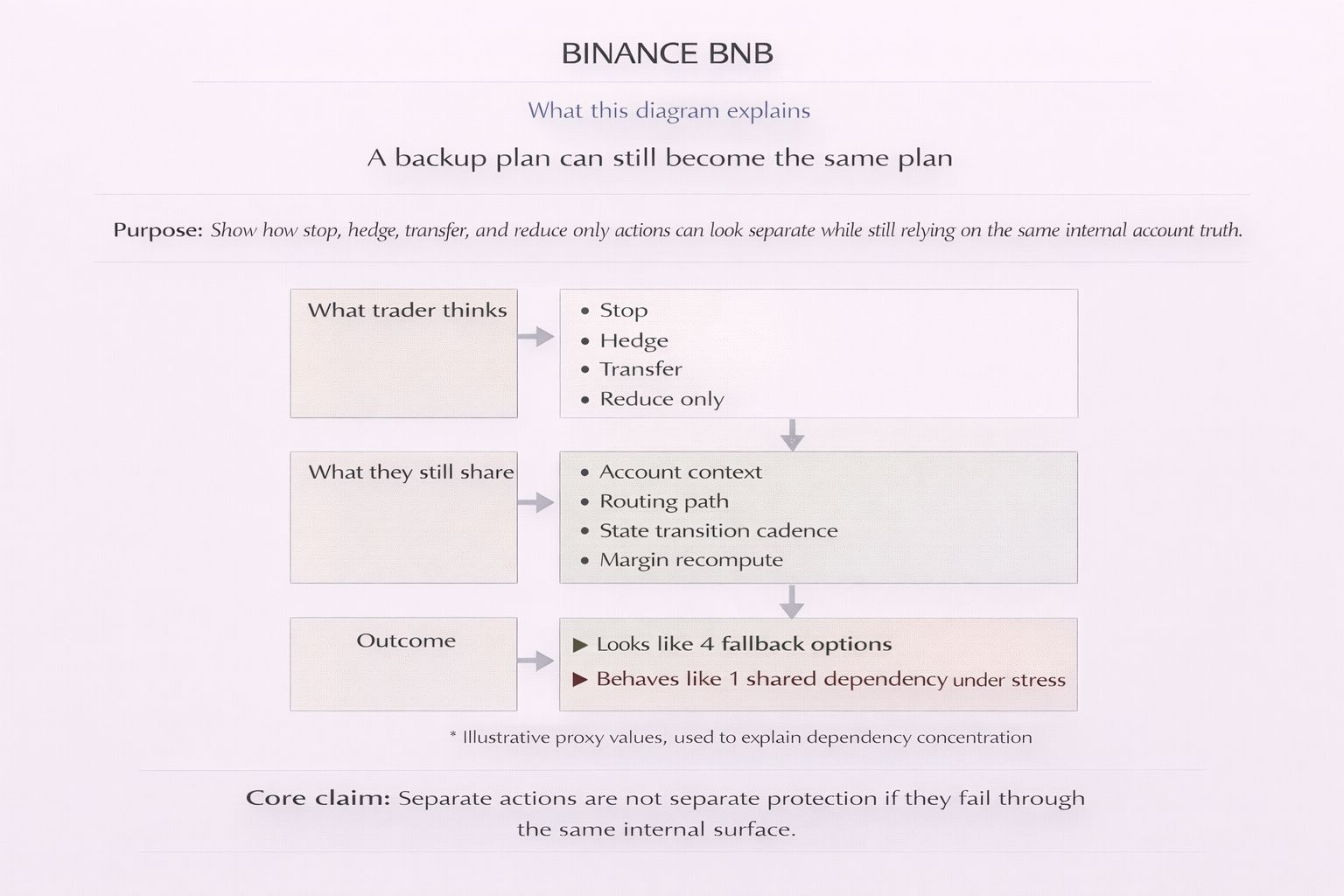
That is the design surface that started to matter to me. Not whether Binance offers many actions. It clearly does. The question is whether those actions fail independently.
That is a harder question than most people ask.
The surface story of Binance is flexibility. The venue feels unified. The workflow is fast. You can transfer, hedge, reduce, convert, move collateral, re enter, all without leaving the environment. In calm conditions that feels like optionality. It feels like having room to adapt. And because the platform is usually responsive, users start assuming that optionality is structural rather than conditional.
This is where the mistake begins.
A lot of fallback logic on Binance is only behaviorally separate. Underneath, it still shares the same account context, the same route integrity, the same state transition cadence, and the same venue truth about what has or has not settled yet. The buttons are different. The dependency is not.
Once I saw that, a lot of trading behavior started looking less robust to me.
The trader who says, “I can always hedge if the stop misses,” may still be leaning on the same internal rhythm that would make the stop messy in the first place. The trader who says, “I can move funds if needed,” may still be relying on the same route surface that becomes slow or awkward exactly when urgency arrives. The trader who says, “I have multiple ways to fix this,” may just be touching the same system 3 times.
That is not diversification. That is repeated contact.
The mechanism is easy to underestimate because Binance is smooth enough to hide it most of the time. Actions are rendered as separate objects. Orders live in one panel. transfers in another. balances in another. hedges in another. The app teaches modular thinking. It encourages the idea that if you can see multiple paths, you possess multiple forms of resilience.
But resilience is not about how many objects exist on the screen. It is about whether failure can stay local.
If a stop degrades, does the hedge still work through a meaningfully different path. If a transfer takes longer than expected, does the reduce only action still compress risk without leaning on the same state clarity. If one correction becomes unreliable, do the others remain economically independent, or do they all start wobbling together because the venue is reconciling one account truth underneath all of them.
That is why the same structure can look careful in a quiet session and strangely thin in a crowded one. Quiet sessions flatter shared dependencies. Everything resolves fast enough that overlap never becomes visible. The fallback sequence looks intelligent because nothing forces the system to reveal whether the alternatives were truly distinct.
Busy weeks reveal the truth much faster.
That is when serious users start adapting in a different way. They stop counting options and start mapping failure surfaces. They ask which fallback actually survives if the account state gets messy. They ask which action can still matter if routing is delayed, if margin treatment is catching up, if product context is misaligned, if the first correction does not settle as cleanly as the screen suggests. They pre position earlier. They simplify more. They prefer one defense that can stand alone over 3 defenses that all depend on the same hidden coherence.
That kind of preparation looks boring from the outside.
Boring is where private advantage hides.
Because most users still experience Binance as convenience. The better ones eventually experience it as coupling. They stop saying “I have options” and start asking “which of these breaks separately.” That shift is quiet, but it changes everything about how a person sizes, how they route capital, how late they are willing to act, and how much confidence they are willing to take from a fallback that may only exist on the surface.
There is also a governance layer here, even if nobody calls it that. The venue decides whether those fallback actions stay independent in the moment that matters. Not through a speech or a rulebook, but through system behavior. Through how order state is resolved. Through how margin is recomputed. Through how internal movement becomes actionable. Through which dependencies the venue lets remain shared.
That is a power surface.
If your protection layers all converge onto one internal truth, then Binance is deciding more about your practical resilience than your trade plan is. You still chose the structure, of course. But the degree to which that structure remains meaningfully plural under stress is a venue level decision.
That is why I mention $BNB late.
$BNB makes repeated action cheaper inside Binance. It lowers the surface cost of touching the system again. That can help disciplined users who already understand which fallback paths are truly distinct. It can also make it easier to mistake frequency for resilience. Cheaper hedging, cheaper re entry, cheaper adjustment, cheaper internal movement, none of that makes the fallback paths less coupled. It just makes repeated contact with the same dependency surface more affordable.
Lower friction does not create independence.
It creates cheaper repetition.
So my own test changed.
I no longer ask how many corrective actions a position gives me.
I ask how many of them still matter if one account truth starts going soft.
Then I replay it after busy weeks. I replay it after sessions where the stop, hedge, and transfer all looked separate until they did not. I replay it when incident windows force fast decisions. I replay it when a structure only survives if several “independent” fixes all happen to resolve cleanly in sequence.
And the test is cold.
If the market moved hard in the next 60 seconds, would my second plan still work if the first one got messy.
Or would both of them collapse into the same Binance dependency at the exact moment I needed them to stay separate.