@Fabric Foundation When I first started thinking about the question of whether robots could earn crypto through Fabric Foundation ROBO Coin, what struck me was how quickly people jump to the wrong conclusion. The common picture is almost science fiction. A robot delivers a package, presses a few digital buttons, and receives a token payment the same way a freelancer receives payment online. It sounds simple. It also misses the real question entirely.
The misconception is that robot income is about payments. It is not. The deeper issue is coordination.
Robots already perform economic work in a quiet way. Warehouses use thousands of automated machines to move goods. Autonomous systems monitor factories, inspect infrastructure, and sort logistics flows. The machines are doing tasks that create value. But the economic layer around those actions still belongs to humans. Contracts, payments, accountability, and verification all sit outside the machines themselves.
My view is that projects like Fabric Foundation ROBO Coin are not trying to make robots rich. They are exploring whether machines can participate inside economic coordination systems.
Surface level, the idea looks like a robotics token attached to a blockchain network. Tokens move between participants. Transactions record activity. Machines appear to be receiving or spending digital assets.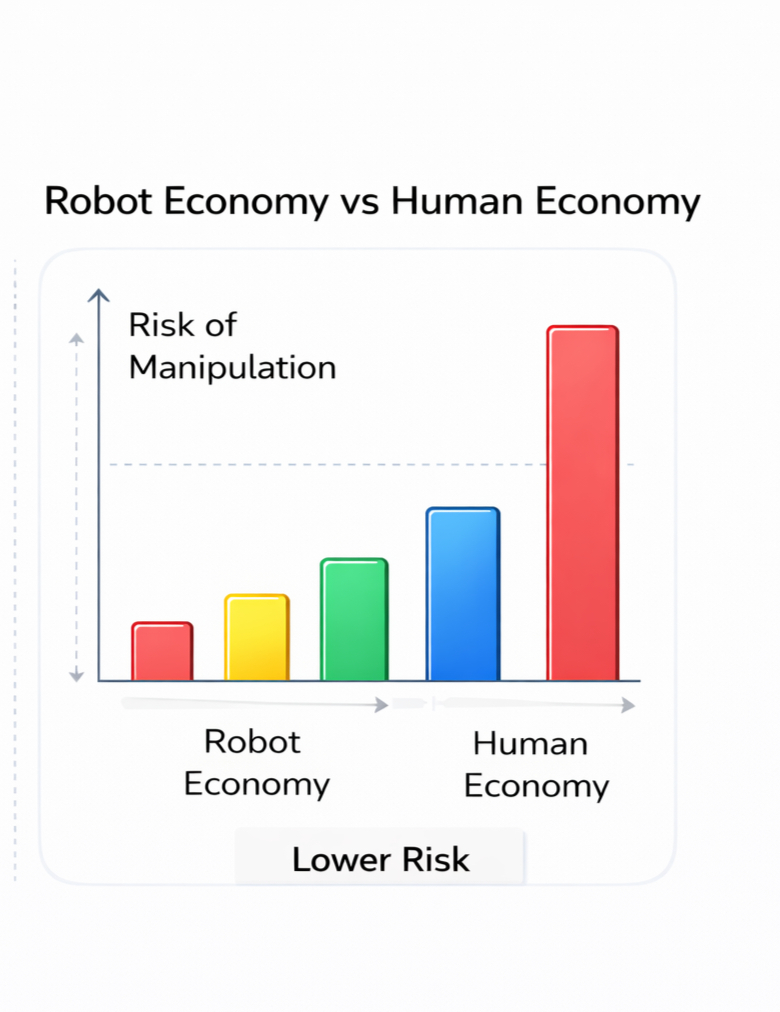
Underneath, something more structural is happening. A blockchain network acts as a shared coordination ledger. That means multiple actors can observe, verify, and reward actions without trusting a single operator.
What this enables is not robot payment in the traditional sense. It enables machine participation in economic feedback loops.
Imagine a warehouse robot completing thousands of sorting actions per day. Surface level, it simply moves objects from one location to another. Underneath, each action produces measurable work that can be verified by sensors, software, or external systems.
If those verified tasks feed into a tokenized reward layer, the robot is not really earning money. The system is measuring and distributing incentives for machine performance.
That distinction matters more than it appears.
Early Fabric Foundation environments have reportedly tested validator groups approaching roughly one hundred nodes. A validator is simply a participant responsible for checking whether recorded actions or transactions follow the network’s rules. The number one hundred is not enormous by blockchain standards, but it is enough to reduce the risk that a single entity controls verification.
That matters because economic coordination requires disagreement.
If multiple validators independently confirm machine actions, the system moves closer to a neutral verification layer rather than a private database controlled by one company.
Block times in testing environments are often discussed around two seconds. On the surface, that looks like a speed metric. Underneath, it describes how quickly the network finalizes coordination events.
Two seconds is short enough that automated systems can interact with the network without stalling their operations.
The timing determines whether the infrastructure can realistically support machine-driven processes.
Token supply also quietly shapes the system’s incentives. Fabric Foundation ROBO Coin structures are often described around a supply approaching one billion tokens. The number itself is not particularly important. What matters is how that supply distributes rewards across participants who verify machine activity.
Too few incentives and validators ignore the work. Too many incentives and actors may attempt to manipulate verification outcomes They fail because of incentives.
Meanwhile the broader crypto environment is creating a strange moment for ideas like this.
Over the past year, AI-related crypto tokens have regularly produced daily trading volumes exceeding several hundred million dollars across exchanges. That number matters because liquidity determines which narratives attract attention. When markets rotate toward AI infrastructure, projects exploring machine economies naturally enter the conversation.
At the same time, capital entering Bitcoin ETFs has pushed billions of dollars into the crypto ecosystem. Those flows do not directly fund robotics protocols, but they increase overall liquidity and risk appetite. When capital expands, investors become more willing to explore adjacent technologies.
Understanding that context helps explain why discussions about robot economies appear now instead of five years ago.
Meanwhile user behavior around artificial intelligence is also changing. Large language models now serve tens of millions of users each day across major platforms. That scale reveals something interesting. People increasingly interact with machines as if they were agents performing work.
The moment machines start performing meaningful work, economic questions follow naturally.
Still, the idea of robots earning crypto introduces several fragile tradeoffs.
Machines perform tasks. Tokens reward the activity.
Underneath, the system depends heavily on data integrity. What this enables is scale. But the risk is false coordination.
Blockchain systems also face a familiar challenge. If most validators accept an incorrect data signal, the network still finalizes that outcome.
Robot economies therefore depend on accurate inputs as much as on secure ledgers.
That tension appears in nearly every decentralized system. Oracle networks, prediction markets, and governance protocols all struggle with the same issue.
Early signs suggest robotics coordination networks will face similar growing pains.
Meanwhile something quieter is happening in the structure of technology markets.
For decades, the dominant focus was performance. Faster processors. Better algorithms. More capable machines.
Now a different question is emerging.
How do systems coordinate trust when machines interact with each other instead of humans?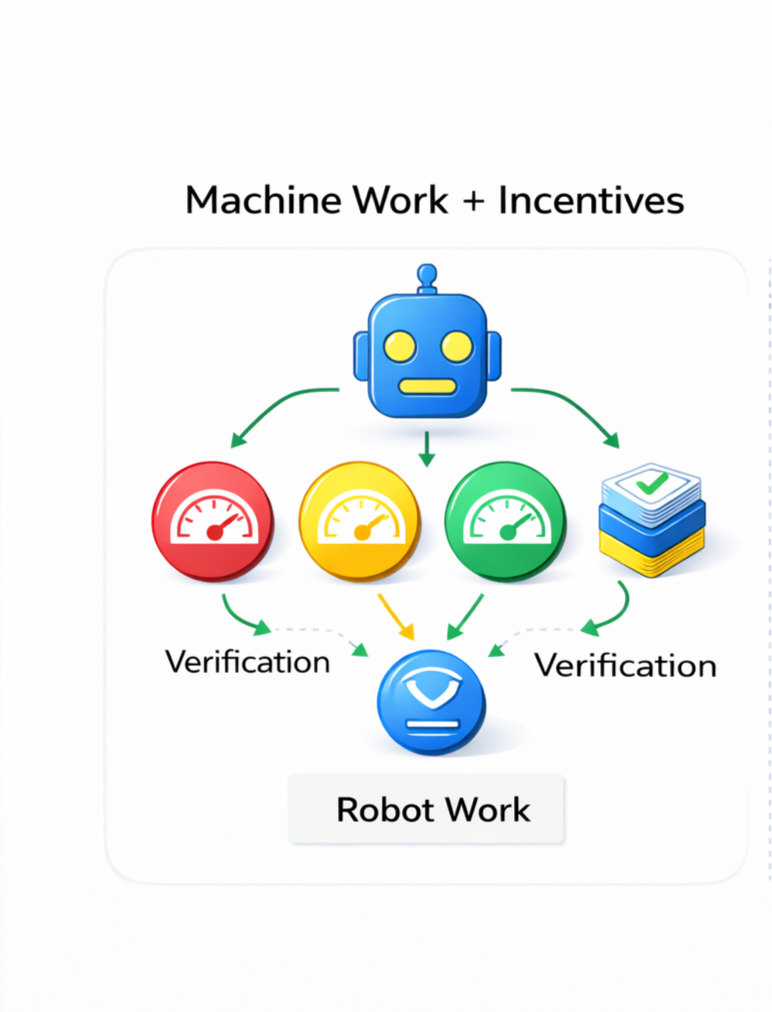
Financial markets solved that question long ago through clearing houses and settlement systems. Those layers exist not because they are exciting, but because they ensure transactions remain predictable under pressure.
Autonomous systems are slowly approaching the same phase.
Robots, AI agents, and automated software will increasingly perform actions that carry economic consequences. Delivering goods, inspecting infrastructure, processing data, managing logistics.
If those systems operate without shared coordination layers, trust remains centralized around the companies that own them.
Projects like Fabric Foundation ROBO Coin explore a different possibility. A world where machine activity connects to open economic infrastructure.
Whether that model works remains to be seen. Coordination systems are fragile. Incentive structures require constant adjustment. And machine-generated data introduces new verification challenges that traditional blockchain networks rarely face.
Still, early experiments suggest the conversation is shifting from intelligence toward infrastructure.
Robots do not necessarily need salaries.
They need systems that can measure, verify, and coordinate the value of what they do.
And if that infrastructure holds, the real question may not be whether robots earn crypto.
It may be whether future economies quietly run on networks designed to coordinate machine work.#ROBO #robo $ROBO

Articolo
Could Robots Earn Crypto Through Fabric Foundation ROBO Coin?
Disclaimer: Include opinioni di terze parti. Non è una consulenza finanziaria. Può includere contenuti sponsorizzati. Consulta i T&C.
0
20
837
Esplora le ultime notizie sulle crypto
⚡️ Partecipa alle ultime discussioni sulle crypto
💬 Interagisci con i tuoi creator preferiti
👍 Goditi i contenuti che ti interessano
Email / numero di telefono