
Over the past few years, I have spent a significant amount of time studying how emerging technologies reshape global systems. Every technological revolution introduces new tools, but the real transformation happens when those tools become connected through shared infrastructure. The internet connected computers, cloud computing connected services, and blockchain introduced decentralized financial coordination. Now, as artificial intelligence and robotics continue to evolve rapidly, a new question has begun to occupy my attention: how will the world’s intelligent machines connect and collaborate with one another?
While exploring this question, I began researching the work of Fabric Foundation. At first glance, Fabric might appear to be just another project at the intersection of blockchain and artificial intelligence. But as I looked deeper into its concept and architecture, I realized that the project is addressing something much more fundamental. Instead of focusing on a single application or tool, Fabric is exploring how machines themselves could eventually operate within a shared network infrastructure, similar to how computers communicate across the internet today.
What makes this idea particularly compelling is the scale of the robotics revolution that is currently underway. Robotics technology is advancing faster than many people realize. Machines are no longer limited to industrial environments. Autonomous robots are being deployed in logistics centers, agricultural fields, hospitals, warehouses, and even urban infrastructure. According to multiple industry reports, the global robotics market could surpass $200 billion within the next decade, driven by growing demand for automation and intelligent systems.
Major companies are already investing heavily in this future. Tesla has been developing humanoid robots designed to assist with physical labor in industrial environments. Amazon operates massive logistics networks powered by thousands of autonomous warehouse robots that optimize the movement of goods. Meanwhile, advanced robotics companies such as Boston Dynamics continue to push the boundaries of machine mobility and real-world navigation. These developments show that robots are quickly becoming an essential component of modern economic systems.
However, while the capabilities of robots are advancing rapidly, the infrastructure used to connect and coordinate these machines remains surprisingly fragmented. Most robots today operate within isolated ecosystems controlled by specific organizations. Their data is stored in private systems, their learning models are managed by centralized platforms, and their operational insights rarely extend beyond the boundaries of their original networks. In other words, machines are becoming smarter, but they are still learning in isolation.
This is where the vision behind Fabric begins to stand out. The project proposes a future where machines can interact within a decentralized infrastructure designed specifically for coordination, data exchange, and economic participation. Instead of robots functioning as isolated tools inside corporate silos, they could theoretically become participants in a shared network where information, services, and incentives circulate freely.
At the center of this ecosystem is the network’s native digital asset, ROBO. The token is designed to act as the economic layer of the network, enabling value exchange between developers, infrastructure providers, and potentially even autonomous machines that contribute useful work or data. This structure reflects a broader idea emerging across decentralized technologies: that global systems can be coordinated through open protocols rather than centralized control.
When I think about the potential impact of such an infrastructure, I find it helpful to compare it to the early days of the internet. Before networking protocols existed, computers operated largely as standalone devices. Once standardized communication systems were introduced, those machines suddenly became part of a global information network. That transformation unlocked entirely new industries and economic models.
Fabric appears to be exploring whether a similar transition could happen in the world of robotics. If machines could connect through shared protocols, their collective intelligence could grow far more rapidly. A robot learning to navigate complex terrain in one region could contribute insights that improve navigation systems for robots operating thousands of miles away. Data collected by environmental monitoring machines could help researchers understand global climate patterns. Logistics robots operating in different cities could share efficiency improvements that optimize transportation networks worldwide.
These possibilities illustrate how powerful interconnected machine systems could become. Instead of millions of independent robots performing isolated tasks, the world could eventually see large-scale networks of machines collaborating and learning together.
Of course, building such a system is extremely challenging. Integrating decentralized infrastructure with real-world robotics requires solving complex technical problems related to data verification, hardware compatibility, network security, and operational safety. Machines operating in physical environments must maintain extremely high reliability standards, especially when their actions can affect real-world infrastructure or human activity.
Another challenge lies in adoption. For a decentralized robotics network to succeed, it must attract developers, robotics companies, and infrastructure providers willing to build on top of open protocols. Historically, many technology companies prefer to maintain closed ecosystems where they control both data and services. Convincing organizations to participate in shared networks will require strong incentives and clear advantages.
Despite these obstacles, the long-term vision remains fascinating. As artificial intelligence continues to advance, machines will generate enormous amounts of valuable data and perform increasingly complex tasks across industries. The question of how that intelligence is shared and coordinated will become more important with each passing year.
From my perspective, this is why projects like Fabric deserve close attention. They are not simply experimenting with blockchain tokens or decentralized applications. Instead, they are attempting to explore what infrastructure might look like in a world where intelligent machines operate at global scale.
If millions—or even billions—of robots eventually participate in economic activity, they will require systems for identity, coordination, and value exchange. The networks that provide these capabilities could become just as important as the internet infrastructure that supports today’s digital economy.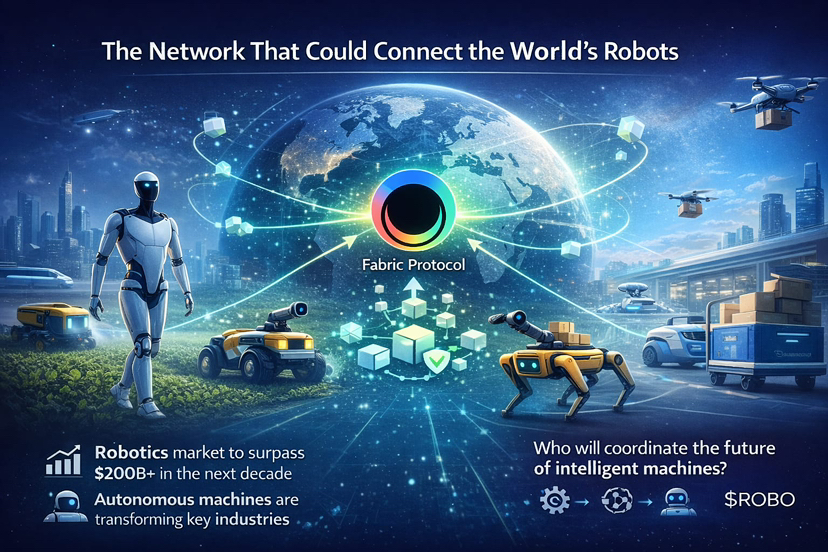
Whether Fabric ultimately becomes the dominant platform for such coordination or simply contributes to the early exploration of these ideas is still uncertain. Technological revolutions rarely follow predictable paths, and many experiments are required before the right solutions emerge.
But the underlying question the project raises is both important and timely: what kind of network will connect the world’s machines?
As robotics and artificial intelligence continue to expand into every sector of the economy, the answer to that question may define how the next generation of intelligent systems collaborates, learns, and creates value.
In many ways, we may only be at the very beginning of that story.