
Something interesting is happening in the public conversation right now. Search interest for the “Epstein Files” in the United States has dropped sharply, and the timing lines up almost perfectly with the escalating U.S.–Iran conflict dominating headlines. Just days ago, the Epstein story was one of the most talked-about topics online. Now, it’s being pushed to the background as global tensions take center stage.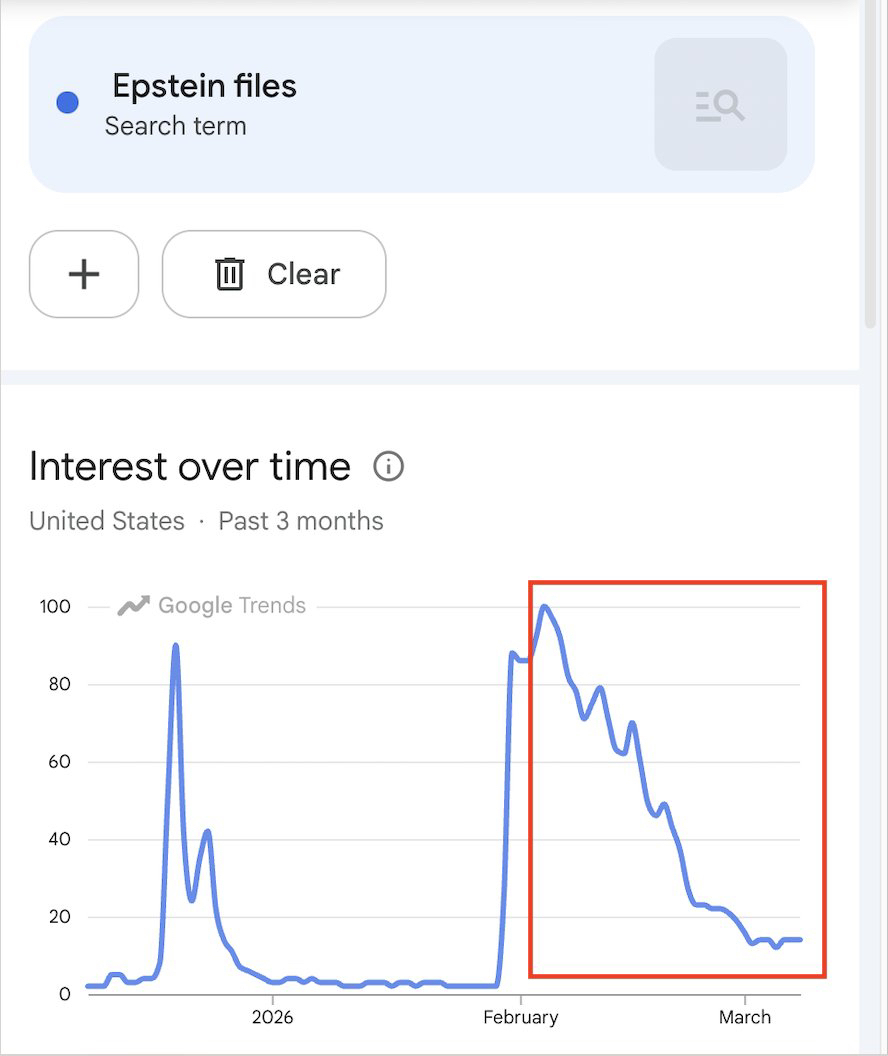
From my perspective, this shift shows how quickly attention moves in today’s information cycle. When a major geopolitical event unfolds, it tends to consume the entire news ecosystem. War updates, military developments, and international reactions suddenly become the primary focus, and almost everything else fades into the background. Even stories that once seemed impossible to ignore can suddenly lose momentum when something bigger captures public attention.
The Epstein files had been driving intense debate across social media and news platforms. People were searching for details, discussing the names involved, and questioning how deep the story might go. The topic was trending across multiple platforms and generating huge spikes in search traffic. But once news about rising tensions and military activity involving the United States and Iran began spreading, the conversation shifted almost overnight.
This doesn’t necessarily mean the Epstein story has disappeared. The documents, investigations, and questions surrounding the case are still there. What has changed is the focus of public attention. When a global conflict begins to unfold, people naturally start looking for updates about security, international stability, and the potential economic impact.
In many ways, this moment highlights how the modern news cycle works. Attention moves quickly and often follows the biggest and most urgent developments in real time. Right now, the geopolitical tension between the United States and Iran has become that dominant story.
The real question is whether interest in the Epstein files will return once the global situation stabilizes. History shows that controversial stories rarely disappear completely—they often re-emerge once the spotlight shifts again. For now, though, the focus of the public conversation has clearly moved elsewhere.