
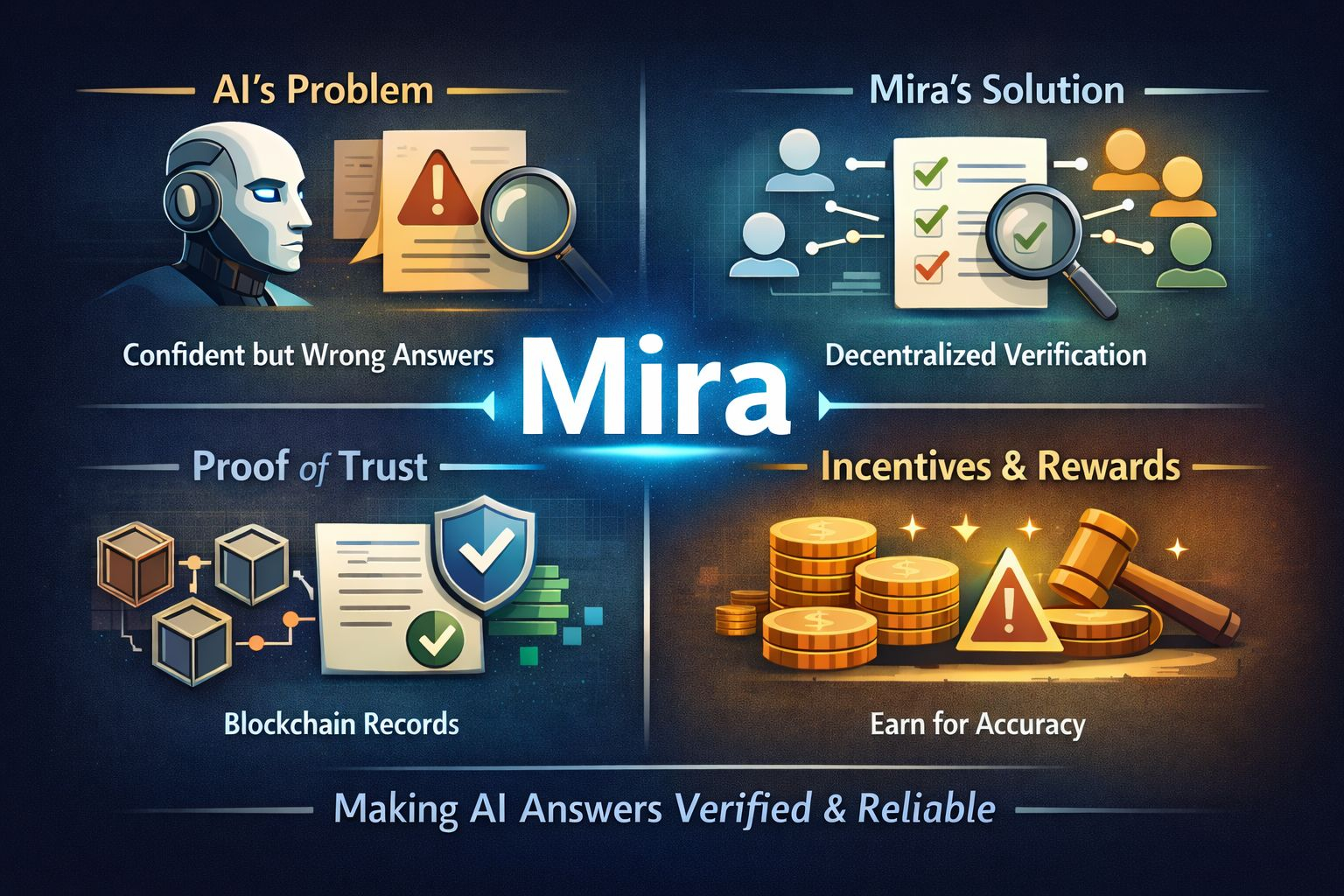
I started paying attention to Mira Network after running into a frustration that probably feels familiar to anyone who spends time using AI tools. You ask a model something important, it replies calmly and confidently, and for a moment it feels like you finally have the answer you were looking for. Then you double check one small detail and the whole thing begins to wobble. A fact turns out to be wrong. A source cannot be found. A quote looks slightly twisted. Something that felt solid a minute earlier suddenly starts to feel unreliable.
That experience is exactly what made me curious about Mira in the first place.
What I found interesting is that the project does not pretend that smoother wording will solve the problem. It starts from a much more realistic place. Just because an answer sounds polished does not mean it is true. AI systems can produce explanations that feel clean and convincing while quietly hiding mistakes inside them. When you use them for small things like asking about a movie or a recipe, those errors do not matter much. But the moment the same systems start touching research, finance, legal work, healthcare guidance, or business decisions, the tolerance for mistakes becomes much smaller.
That is where Mira seems to step in.
Instead of asking people to trust a single model more deeply, the idea behind Mira questions whether one model should ever carry that much authority in the first place. When I first read about the approach, it actually felt very similar to how people handle important information in real life. When something matters, we rarely rely on one opinion and stop there. We ask again. We compare viewpoints. We look for agreement across different sources. We try to see if what we are hearing holds up when examined from multiple angles.
Mira takes that same instinct and applies it to machine systems.
Rather than allowing one model to generate an answer and quietly act as its own judge, the system spreads the verification process across a wider network. The result is that the answer is no longer just something produced by a single system. It becomes something that has been examined.
One detail that stood out to me while reading about Mira is the way it treats a generated response. At first glance an answer might look like one clean paragraph, but when you really think about it, that paragraph is usually made up of many separate claims. A date. A number. A cause and effect explanation. A quote. A conclusion. All of those pieces sit together inside a few confident sentences. If even one of them is wrong, the whole answer can start to fall apart.
Mira tries to deal with that by breaking large outputs into smaller claims and checking them individually.
The more I thought about it, the more practical that idea felt. A lot of mistakes in AI answers are not huge or obvious. They hide quietly inside writing that feels trustworthy. A paragraph can sound thoughtful and balanced while slipping in a small but important error. By isolating those claims and sending them through a verification process, Mira tries to catch those weak spots before they pass unnoticed.
In simple terms, it replaces blind trust with scrutiny.
Another part that caught my attention is the decentralized structure behind the project. Mira is built on the belief that verification should not live in one pair of hands. If a single company or system decides what counts as verified, many of the same trust problems still remain. Bias can stay hidden. Incentives can go unchallenged. Mistakes can slip through behind centralized control.
By spreading the verification work across independent participants, Mira is trying to reduce that risk.
Of course decentralization does not magically create truth. Nothing works that neatly. But it does make it harder for verification to turn into nothing more than a private stamp of approval from the same system that produced the answer in the first place.
The blockchain element fits naturally into this design. Mira links the result of verification to cryptographic proof, which means the process leaves behind a record. That part matters because most people using AI today receive answers with no receipt at all. A response appears on the screen and that is where the story ends. You have no idea what was checked, what was uncertain, or how the system reached its level of confidence.
Mira is trying to move toward something more transparent.
In that model, a verified answer does not simply exist. It carries proof that it passed through an actual process.
When I think about how these systems might be used in higher stakes environments, that kind of record starts to make a lot of sense. A company relying on machine generated analysis may want more than a convincing looking summary. It may want evidence that the information was checked before anyone acted on it. The same applies to research tools, compliance systems, policy work, or internal decision making. In those environments trust is not just emotional. It is procedural.
People want to know what actually happened before the answer reached them.
Another thing Mira seems to take seriously is incentives. Any network that relies on human participation eventually bends around incentives. If the people inside the system have no reason to care about quality, reliability fades quickly. If careless behavior still leads to rewards, the whole structure weakens.
Mira tries to deal with that by giving participants something at stake. Careful verification is rewarded, while dishonest or careless behavior carries consequences.
That part may sound simple, but it is actually important. Human systems always move toward whatever behavior the rules reward. Technology follows the same pattern. Mira does not assume everyone will behave perfectly. Instead it tries to design incentives that make careful verification the logical choice.
What also makes the project interesting to me is that it does not seem to be chasing the same hype cycle as many AI projects. Most of the excitement in this space focuses on what machines can produce. Mira shifts attention toward a different question.
Should those outputs actually be trusted?
That is a harder conversation, but it may also be the more important one.
Of course the challenge ahead is not small. Verification sounds clean until it runs into the messy reality of language. Not every statement fits neatly into true or false. Some claims depend on context. Some require interpretation. Some may technically be correct while still leaving a misleading impression. A summary might contain no obvious factual mistakes and still lead someone toward the wrong conclusion.
That means Mira is stepping into complicated territory.
But that does not make the effort less valuable. If anything, it makes it more necessary. As AI systems become more powerful, leaving them completely unchecked becomes harder to justify. People might tolerate uncertainty when using them casually, but once real decisions start depending on the answers, polished language and confident tone are no longer enough.
Something stronger has to stand behind the words.
That is the reason Mira stayed on my radar. It is trying to build a world where machine generated information is trusted not because it sounds fluent, but because it has actually been examined.
And honestly, that feels like a standard the industry has needed for a long time.
For all the excitement around powerful AI systems, one simple question has been sitting in the room the whole time.
How do you know when to believe them?
Mira is one attempt to answer that question seriously. Not with marketing language or borrowed confidence, but with a structure designed to earn trust instead of assuming it.
@Mira - Trust Layer of AI #Mira $MIRA
