
@Mira - Trust Layer of AI One of the hardest things about modern AI is not getting an answer. It is knowing what kind of answer you just received. A language model can produce something fluent, specific, and well organized, and still be wrong in a way that feels almost designed to pass unnoticed. Mira Network is built around that discomfort.
The main idea is that AI answers should not be trusted just because they sound sure of themselves or come from one model. They should be broken into smaller claims, checked by different systems, and backed by something more like proof than presentation.That shift matters because the reliability problem is not theoretical anymore. In one 2024 study on references generated for systematic reviews, hallucination rates reached 39.6% for GPT-3.5, 28.6% for GPT-4, and 91.4% for Bard. Separate work on fine-tuning found that when models are trained on new factual knowledge, they can become more prone to hallucination as that new material is absorbed. Mira’s own whitepaper starts from the same conclusion: better interfaces do not solve the underlying issue that probabilistic models can produce convincing but false statements, especially when the user lacks time or expertise to verify them manually.
What Mira is trying to build is not simply another chatbot with a better tone. It is a verification network. The system takes candidate content and transforms it into smaller, independently verifiable claims. Those claims are then distributed to verifier nodes, checked by multiple models, passed through a consensus process, and returned with a cryptographic certificate that records the outcome. Mira describes this as trustless AI output verification, and the wording is important. The real product is not text generation. It is evidence about text generation. 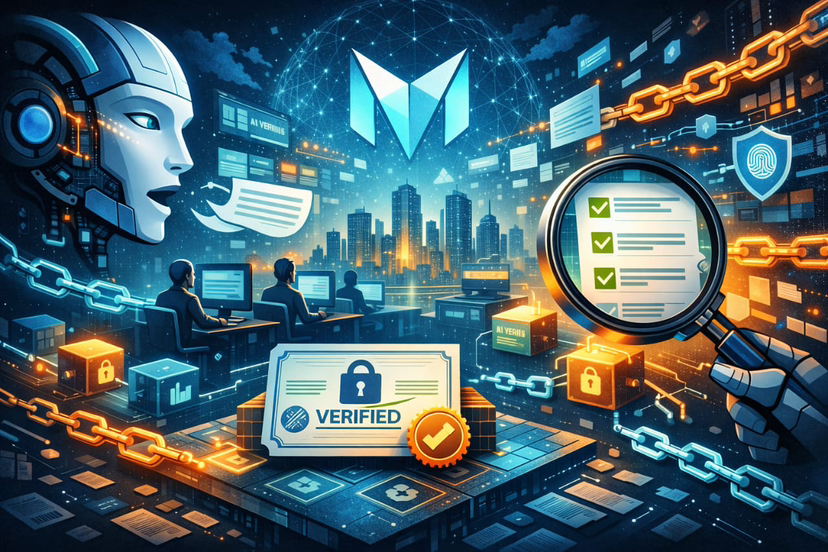
This is where the phrase “receipts for machine speech” becomes useful. Mira is effectively arguing that if AI is going to speak in environments where decisions matter, it needs to leave behind an audit trail. The network’s verification workflow is designed so that the answer is not just “true” or “false” in a vague sense. The network records which claims were checked, how consensus was reached, and when validation is successful, it can write a certificate to the blockchain. On Mira Verify, the company frames this in very direct terms: audit everything, verify everything, and make the consensus process visible enough that users do not have to trust a hidden backend.
That sounds neat in theory, but the interesting part is the intermediate step. Mira does not ask multiple models to judge a long answer as one blob of prose. Its whitepaper argues that this fails at scale because different verifier models may focus on different parts of the same passage. So the network standardizes the problem first. A compound statement becomes a set of discrete claims. Each claim gets routed to verifiers under the same context and then aggregated back into a result. In other words, Mira is less interested in whether an answer feels coherent than whether its smallest factual units can survive independent scrutiny. That is a much stricter standard, and also a more expensive one.
Expense is not a side issue here. It sits at the center of the design. Mira’s whitepaper says node operators are economically incentivized through a hybrid Proof-of-Work and Proof-of-Stake model, which is unusual because the “work” is not arbitrary hashing but inference-based verification. The paper also explains the awkward problem this creates: once verification is turned into standardized multiple-choice style tasks, random guessing can become statistically attractive unless there is a penalty for bad behavior. That is why staking and slashing are part of the design. If operators can guess cheaply, the network has to make dishonesty costlier than honest computation.
The numbers in the whitepaper show why this matters. With two answer options, random success begins at 50% for a single verification. With four options it is 25%, and with repeated rounds the probability drops fast, but only if the network actually enforces repeated, diversified checks. Mira’s answer is to combine stake risk, duplication in earlier phases, and later sharding across nodes to make collusion and lazy verification harder. The design is not claiming perfect truth. It is claiming a system where manipulation becomes technically and economically less attractive over time. That is a more credible promise.
There is also a privacy angle that often gets ignored in casual discussions of AI verification. Mira says complex content is broken into entity-claim pairs and randomly sharded across nodes so that no single operator can reconstruct the entire submission. Verification responses remain private until consensus is reached, and the resulting certificates are meant to contain only the information necessary to prove the outcome. This matters because any serious verification system will eventually be asked to handle sensitive material, not just public trivia. If every verifier needs the full original prompt, the trust problem simply moves from “is the answer true” to “who saw my data.” Mira at least treats that as a first-order architectural concern.
What makes the project more than a research sketch is that Mira has been turning the verification idea into products.
Mira is no longer talking only about the idea of verification. On its website, Mira Verify is presented in beta as an API for outputs that can be checked, and in February 2025 the team launched Klok as a user-facing chat app built on that same system. At about the same time, Mira said it had crossed 500,000 active users and had several live deployments. Those numbers have not been independently confirmed here, so they are best understood as company claims. Still, they help explain Mira’s message to the market: this is not supposed to remain an abstract protocol concept, but something people can interact with directly.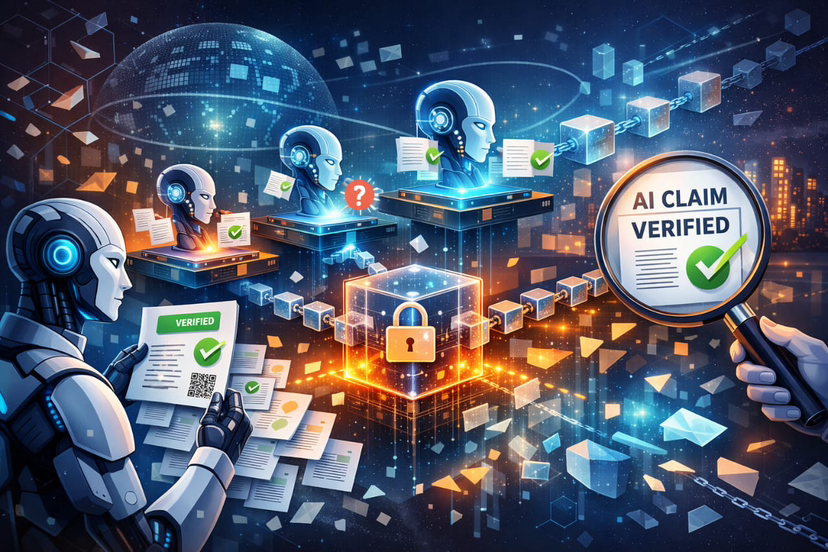
Still, the hardest question is whether certifying claims on-chain actually solves the human problem around AI, or only part of it. A certificate can show that a network checked a claim under certain conditions, using certain models, and reached some threshold of consensus. That is valuable. It can reduce blind trust and create accountability where none existed before. But it does not remove judgment from the system. Someone still decides how claims are decomposed, which domains matter, what threshold counts as enough agreement, and when context is too ambiguous for machine consensus to mean very much. Mira’s own materials recognize some of this by allowing customers to specify domain and consensus requirements rather than pretending verification is universal and context-free.
The real value of Mira is in its infrastructure role, not in claiming it can fully fix trust online. What matters most is this: if AI is going to affect money, law, medicine, workflows, or machine actions, then its claims need evidence that holds up when someone checks them closely.
Not style. Not branding. Not a blue check for model prose. Something closer to a chain of custody for claims. Mira is trying to build that chain of custody by turning speech into checkable units and consensus into an auditable artifact. Whether it reaches the scale and neutrality needed to make that durable is still an open question. But the instinct behind it is correct. In a world filling up with machine language, the scarce thing will not be text. It will be receipts
@Mira - Trust Layer of AI #Mira $MIRA
