
@Fabric Foundation What stands out to me about Fabric is that it is not really trying to make robots look impressive on a demo day. It is trying to make robot activity legible enough to govern, reward, challenge, and eventually trust at network scale. The whitepaper keeps coming back to that point from different angles: public ledgers for coordination, open oversight, structured data collection, verified task execution, validator challenges, and rewards tied to measurable contribution rather than passive holding. That is why the separation between raw data and proofs matters so much here. In a system like this, those two things are related, but they are not the same job.
Raw data is the messy part. It is the stream of what robots actually do in the world: task outcomes, operating conditions, model behavior, usage patterns, maybe even edge-case failures that nobody expected when the system was first designed. Fabric’s roadmap is explicit that early deployments are supposed to support robot identity, task settlement, and structured data collection, then expand into broader real-world operational data and wider data pipelines over the course of 2026. That tells you the network is being designed to learn from reality, not from a fixed benchmark frozen in advance.
Proof is a different layer. Proof is the smaller, more deliberate artifact that says something specific about that underlying reality and makes it usable for payment, governance, or punishment. Fabric’s own language is revealing here. It talks about verified task execution, verified training data, cryptographic attestation for compute, validator quality attestations, and challenge-based fraud detection. None of that suggests that every bit of real-world data is going onchain in raw form. It suggests a narrower system: collect broad operational evidence, then produce targeted attestations about the pieces that matter enough to settle. 
That distinction feels especially important in robotics because physical work is not clean in the way digital execution sometimes is. Fabric says this almost directly when it notes that robot service provision has partial observability: task completion can be attested, but not cryptographically proven in general. I think that line is one of the most important in the paper. It quietly shows that the network cannot treat the real world like a smart contract where every action is easy to check. A robot can unload cargo, inspect equipment, help in a store, or perform home assistance, but the full truth of that activity is always larger than any one proof object.
Once you accept that, the architecture starts making more sense. You do not try to turn every event into a universal proof. You separate collection from adjudication. First, gather structured data and operational traces. Then, where money, ranking, or accountability depends on it, create verifiable claims from that material. Then allow challenges. Fabric’s verification model is built around exactly that tradeoff. The whitepaper says network integrity does not require universal verification of all tasks because that would be prohibitively expensive. Instead, it uses a challenge-based system intended to make fraud unprofitable in expectation. That is less elegant than saying “everything is proven,” but it is probably more honest.
This matters more in Fabric than in many other protocols because the protocol is trying to reward real-world contribution across several categories at once. The contribution score can include task completion, data provision, compute provision, validation work, and skill development. Those are different kinds of output. A GPU job can be attested more neatly than a physical service interaction. Training data can be standardized and quality-scored, but it still lives in a broader pipeline than the compact proof used to reward it. Skill adoption metrics are even more indirect. So if Fabric blurred data and proof into one thing, it would either overpay for weak evidence or become too rigid to support the variety of work it wants to incentivize.
There is also a governance reason for keeping them apart. Fabric frames ROBO as the asset for fees, participation, and governance, and the whitepaper makes clear that governance parameters shape how contributions are weighted and how fraud outcomes feed into the network’s evolving economic model. That only works if the system preserves a distinction between the broad evidence base and the narrow claims that governance acts upon. Otherwise every governance dispute turns into an argument over raw telemetry, incomplete logs, or inaccessible private context. A protocol cannot really vote on reality in its full messy form. It can only vote on how certain claims derived from that reality should be recognized, challenged, or priced.
Another reason this separation matters here is alignment. Fabric repeatedly presents itself as infrastructure for open and verifiable human-machine alignment, not just robot coordination. It emphasizes human-readable guardrails, modular stacks rather than opaque end-to-end systems, and public development of technical blueprints. That only feels credible if humans can inspect the meaning of a proof without needing access to every underlying dataset, while still knowing that the broader data layer exists for auditing, improvement, and dispute resolution. In other words, proofs need to be legible and bounded; data needs to be rich and expandable. Collapse those two together and you risk losing both transparency and practicality at the same time.
I also think there is a privacy and operational angle hiding underneath this. Fabric is about robots in the real world. Real-world robot data can include location traces, environment details, interaction records, perhaps commercially sensitive information, and all the boring but important context that makes a task understandable. That kind of material is useful for training and auditing, yet not all of it belongs in the same place or with the same visibility as a proof that says a task was completed, a compute job ran, or a validator upheld a challenge. The whitepaper does not reduce this to a slogan, but the design choices point in that direction: broad data systems for learning and operations, narrower attestations for settlement and incentives. 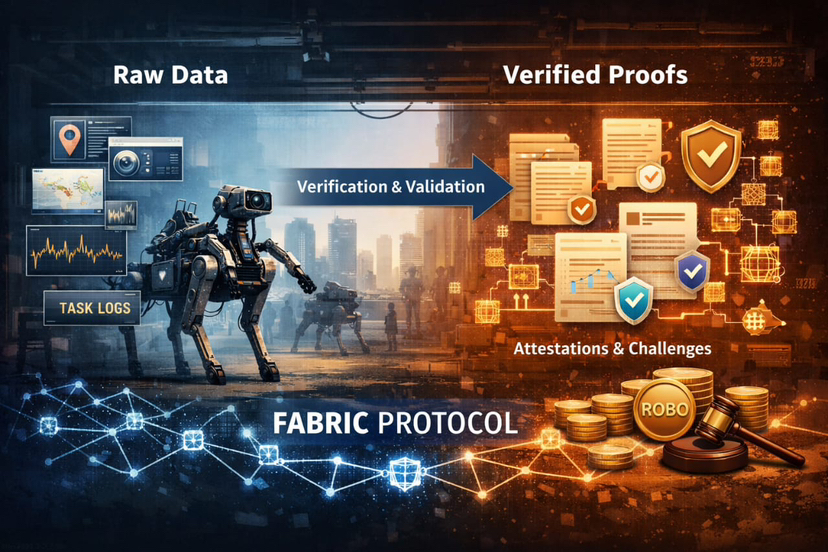
What makes Fabric unusual is that the economic layer depends on getting this distinction right early. The roadmap moves from structured data collection in Q1 to incentives tied to verified task execution and data submission in Q2, then to wider validation and more complex workflows after that. So the protocol is not treating proof as a cosmetic add-on. It is treating proof as the compression layer that lets messy robot activity become governable without pretending the mess does not exist. That is a subtle difference, but it is probably where the serious work is.
So when I think about Fabric and ROBO, I do not read “separating data from proofs” as a minor implementation detail. I read it as a survival requirement for any robot economy that wants to be open, incentive-compatible, and somewhat believable. Data tells the network what happened in all its awkward detail. Proof tells the network which claims are strong enough to pay, rank, challenge, or slash. In a purely digital protocol, you can sometimes blur those boundaries and get away with it. In a physical machine network, that shortcut breaks down fast. Fabric seems to understand that already, and honestly, that may be one of the more mature things about it.