
Title: The Forgotten Internet Code That Might Power the Robot Economy
Sometimes the most interesting parts of technology are the ones that were almost forgotten.
Back in the mid-1990s, when the early architecture of the internet was being designed, developers created something called HTTP status codes. These were simple signals that allowed servers and browsers to communicate. One of those codes was 402, labeled “Payment Required.” The idea behind it was surprisingly forward-thinking. Engineers believed that one day the internet might support automatic digital payments for services.
But that future never really arrived—at least not back then.
Online payment systems in the 1990s were slow, centralized, and built entirely around humans. Credit cards, banks, and identity verification all required manual approval. There was simply no infrastructure for machines or software to handle payments on their own. Because of that, HTTP 402 quietly faded into the background. It remained part of the internet’s technical standards, but it was never widely used.
For nearly three decades, it was just sitting there.#ROBO
Now, interestingly enough, that old idea is starting to feel relevant again.
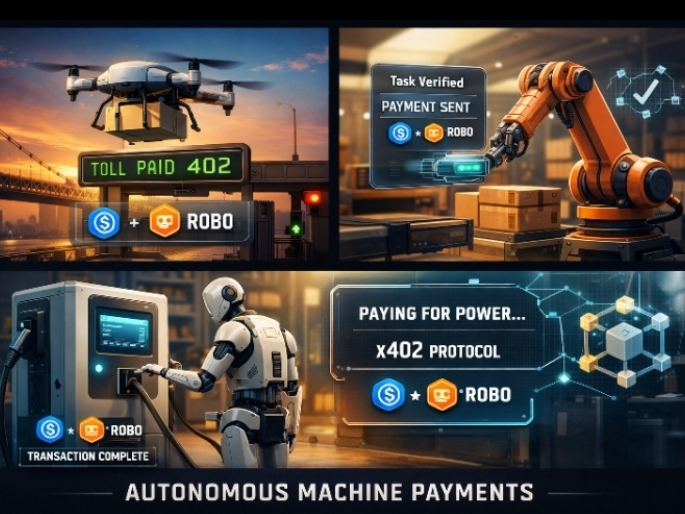
As robotics and artificial intelligence continue to evolve, machines are slowly moving beyond simple automation. Delivery drones are beginning to transport goods. Warehouse robots manage logistics. Service robots assist in hospitals, factories, and public spaces. These machines already perform work that creates real economic value.
But there has always been one missing piece: money.
Machines can perform tasks, but they cannot manage the financial side of those tasks. Every payment still depends on a human operator somewhere in the system. That limitation might seem small, but it prevents robots from functioning as truly independent economic actors.
This is where blockchain technology enters the conversation.
Unlike traditional banking systems, blockchain networks allow digital assets to move automatically between verified identities. In theory, that means a machine could eventually hold a digital wallet, receive payments for completed work, and pay for the resources it needs to continue operating.
Some developers are now experimenting with ways to revive the concept behind HTTP 402 using modern blockchain infrastructure. Instead of simply signaling an error, the code could act as a trigger that requests payment before a digital service continues.
Imagine a charging station for a robotic delivery vehicle. When the robot connects, the station could automatically request payment through a digital protocol. The robot’s system verifies the request, sends the payment, and the charging process begins—all within seconds and without human approval.
Stablecoins are often mentioned in this context because machines require predictable pricing. If a robot is paying for electricity, network access, or maintenance services, the value of its payment cannot fluctuate wildly. Stable digital currencies provide a level of consistency that volatile cryptocurrencies do not.
Of course, payments alone are only part of the equation.
A much bigger challenge appears when machines begin earning money: how do you prove the work actually happened?
If a robot claims it sorted inventory in a warehouse or completed a delivery route, the system must be able to verify that task. Without verification, automated payments would be impossible to trust. This is why some projects are exploring cryptographic methods such as zero-knowledge proofs.
These proofs allow a machine to demonstrate that it completed a task without revealing every detail of how the task was performed. In practical terms, a robot could prove it finished a job while still protecting sensitive operational data.
However, this process requires heavy computation. Generating cryptographic proofs can be expensive and time-consuming on regular hardware. If verifying a task costs more than the task itself is worth, the entire system becomes impractical.
To address this issue, some teams are experimenting with specialized hardware designed specifically for cryptographic workloads. By accelerating proof generation, verification becomes cheaper and faster, making large-scale machine economies more realistic.
Another important component is software infrastructure.
Robots today often operate in isolated environments, with different hardware platforms and proprietary software systems. This fragmentation makes it difficult for developers to create universal robotic applications. But if robotics platforms eventually adopt more open operating systems, the ecosystem could begin to resemble the smartphone industry.
In the same way mobile apps transformed smartphones, modular “skills” could expand the capabilities of robots. A machine might download new navigation abilities, warehouse management tools, or service routines through an open marketplace. Each skill would increase the robot’s economic usefulness.
Still, it is important to stay realistic.
Technological ideas often appear convincing long before real-world adoption begins. Even if the infrastructure works, the transition toward machine-to-machine payments will depend on many external factors. Hardware production, regulatory policies, and industry adoption all play major roles.
Companies will only deploy these systems at scale when they see clear economic benefits and reliable security.
What we are seeing today is not a finished machine economy. Instead, it is the early groundwork being laid. Payments, verification systems, robotic software, and blockchain identity are slowly converging into something larger.
And in a strange way, it all circles back to that forgotten HTTP status code from the 1990s.
For decades, “402 Payment Required” was little more than a technical placeholder. Now it might represent an idea that the internet was not ready for at the time—an economy where machines can work, earn, and pay for the resources they need to keep operating.
Whether that vision fully materializes remains uncertain. But the pieces are starting to move into place, and tharakes the concept worth watching.$ROBO @Fabric Foundation #ROBO
