
Yaar, picture this: I’m chilling at a roadside chai tapri near Arfa Software Technology Park in Lahore, same spot where I coded my first Solidity contract back in 2021 while dodging load-shedding. Horns blaring, bikes weaving like crazy, and I’m thinking—man, our traffic is already a decentralized mess run on pure human instinct. Now imagine thousands of delivery drones and warehouse bots running the same streets, but on a public ledger. One weak link, one clever hack, and your chai order turns into a flying brick through someone’s window. That’s exactly the fire Fabric Protocol is trying to put out with its $ROBO token.
I’ve been deep in Pakistan’s crypto scene since the wild 2022 bull run—when even my uncle in Bahawalpur started asking about “blockchain waale robots.” Fabric Protocol isn’t just another Layer-1; it’s building public-ledger networks where robots actually own their actions, get paid in $ROBO, and vote on upgrades. But the real story? Cybersecurity. Because when machines talk on an open chain, every vulnerability feels like leaving your house door open in Anarkali Bazaar at midnight.
So here’s the question that kept me up last night: if a robot swarm can fix our flood-prone villages faster than any government app, can we actually trust the ledger to keep it from turning evil?
Let me break it down like I’m explaining it to my cousin who still thinks Bitcoin is “digital tulips.”
Fabric Protocol runs a public ledger specifically tuned for robotic networks. Think of it as Hyperledger on steroids but fully decentralized—no permissioned gatekeepers. Every bot has a wallet, every action (move, sense, deliver) gets timestamped on-chain. Robo is the gas, the stake, and the reward all in one. You spend it to command a bot fleet, stake it to become a “validator node” that watches for shady robot behavior, and earn it when your home server helps secure the swarm.
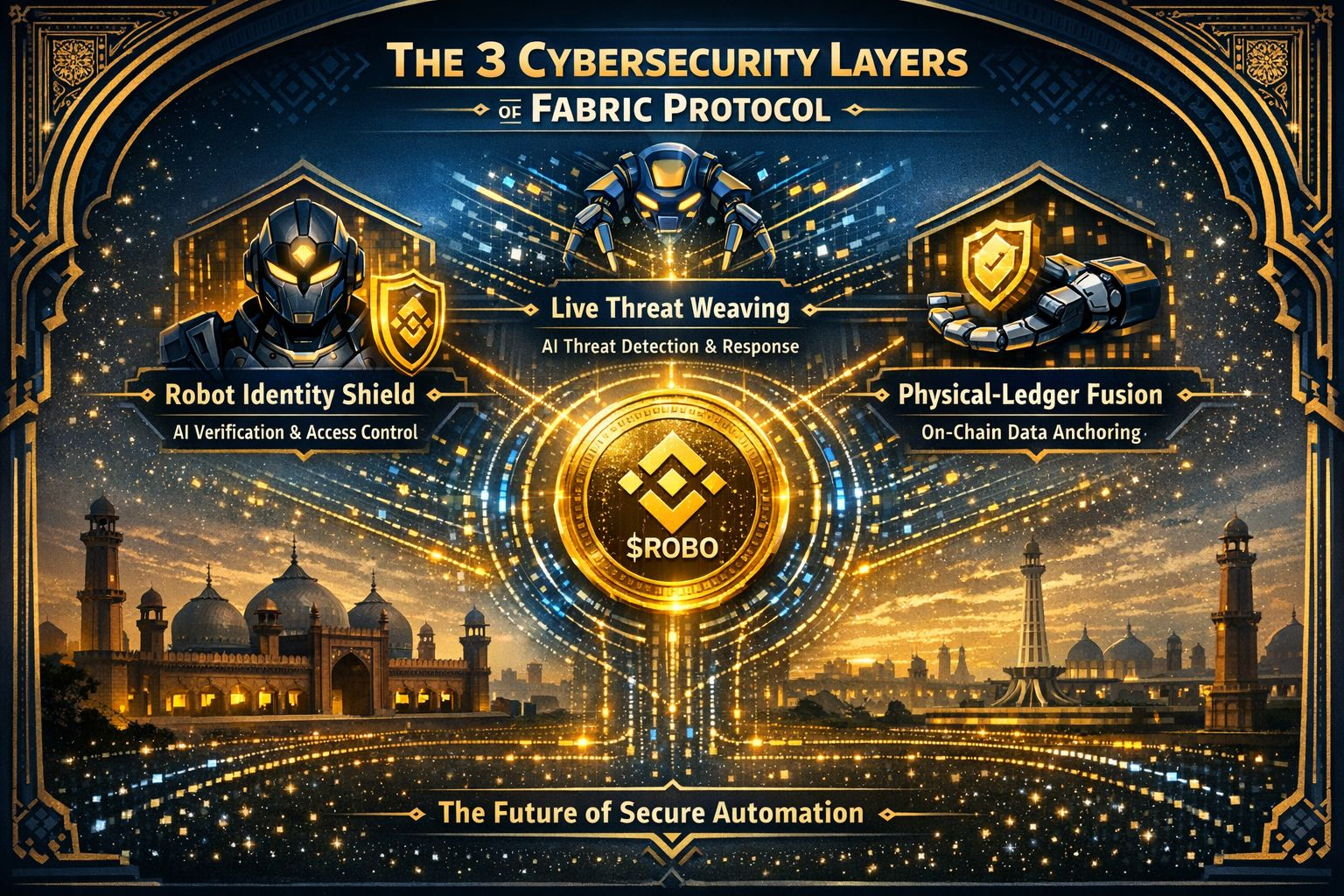
What makes it low-key impressive are three things most projects copy-paste but Fabric actually ships:
Robot Identity Shield – Zero-knowledge proofs so a bot proves “I’m the real delivery drone from Karachi” without spilling its exact GPS history. No more fake bots flooding the network like those scam accounts on Instagram.
Live Threat Weaving – An on-chain AI oracle (yes, the good kind) that spots anomalies faster than a Lahore traffic cop spots a signal jumper. If a bot suddenly starts zig-zagging toward a bank instead of your house, the network can quarantine it in seconds.
Physical-Ledger Fusion – Here’s my favorite Pakistani twist: the ledger isn’t just digital. Fabric lets robots “stake” physical proof-of-location via cheap LoRa sensors. Imagine a bot in the rice fields of Punjab proving it’s actually there before getting paid in $ROBO. Tamper with the sensor? The whole swarm sees the lie on-chain.
But let’s be real, bro—no tech is bulletproof. The biggest risk I see? Smart-contract bugs in the early robot command modules. One exploited vulnerability and a malicious actor could hijack a whole delivery fleet. We saw something similar with those bridge hacks in 2022; now picture the bridge being literal flying robots over the Ravi River. Fabric’s team is auditing like crazy and using formal verification, but in crypto, “trust but verify” still applies.
Here’s where my mind goes wild: imagine a Pakistani freelancer in Gulberg using $ROBO to hire a swarm of micro-bots that assemble his prototype in a co-working space at Arfa Park. No bank delays, no middleman. The bots get paid instantly on-chain, the ledger logs every screw tightened, and cybersecurity keeps the competitor from spoofing the order. That’s not sci-fi anymore—that’s the kind of real-world unlock this tech can drop in our chaotic economy.
Now the fun part—how I’m actually trading Robo on Binance (and why you might want to too).
I’m not here to shill moonshots. This is a long-term play for me. Cybersecurity + AI + robotics is the triple threat nobody is sleeping on. My simple strategy: DCA every dip below the 50-day moving average, especially after any “robot hack” FUD hits the timeline. Spot only—no leverage, I’ve been burned once in 2021 and still remember the pain.
Why? Because every time a big company announces a robot pilot (think local e-commerce giants testing drone delivery), $ROBO gets a legitimacy bump. Plus Binance is running CreatorPad bonuses right now—extra rewards just for holding and trading during the campaign. I grabbed a small bag last week when it dipped 12% on some random market-wide panic. Already up nicely.
If this sounds interesting, jump into Binance, grab a small bag, and drop your trade stories in the comments! Let’s see who’s riding this wave. Who knows, maybe your entry screenshot becomes the next viral post.
The community around Fabric Protocol feels different, yaar. Not just Telegram degens screaming “to the moon.” I’ve jumped into their Discord and found actual roboticists from Islamabad coding simulation tests at 3 a.m. Builders, not just speculators. Next big milestone? Mainnet launch with live drone integration in Q3 2026—rumor says they’re partnering with a local agri-tech startup for crop-monitoring bots. That would be massive for Pakistan.
Biggest risk? Regulatory gray area. If some government body suddenly decides “robots on blockchain = bad,” we could see delays. But honestly, with the way our economy is going, I’m more worried about missing the train than the train crashing.
Be honest: Are you bullish? Vote with a 🔥 in the replies!
Bottom line? Fabric Protocol isn’t promising robot butlers tomorrow. It’s promising we can build them without handing the keys to hackers. In a country where we’ve turned load-shedding into an art form of survival, securing the next wave of machines feels like the most Pakistani thing ever—jugaad, but on a tamper-proof ledger.
I’m excited. You should be too. Share this with your crypto group, tag a friend who’s into robotics, and let’s talk in the comments. The bot revolution is coming—let’s make sure it’s secure.