
I learned a long time ago that when a token holds tight ranges after violent moves, the market is asking a question it has not answered yet. ROBO closed today at 0.03950 USDT, down 4.98 percent in 24 hours, with a tight intraday range between 0.03841 and 0.04192. That kind of compression after the launch volatility we saw in late February and early March usually means one of two things. Either conviction is building quietly while retail steps back, or the story is losing participants faster than it is gaining them, and price is searching for a level that actually holds. What makes ROBO interesting right now is not whether it bounces or breaks. It is whether the token can prove that Fabric Foundation is building something traders will care about in six months, not just six days.
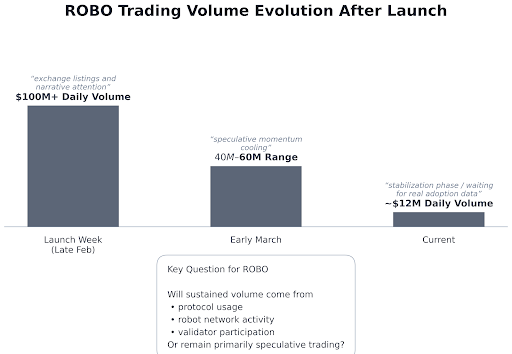
The data I am watching most closely is not price. It is volume structure. ROBO printed 304.56 million tokens in 24 hour volume, which at current price translates to roughly 12.13 million USDT. That is meaningful liquidity for a token that only launched on February 27, but it is also down sharply from the $100 million plus we were seeing in early March when listings were fresh and the robot economy narrative was pulling in attention. Volume decay is normal after launch week. The question is whether it stabilizes at a level that supports actual protocol usage, or whether it keeps bleeding until ROBO becomes another thinly traded idea token waiting for the next headline. Fabric Foundation says ROBO is used for network fees, identity verification, staking, and governance within the protocol. If that is true, then sustained volume should correlate with network activity, not just speculative churn. Right now, I cannot tell which one we are seeing, because Fabric Foundation has not published the onchain metrics that would clarify whether robots are actually registering, whether tasks are settling, or whether validators are participating beyond the initial setup phase.
That lack of transparency is the friction I keep coming back to. The Fabric whitepaper describes an ambitious system where general purpose robots get governed through open protocols, where builders stake ROBO to participate, and where quality thresholds and operating parameters can propagate across sub-economies if they prove themselves useful. Those are serious technical goals, and if Fabric executes them, ROBO stops being a narrative token and starts being infrastructure. But serious goals also require serious evidence, and right now the evidence is mostly partnerships, listings, and volume. I want to see retention. I want to see whether developers keep building, whether robot operators keep staking, whether the network shows repeated usage instead of one-time curiosity. Volume tells you people showed up. Retention tells you they stayed, and staying is what turns a coordination experiment into an actual economy.
The technical picture is not giving me strong signals either way yet. The 4 hour chart shows ROBO consolidating just under 0.04000, with the EMA 20 at 0.04060 sitting as near-term resistance. If ROBO reclaims that level and holds it through the next few sessions, it suggests buyers are defending the range and positioning for another leg. If it breaks below 0.03841, the 24 hour low, then we are probably heading toward the mid to low 0.03s while the market reprices for lower expectations. The RSI at 43.06857 is cooling off but not oversold, and the MACD is flat, which tells me momentum has stalled but not collapsed. This is the kind of setup where the next catalyst matters more than the current price, because the chart itself is not giving conviction in either direction.
Here is where I have some friction with the Fabric story right now. The project positions itself as decentralized infrastructure for the robot economy, but the governance structure is still taking shape. The whitepaper says token holders can signal on network upgrades and protocol parameters, but it also says governance rights do not extend broadly beyond protocol operations, and that early stage decision making may involve a limited set of stakeholders. That matters because in systems like this, the people deciding which validator rules get enforced, which quality thresholds get tightened, and which version changes get pushed to the network often have more real power than the people holding the token. If Fabric Foundation or a narrow coalition of early participants ends up being the de facto release manager for everything that matters, then ROBO governance starts looking cosmetic. I am not saying that is happening. I am saying the whitepaper leaves the door open for it, and traders should be watching whether governance becomes legible onchain or whether it stays opaque and centralized while the narrative talks about decentralization.
The other thing I keep thinking about is what retention actually looks like for a protocol like Fabric. In most DeFi or Layer 1 systems, retention shows up as TVL growth, transaction count increases, or active address expansion. For Fabric Protocol, retention should show up as robots registering identities onchain, tasks settling through the protocol, validators staking and participating, and developers shipping applications that interact with the Fabric network. Those are the metrics that would tell me ROBO is not just a token attached to a good idea, but a token embedded in a system that people are using repeatedly because it solves a problem they cannot solve another way. Right now, I do not have those numbers. Fabric Foundation has announced partnerships with hardware manufacturers like UBTech, AgiBot, Fourier Intelligence, and Unitree, and they launched the x402 protocol with Circle to enable autonomous USDC payments for robot services. Those are real developments, but partnerships and protocol launches are inputs, not outcomes. I want to see the outcomes, and the outcomes are onchain activity that proves the system works at scale.
The allocation structure also tells me to be cautious about supply pressure over the next year. Fabric allocated 29.7 percent of ROBO to ecosystem and community, 24.3 percent to investors, 20 percent to team and advisors, and 18 percent to foundation reserve, with much of that supply subject to cliffs or linear vesting schedules. The circulating supply right now is around 2.231 billion tokens out of a 10 billion maximum, which means roughly 78 percent of the total supply is still locked. That is fine for price stability in the short term, but it also means that as vesting unlocks start hitting the market in late 2026 and 2027, ROBO will need genuine demand from network usage to absorb that supply without collapsing. If Fabric Foundation cannot prove retention by the time major unlocks arrive, the token risks becoming a slowly diluting placeholder for a network that never scaled beyond proof of concept.
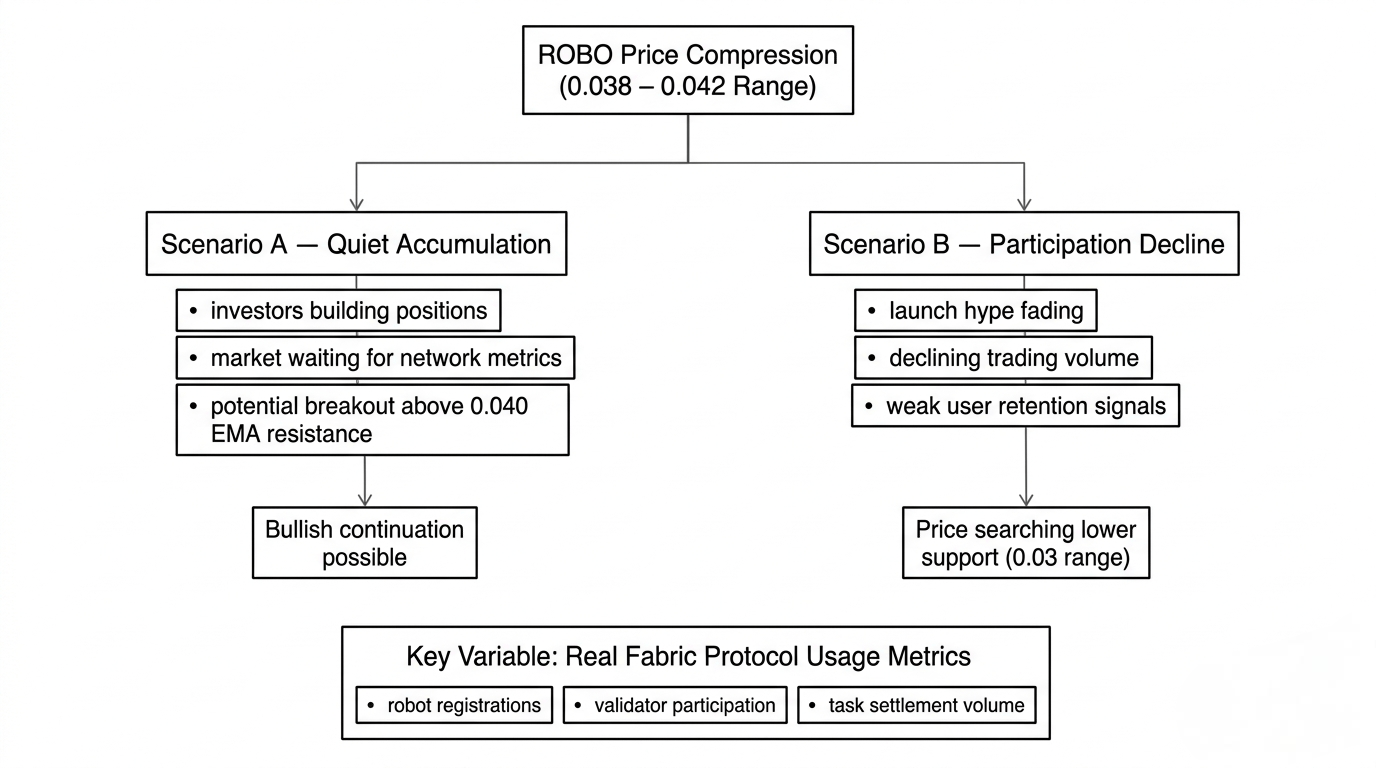
So what would change my mind in either direction? I am watching for three things. First, I want Fabric Foundation to publish transparent onchain metrics about robot registrations, task settlement volume, validator participation, and x402 transaction flow. If those numbers show month over month growth, that is retention, and retention is what separates infrastructure from narrative. Second, I want to see whether ROBO volume stabilizes above 10 million USDT daily without needing constant new listings or marketing pushes. Sustained liquidity at that level tells me there is real two-sided interest, not just tourists passing through. Third, I want evidence that governance decisions are happening onchain and that those decisions are shaping the network in ways token holders can track and verify. If governance stays opaque or if all meaningful decisions come from a small group behind closed doors, then ROBO is not decentralized infrastructure. It is a token attached to a centralized project, and that changes the risk profile significantly.
For now, ROBO is sitting in a tight range, testing whether the market believes Fabric Foundation can deliver on the vision or whether the launch excitement was the peak. I am not long, I am not short, I am watching. The chart is neutral, the fundamentals are incomplete, and the retention story has not proven itself yet. That does not make ROBO uninvestable. It makes it early, and early means the next few months will clarify whether this is infrastructure worth holding or just another well packaged idea that could not turn attention into staying power. The token is live, the protocol is live, the partnerships exist. What happens next depends on whether Fabric Foundation can show us the numbers that prove people are not just talking about the robot economy, they are actually building it, using it, and coming back for more.
#ROBO $ROBO @Fabric Foundation
