
$ROBO #ROBO @Fabric Foundation

Yesterday I was thinking about something simple.
If robots really start working everywhere — warehouses, deliveries, inspections — they won’t all belong to the same company.
Different operators.
Different machines.
Different priorities.
And that’s where things start getting messy.
Because machines don’t just need tasks. They need rules around those tasks.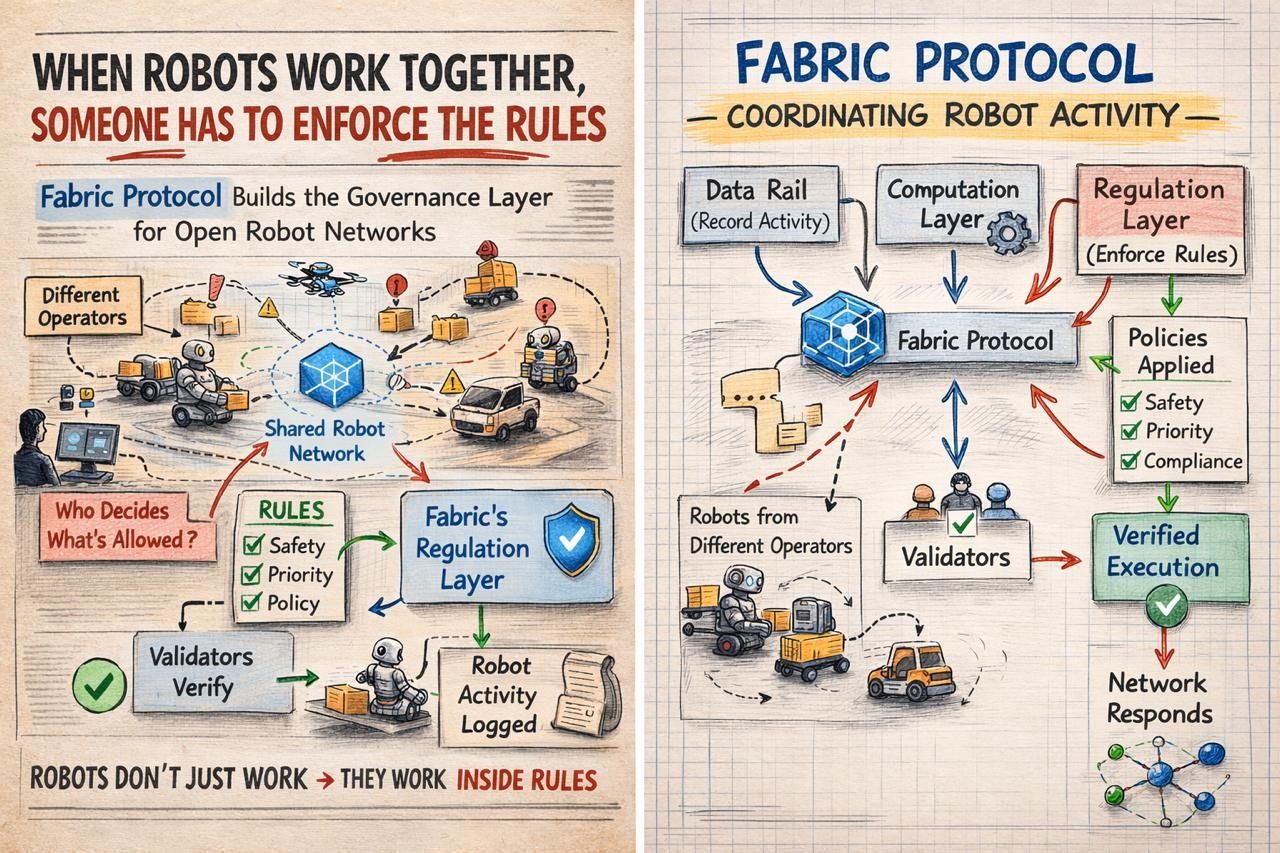
Who gets priority when two robots arrive at the same job?
What happens if a machine tries something outside safety limits?
Who decides if the job was actually completed properly?
Most robotics systems today don’t deal with this problem. Everything runs inside one company. One environment. One control system.
But when I was looking at Fabric Protocol’s architecture, something stood out to me.
They seem to assume robots won’t always live inside closed systems.
They might exist in shared networks.
That’s where a small detail started making sense.
Fabric separates things into different rails.
Data.
Computation.
And something called a regulation layer.
At first I didn’t think much about it.
But the more I looked at it, the more it felt like Fabric isn’t just thinking about robots doing work.
They’re thinking about robots working inside rules.
Not rules from a single company.
Rules enforced by the network itself.
Imagine a warehouse zone where multiple robot fleets operate.
Delivery robots from one provider.
Inspection drones from another.
If a machine tries something outside safety policy, the system needs a way to respond.
Not just log it somewhere.
Actually enforce something.
That’s the piece Fabric seems to be experimenting with.
Validators verifying execution.
Policies influencing how machines interact.
Robot activity becoming something the network can evaluate, not just observe.
What I find interesting is that most robotics conversations online focus on intelligence.
Better AI models.
Smarter machines.
But large systems rarely break because of intelligence problems.
They break because coordination is messy.
Who decides what happens next.
Who enforces the rules.
Who keeps the record.
Fabric looks like it’s trying to build that layer quietly in the background.
Not the robots.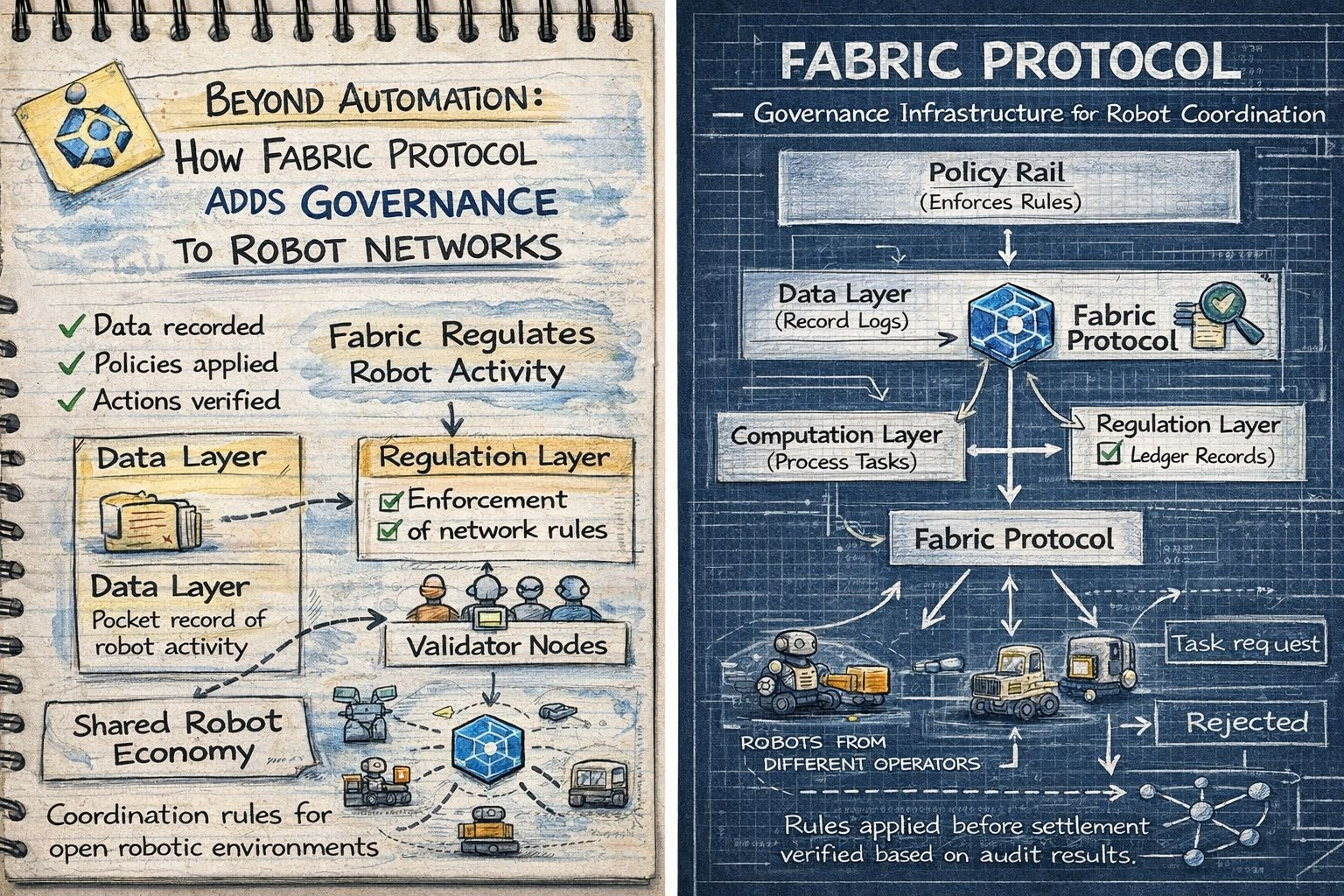
The infrastructure that keeps robot activity organized when the network gets bigger.
And honestly, that’s the part that might matter the most if robot economies actually start forming.