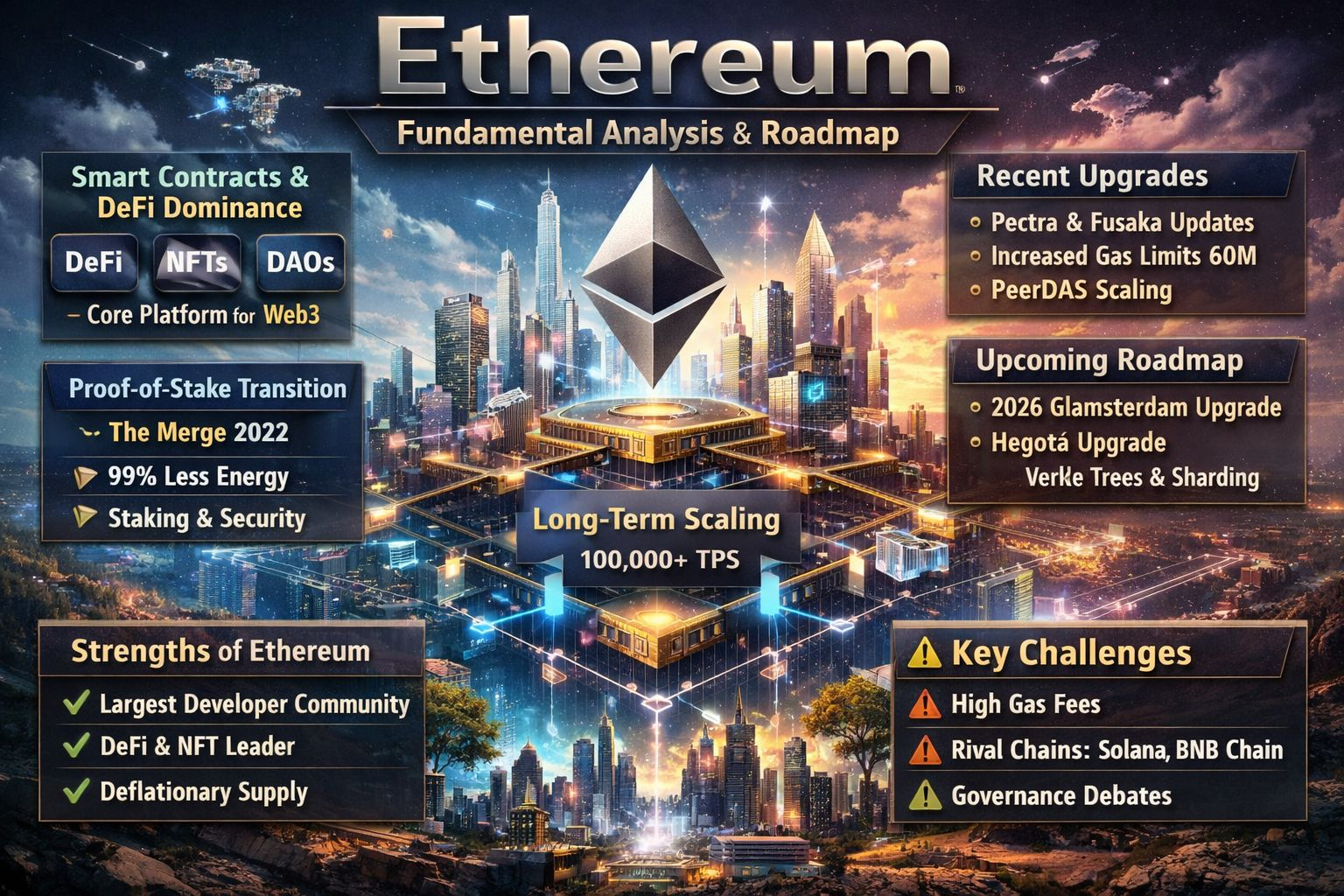
$ETH is the second-largest cryptocurrency by market capitalization after Bitcoin and is widely considered the backbone of the decentralized application (dApp) and DeFi ecosystem. Unlike Bitcoin, which primarily serves as digital money, Ethereum acts as a programmable blockchain that allows developers to build smart contracts, decentralized finance platforms, NFTs, and Web3 applications.
The network was proposed by Vitalik Buterin in 2013 and launched in 2015. Its native token @Ethereum is used for transaction fees (“gas”), staking, and network security.
Key Fundamentals
1. Smart Contract Dominance
Ethereum introduced smart contracts, self-executing code on the blockchain. These power thousands of applications such as:
DeFi platforms (lending, trading)
NFT marketplaces
Blockchain gaming
DAO governance systems
Because of this ecosystem, Ethereum hosts most of the total value locked (TVL) in DeFi, making it the main infrastructure layer for Web3.
2. Transition to Proof-of-Stake (The Merge)
One of Ethereum’s most important developments was “The Merge” in 2022, which replaced Proof-of-Work mining with Proof-of-Stake (PoS).
Key impacts:
Energy consumption reduced by over 99% @Ethereum holders can stake coins to secure the network
Lower inflation and potentially deflationary supply
This upgrade laid the foundation for future scalability upgrades.
3. Massive Developer Ecosystem
Ethereum has the largest developer community in crypto, which creates strong network effects:
Thousands of decentralized apps
Layer-2 networks like Arbitrum, Optimism, and Base
NFT projects and tokenized assets
Because developers build on
@Ethereum first, it maintains a technological moat over competitors.
Recent Developments (2025-2026)
1. Pectra Upgrade
The Pectra upgrade introduced several improvements:
Smart-wallet functionality through account abstraction
Transaction batching and gas sponsorship
Higher validator balance limits and faster onboarding
These upgrades aim to make
@Ethereum more user-friendly and scalable.
2. Fusaka Upgrade
This update introduced PeerDAS technology, which allows validators to sample data instead of downloading it completely.
Benefits:
87.5% lower bandwidth requirements
8× capacity expansion for rollups and scaling solutions
3. Increasing Gas Limits
@Ethereum developers have gradually increased the gas limit from 30 million to 60 million, allowing more transactions per block.
@Ethereum Roadmap (Future Development)
@Ethereum long-term roadmap focuses on scalability, decentralization, and usability.
1. Glamsterdam Upgrade (2026)
Expected in 2026, this upgrade will introduce:
Proposer-Builder Separation (ePBS)
Gas optimization (lower DeFi transaction costs)
Improved network efficiency
2. Hegotá Upgrade
A major upgrade introducing Verkle Trees, which significantly reduce node storage requirements.
Benefits:
Node data reduced by around 90%
Easier to run nodes on consumer hardware
Improved decentralization
3. Long-Term Scaling (2027+)
@Ethereum plans to implement:
zkEVM integration
Sharding technology
Layer-2 interoperability
These upgrades could enable hundreds of thousands of transactions per second across Layer-2 networks.
Strengths of
@Ethereum
✔ Largest Web3 ecosystem
✔ Massive developer adoption
✔ Continuous technical upgrades
✔ Strong DeFi and NFT dominance
✔ Deflationary tokenomics after PoS
Risks and Challenges
⚠ High gas fees compared to some competitors
⚠ Competition from chains like
Solana
BNB Chain
⚠ Governance debates within the Ethereum community.
Long-Term Outlook
Ethereum aims to become a “global decentralized computer” powering the internet of value.
With its roadmap focusing on:
scalability
cheaper transactions
stronger decentralization
many analysts believe
@Ethereum will remain one of the most influential blockchain platforms in the next decade.
#Trump'sCyberStrategy #MarketPullback #USJobsData #AIBinance #AltcoinSeasonTalkTwoYearLow