
okay so ive been going through the $Robo utility mechanisms pretty carefully and the one that keeps standing out to me isnt governance or rewards 😂
its the work bond system.
most people holding $Robo are focused on exchange listings and Q2 activation. fair enough. but the work bond mechanism is already designed and its the part that creates token demand directly tied to real network participation — not speculation, not narrative, just operators staking to work.
what bugs me:
here is how it actually works. every robot operator who wants to provide services on the Fabric network has to post a refundable performance bond in $Robo before doing anything. the whitepaper calls this the Security Reservoir. its not optional. theres no workaround. to register hardware and provide services — you stake $ROBO first.
the bond requirement isnt a flat fee either. it scales with declared capacity. the formula from the whitepaper: Bi = κ · Ki · Pt⁻¹. operator bond equals bond-to-capacity ratio times declared throughput divided by current token price. κ is set at 2.0 epochs — meaning the bond covers roughly two months of potential fraud exposure.
what this creates is token demand that scales linearly with network capacity. as more operators join and declare higher capacity — more $ROBO gets locked in bonds automatically. the whitepaper calls this unit price elasticity — if $ROBO price doubles, the token quantity required for bonds halves, but the total USD value locked stays constant. demand adjusts with price but the USD commitment stays fixed.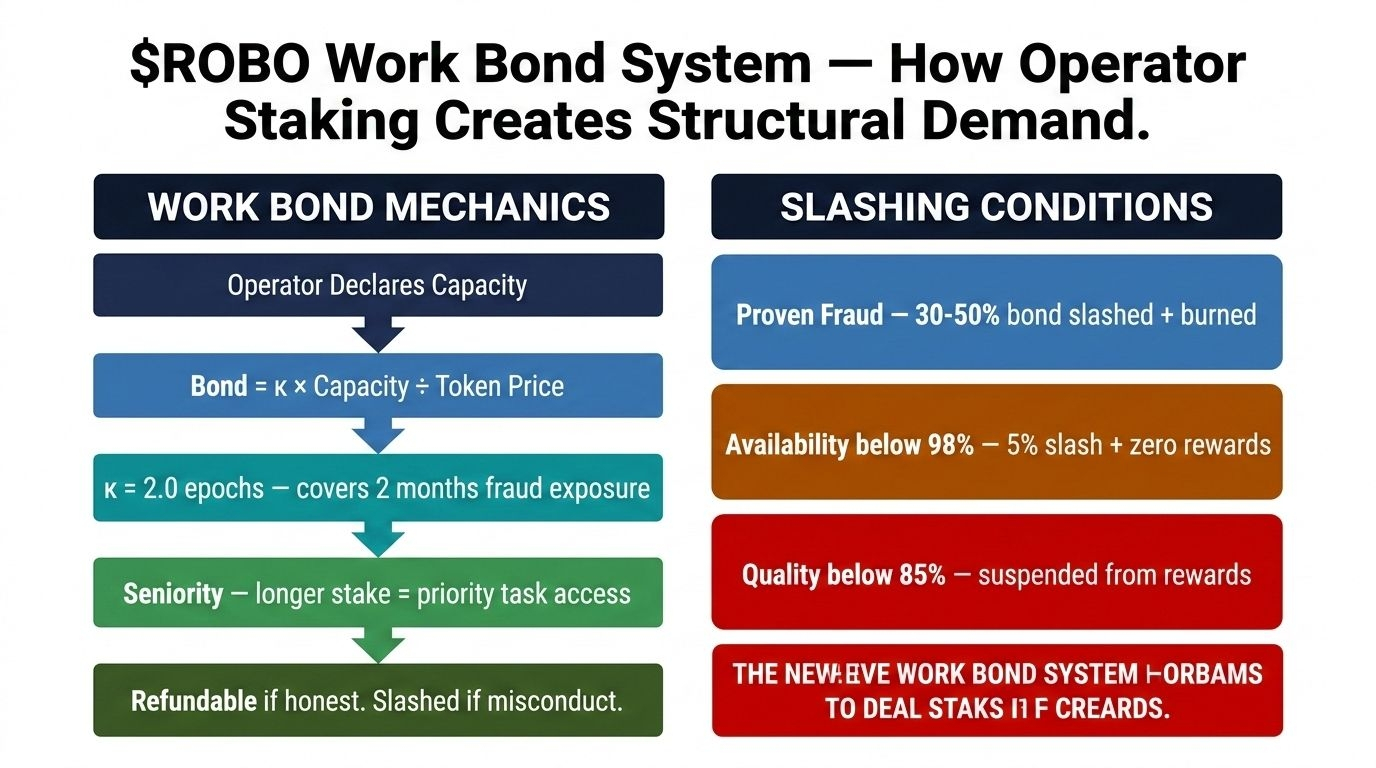
the angle nobody discusses:
the bond also has a seniority component. selection for tasks is weighted by both the total value in the bond reservoir and how long it has been held. operators who stake more and stake longer get priority access to higher value tasks. this creates an incentive to stake early and stake large — not just the minimum required.
bonds are refundable if the operator performs honestly. but slashing conditions apply for fraud, availability failures below 98% uptime over 30 days, and quality degradation below 85% score. a 5% slash for availability failure. 30-50% slash for proven fraud. slashed tokens get burned — permanently removed from circulating supply.
so the work bond system does three things simultaneously. it locks $Robo supply proportional to network capacity. it burns $ROBO when operators misbehave. and it creates seniority incentives that reward long-term committed operators over short-term participants.
my concern though:
the bond system requires actual robot operators to participate at scale before it creates meaningful supply pressure. right now operator count is small. Q2 2026 is when the network expands across additional robot platforms and environments. until operator numbers grow significantly the locked supply from work bonds stays small relative to total circulating supply of 2.23 billion tokens.
the mechanism is elegantly designed. but elegant design requires network scale to translate into market-relevant token dynamics.
what they get right:
the refundable structure is smart. operators dont lose their bond by simply participating — they only lose it through misconduct. this lowers the barrier to entry compared to a burn-to-participate model while still creating real economic skin in the game. operators who behave correctly get their full bond back when they exit.
the USD-denominated stability is also well designed. bonds are denominated in stable USD value and settled in $Robo via on-chain oracle. this means bond requirements dont become prohibitively expensive if $ROBO price rises sharply — the token quantity adjusts automatically. operators can plan around USD costs rather than token price volatility.
honestly dont know if the work bond mechanism becomes a significant supply sink as operator count scales through Q2 and beyond or if network growth stays slow enough that bond demand remains a theoretical feature rather than a visible market dynamic 🤔
watching: operator registration numbers post Q2 activation, total $Robo locked in work bonds on-chain, whether slashing events start appearing as network activity grows.
what's your take — work bonds creating structural $ROBO demand tied to real operator participation is the most underrated mechanism in the system or it only matters once operator scale reaches levels nobody has confirmed yet?? 🤔