A few days ago I was watching a video where an autonomous delivery robot was moving along a sidewalk. The robot was moving around obstacles on its own. After it finished its route it rolled toward a charging station. Docked itself to recharge.
I was really impressed by how everything worked. Then I thought: who is this robot really? What is this robot's identity?
We have passports, national IDs, bank histories and legal recognition. These things help us participate in society and the economy. Our identities help establish trust track our actions and build reputation over time.
Robots do not have that kind of identity.
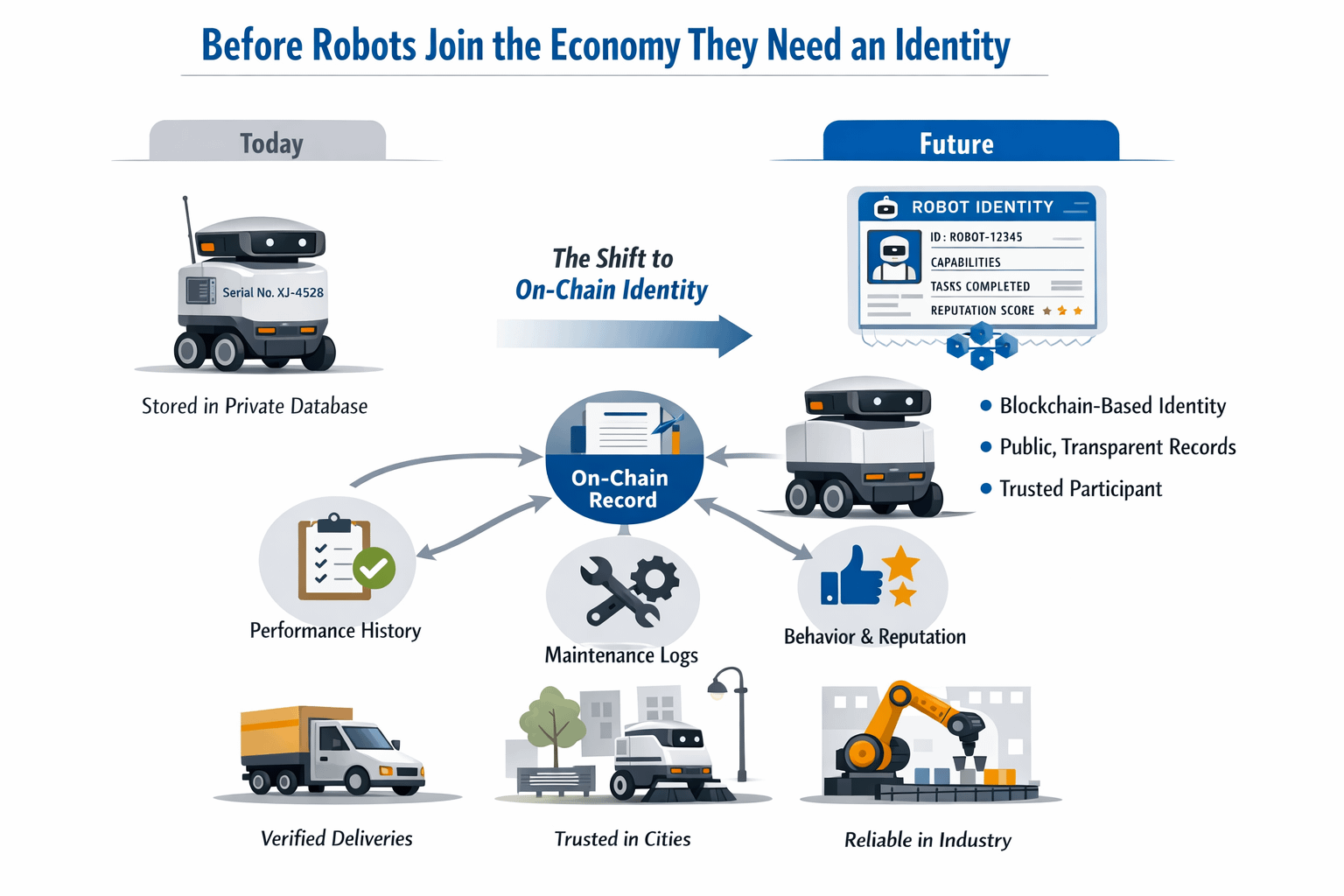
Today, robots, drones and autonomous machines are already doing work. They deliver packages move goods inside warehouses and assist in factories. Their identity is usually a serial number stored on a company's internal server. If that company shuts down or its servers go offline much of the robots history could disappear with it. A machine that may have completed thousands of tasks could suddenly lose the record of everything it has done.
This is where the idea of on-chain identity for robots starts to become interesting.
Imagine if every robot had an identity recorded on a public blockchain than inside a private corporate database. This robots identity could store information about the robots capabilities the tasks the robot has completed and the robots behavioral track record over time. Instead of being just a device, the robot would become a recognizable participant within a larger digital system.
This is the type of infrastructure that organizations like Fabric Foundation are beginning to explore. Their vision is to build a framework where robots can have identities that exist independently of any single company or server.
From a business perspective the implications could be significant.
For instance imagine a logistics company deploying delivery robots. If each robots past performance successful deliveries, navigation reliability and maintenance history were recorded on a ledger the company could make decisions about which robots to trust. At the same time, an insurance provider could evaluate risk using real performance data instead of assumptions.
Another example could appear in maintenance. Cities might use fleets of cleaning robots to maintain streets or public spaces. If these robots shared an identity layer city operators could easily identify which robots consistently perform well and which ones need improvement. Over time robots with track records would naturally earn work and stronger reputations.
What is interesting is that this shift is not really about making robots more intelligent. It is about creating the conditions that allow robots to participate in systems of trust.
Economies have always relied on records, accountability and reputation. Humans depend on identity systems to access opportunities and build credibility. If robots gain identities an entirely new kind of robot economy could begin to emerge.
That is why some observers believe Fabric Foundation is not simply working on robotics technology. In a sense they may be laying the groundwork for an environment where robots can exist as trackable actors within economic systems.
Seen from this perspective the future of robotics might not depend on algorithms or better hardware. It may depend much on whether robots can prove who they are and what they have done.
That leads to a powerful question:
When robots eventually work alongside us in the economy earning trust, completing tasks and building reputations will we still see robots as mere machines or as identifiable participants, within the systems we rely on?