A few months ago I asked an AI tool to help me understand a technical report I didn’t have time to read fully. The response came back almost instantly. It was well written, structured, and surprisingly confident. At first glance it felt helpful. But something about it bothered me, so I went back to the original report.
That’s when I noticed the problem.
Parts of the explanation were simply… wrong. Not slightly off. Entire claims had been invented. References that sounded legitimate weren’t actually in the paper. The system had filled in gaps with things that felt plausible.
What struck me most wasn’t the mistake itself. People misread things all the time.
It was the certainty.
The answer sounded like it came from someone who had studied the paper carefully. But in reality it was closer to a guess that happened to be written convincingly.
Since then I’ve seen similar moments in many places. AI tools writing code that references functions that don’t exist. Automated assistants explaining documentation that was never published. Systems generating answers that sound precise but collapse under basic verification.
None of this makes AI useless. Far from it. These systems can be extremely capable.
But it highlights something that feels more important than intelligence: trust.
For people who have spent time around crypto systems, that word carries a slightly different meaning. Trust doesn’t usually come from believing someone is smart or competent. It comes from knowing that the system itself makes dishonesty or mistakes visible.
Blockchains work because no single machine gets to decide what is true. Transactions are verified by many participants. Records are public. Bad behavior has consequences. Incentives are designed so that cooperation becomes the easiest path.
In other words, trust is something the structure produces.
AI systems, at least today, operate very differently. A model generates an answer. The answer appears on a screen. Most of the time we simply accept it or reject it based on intuition.
There’s rarely a mechanism that shows how the answer was produced or whether it can be independently verified.
That gap becomes more uncomfortable when AI begins moving beyond conversations and into systems that actually act. Financial algorithms, autonomous agents, robotic infrastructure. In those environments, an incorrect output is no longer just an awkward paragraph.
It can trigger real consequences.
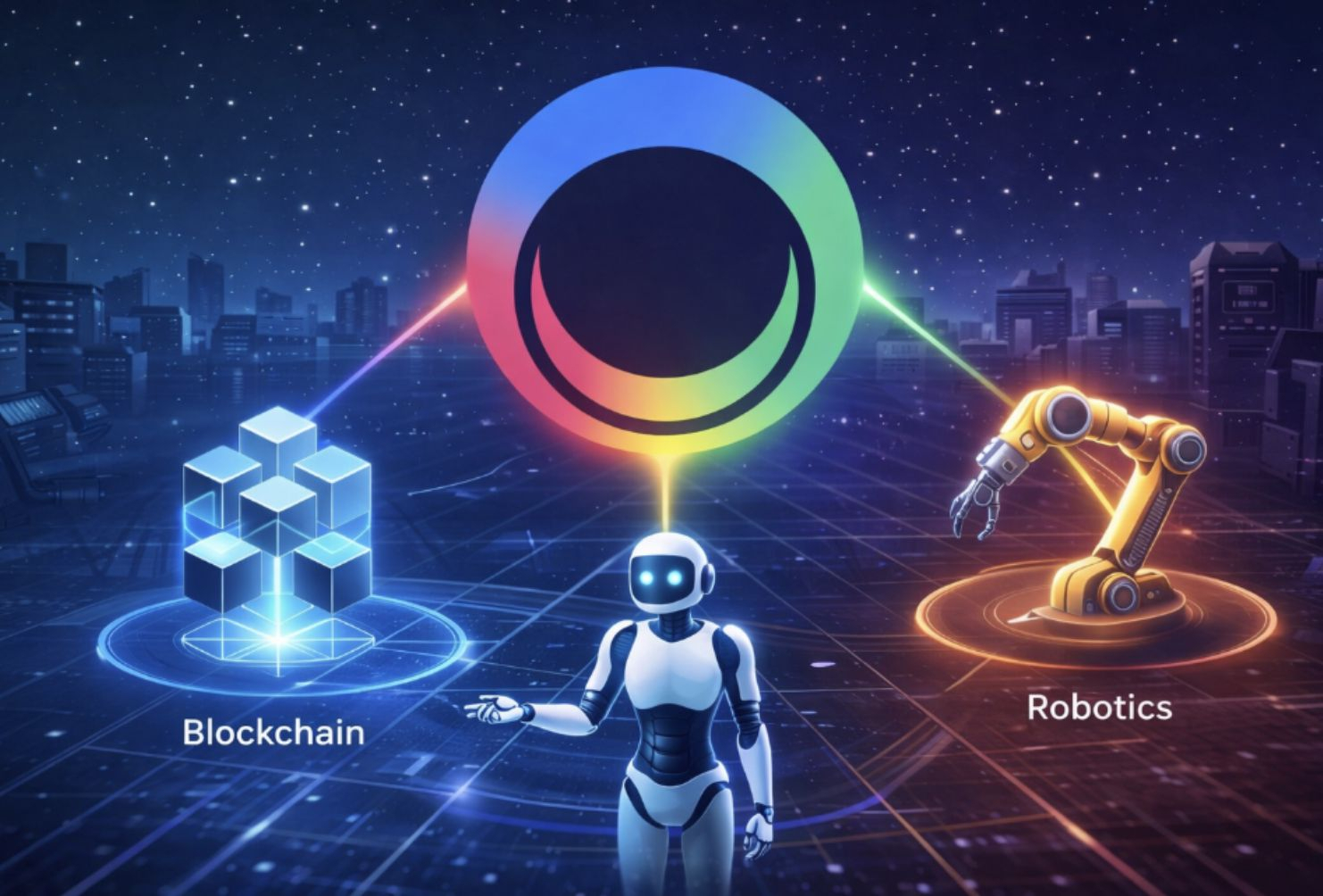
This is where ideas around Fabric Protocol start to feel interesting, not because they promise smarter AI, but because they attempt to address the missing layer of verification.
Fabric Protocol is described as an open network supported by the Fabric Foundation. The goal is to coordinate data, computation, and governance for autonomous systems through a public infrastructure layer. That description can sound abstract at first.
But the idea becomes clearer when viewed through the lens of crypto architecture.
Instead of treating AI outputs as final answers, the system treats them more like claims that can be verified. Computations can be recorded. Agents can be accountable for the work they perform. Multiple participants can check whether processes were executed correctly.
The structure begins to resemble something familiar: consensus.
In crypto, consensus isn’t about everyone agreeing philosophically. It’s about independent verification. Multiple actors check the same information and converge on a shared result. If someone behaves dishonestly, economic penalties discourage it.
This logic translates surprisingly well to autonomous systems.
An AI model might produce an output, but that output doesn’t have to exist in isolation. Verification mechanisms can examine the computation behind it. Incentive structures can encourage honest participation. Governance systems can regulate how agents evolve over time.
None of this guarantees perfection.
Mistakes will still happen. Machine learning systems are inherently probabilistic. Even the most carefully designed models produce errors. Humans do too.
The difference lies in whether those mistakes can be detected and accounted for.
Fabric’s design philosophy seems to accept that reality rather than pretending intelligence alone will solve it.
In that sense, it doesn’t frame itself as “AI combined with blockchain.” That description misses the point. What it really tries to introduce is something closer to a trust layer.
A place where autonomous systems can be observed, verified, and coordinated without relying entirely on a single authority.
Of course, the idea raises difficult questions.
Verification adds friction. Cryptographic proofs take time to compute. Distributed networks introduce latency. Systems that rely on consensus tend to move slower than centralized alternatives. For applications where speed matters, that trade-off could become a real obstacle.
There’s also the problem of cost. Public infrastructure requires resources to operate. Validators, nodes, and computation layers all need incentives to exist.
Crypto history is full of projects that designed elegant technical systems but struggled to maintain long-term economic sustainability.
Another issue is diversity. Verification works best when participants operate independently. If most agents rely on the same underlying AI models, the system could end up reinforcing the same blind spots rather than correcting them.
And then there’s adoption.
Developers already face steep learning curves when working with blockchain infrastructure. Adding verifiable AI frameworks could make the environment even more complex. Many companies may choose the simpler path of centralized AI services simply because they are easier to integrate.
Convenience has always been a powerful force in technology.
So it’s reasonable to remain skeptical about whether systems like Fabric will gain real traction.
But skepticism doesn’t make the problem disappear.
The more AI becomes embedded in financial markets, logistics networks, and robotic platforms, the more uncomfortable it feels to rely purely on model outputs without any structural verification. Confidence alone is not a reliable signal.
Crypto communities have spent more than a decade thinking about this issue from a different angle. The whole point of consensus systems was to remove the need to trust any single actor.
In a strange way, autonomous AI might be pushing us toward the same realization again.
Intelligence is useful, but it isn’t the foundation of trust.
Trust comes from systems where actions can be examined, mistakes can be surfaced, and accountability exists by design rather than by assumption.
Fabric Protocol seems to be exploring that territory. Whether it ultimately succeeds will depend on many factors that go far beyond architecture. Incentives, governance, developer adoption, and time will all play their roles.
But the direction itself reflects something quietly important.
We are building machines that can think, decide, and act at increasing scale. That process will inevitably produce errors. What matters is whether the surrounding systems are capable of recognizing those errors and responding to them.
The future of AI may not depend solely on how intelligent machines become.
It may depend just as much on how carefully we design the structures that keep them accountable.
#ROBO @Fabric Foundation $ROBO