Artificial intelligence is becoming an essential part of modern business. Companies are using AI to automate tasks, analyze data, improve customer service, and make smarter decisions. From healthcare and finance to retail and logistics, AI is changing how organizations operate. However, despite all these benefits, many enterprises are still cautious about relying fully on AI systems.
The main reason for this hesitation is trust. AI models can sometimes produce incorrect or misleading information. These mistakes are often called AI hallucinations, where the system generates answers that sound confident but are actually wrong. For businesses that rely on accurate information, this can be a serious problem. A wrong AI-generated insight in finance, healthcare, or legal services could lead to costly mistakes or even legal consequences.
Because of this challenge, companies are looking for ways to make AI systems more reliable and trustworthy. This is where Mira Network comes in. Mira Network introduces a verification layer designed to check the accuracy of AI-generated responses before they are used in real-world business operations. By improving the reliability of AI outputs, Mira Network is helping enterprises adopt artificial intelligence with greater confidence.
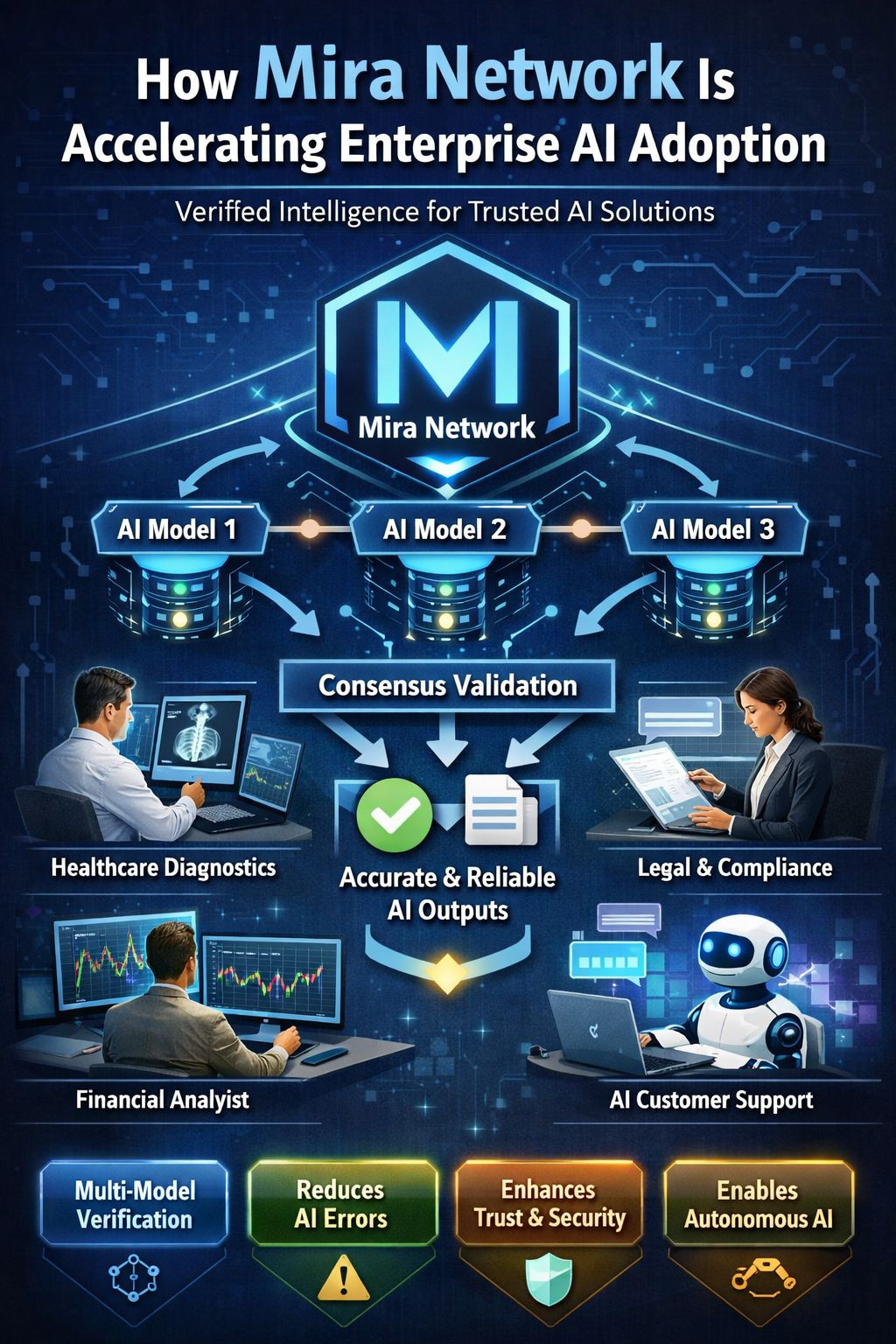
Mira Network works on a simple but powerful idea. Instead of relying on a single AI model to generate and deliver information, the network verifies that information using multiple AI systems. This approach acts like a fact-checking system for AI, ensuring that the information provided by AI models is accurate and dependable.
To understand why this matters, it helps to look at the challenges businesses face when adopting AI. Many organizations worry about incorrect answers, lack of transparency, and potential risks associated with automated decision-making. When AI systems generate inaccurate information, it can lead to wrong business decisions, damaged customer trust, or compliance issues with regulations. These risks make enterprises hesitant to fully integrate AI into critical workflows.
Mira Network addresses this issue by introducing a structured verification process. When an AI system generates a response, Mira first analyzes the answer and breaks it into smaller pieces of information. Instead of evaluating the entire response at once, the system examines each individual claim separately. This makes it easier to verify whether the information is correct.
After the response is divided into smaller claims, each claim is checked by multiple AI models within the network. These models independently evaluate the accuracy of the statement. Because several systems are involved in the verification process, the chances of errors or bias from a single model are significantly reduced.
Once the models evaluate the claims, the network compares their responses and determines which information is most reliable. This process works through a consensus mechanism similar to systems used in decentralized technologies. If multiple models confirm that a claim is correct, it becomes part of the verified output. If there is disagreement or uncertainty, the system can flag the information for further review.
For enterprises, this verification process offers several important benefits. The most obvious advantage is greater accuracy. By checking AI-generated information through multiple models, Mira Network reduces the likelihood of incorrect responses. This helps businesses rely on AI outputs with more confidence.
Another major benefit is risk reduction. Many industries operate in environments where accuracy is extremely important. For example, healthcare organizations cannot afford mistakes in diagnostic recommendations. Financial institutions rely on precise data for risk analysis and investment decisions. Legal professionals must ensure that their research and documentation are accurate. Mira Network helps reduce these risks by validating AI-generated insights before they are used.
Mira Network also makes it easier for developers to build AI-powered applications. Many companies want to use multiple AI models to improve performance and reliability, but managing several systems can be complicated. Mira provides a unified infrastructure that allows developers to access different AI models through a single platform. This simplifies the development process and allows teams to focus on building useful applications rather than managing complex integrations.
Another advantage is cost efficiency. Without automated verification systems, companies often need human reviewers to check AI outputs and correct mistakes. This manual process takes time and can be expensive. By automating the verification process, Mira Network reduces the need for constant human oversight while still maintaining high levels of accuracy.
The impact of Mira Network can be seen across many industries. In healthcare, AI is increasingly used to analyze medical data, detect patterns in diagnostic images, and assist doctors with treatment planning. However, medical professionals must be able to trust the information generated by AI tools. Mira Network helps verify these insights, ensuring that doctors receive accurate and reliable data before making clinical decisions.
Financial services are another sector where reliable AI is essential. Banks and fintech companies use AI to detect fraud, analyze financial risks, and automate trading strategies. Even small inaccuracies in these systems can lead to significant financial losses. By verifying AI-generated insights, Mira Network helps financial institutions use AI more safely and effectively.
The legal industry is also beginning to adopt AI for tasks such as contract analysis, legal research, and document review. While AI can significantly speed up these processes, lawyers must be confident that the information they receive is correct. Mira Network can validate AI-generated interpretations, helping legal professionals rely on AI tools with greater trust.
Customer service is another area where verified AI can make a difference. Many companies now use AI-powered chatbots to handle customer inquiries. These systems can respond quickly and operate around the clock, but they sometimes provide incorrect answers. Mira Network can verify chatbot responses before they are delivered to customers, helping companies provide more accurate and reliable support.
As AI technology continues to evolve, businesses are moving toward autonomous AI systems. These systems are designed to perform tasks independently, such as managing supply chains, analyzing market data, or conducting research. While autonomous AI offers enormous potential, it also requires extremely high levels of reliability. If these systems are going to operate without constant human supervision, their outputs must be accurate and trustworthy.
Mira Network plays an important role in enabling this future. By providing a verification layer that checks AI outputs before they are used, the network helps create a foundation for trustworthy autonomous systems. This infrastructure could become an essential part of the next generation of enterprise AI.
Of course, like any emerging technology, Mira Network still faces some challenges. The ecosystem is still developing, and widespread adoption will take time. Enterprises may need to adapt their existing systems to integrate verification layers. There may also be performance considerations, as verifying information through multiple models can require additional computing resources.
However, these challenges are common in the early stages of technological innovation. As the technology matures and more organizations begin to adopt verified AI systems, these issues are likely to become easier to manage.
Looking ahead, the importance of trustworthy AI will only continue to grow. As businesses rely more heavily on artificial intelligence for decision-making and automation, ensuring the accuracy of AI-generated information will become critical. Verification systems like Mira Network could become standard components of AI infrastructure, helping organizations maintain transparency, reliability, and accountability in their AI operations.
In simple terms, Mira Network is helping solve one of the biggest problems in artificial intelligence: trust. By verifying AI outputs through multiple models and decentralized consensus mechanisms, the network helps reduce errors and improve reliability. For enterprises that want to adopt AI without exposing themselves to unnecessary risks, this type of infrastructure can make a significant difference.
As organizations continue exploring the possibilities of artificial intelligence, solutions like Mira Network may play a key role in shaping the future of enterprise AI adoption.