Artificial intelligence has reached a strange moment in its history. Machines are doing more for us than ever before—writing code, diagnosing illnesses, optimizing supply chains, even driving vehicles. Yet the deeper these systems go into our daily lives, the harder it becomes to explain how they actually arrive at their decisions. The answers appear instantly, but the reasoning behind them often disappears inside layers of neural networks that even their creators struggle to fully interpret. It’s a bit like asking a genius a question and receiving the correct answer—without ever seeing the steps they took to get there.
This is the tension people often describe as the “black box” problem of AI. We see the results, but the path leading to those results remains hidden. Fabric Protocol was born from a simple but powerful idea: what if the actions of artificial intelligence and robots didn’t have to remain mysterious? What if every meaningful machine action could leave behind a verifiable trail—something like a digital receipt that proves exactly what happened?
Instead of asking people to trust AI companies, Fabric tries to shift the conversation toward verification. The protocol blends two worlds that are rarely connected: blockchain transparency and autonomous machine intelligence. Blockchain networks were originally designed to make financial transactions transparent and tamper-proof. Fabric extends that idea to machines themselves, imagining a future where the activities of robots and AI systems can be recorded, validated, and permanently logged through cryptographic proofs.
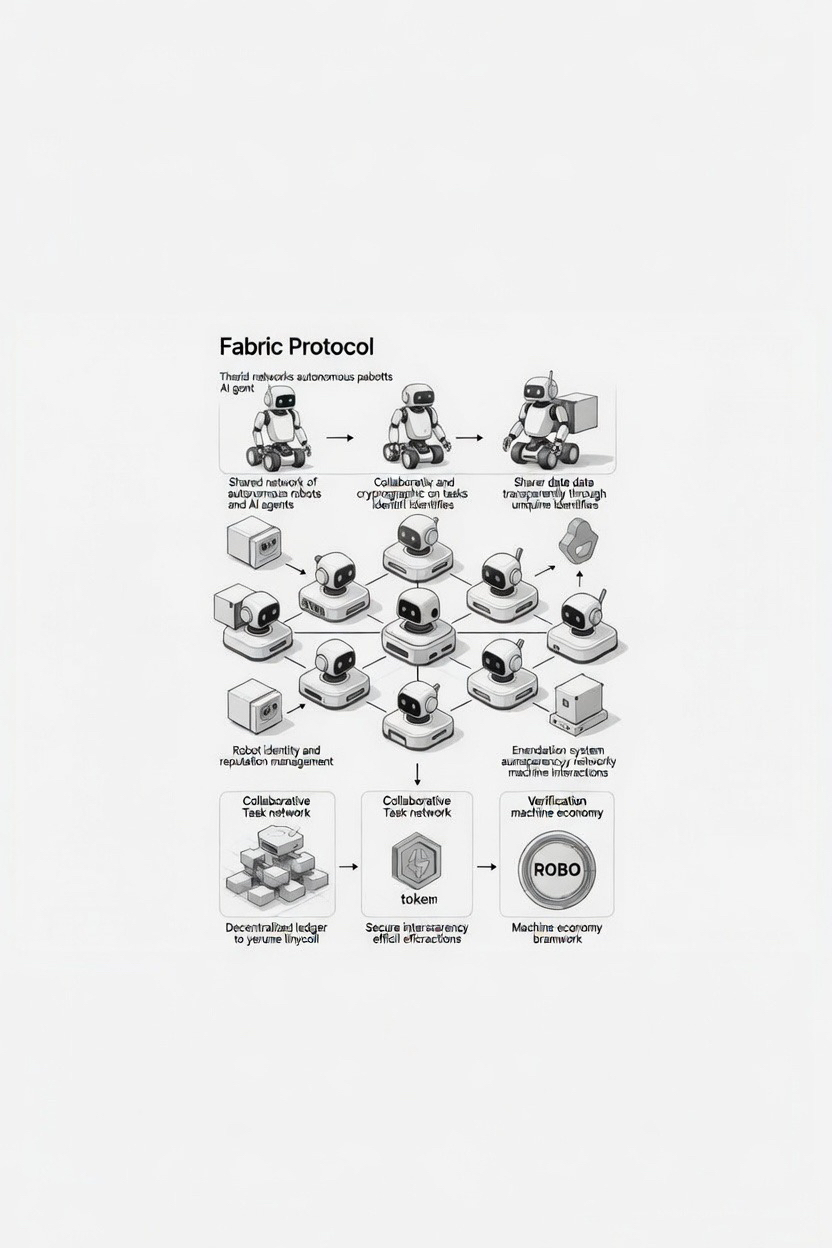
In practical terms, the project introduces the concept of a shared network where machines can interact, perform tasks, and prove that those tasks were executed correctly. Each robot or AI agent can register a cryptographic identity within the system, almost like receiving a passport in a digital nation of machines. With that identity, the machine can accept jobs, communicate with other machines, and record the outcome of its work on a decentralized ledger.
The result is what Fabric calls a machine economy. Instead of robots being isolated tools controlled entirely by centralized platforms, they become participants in a broader network. A delivery robot might accept a task to transport goods across a warehouse. A drone might coordinate with ground robots to complete a delivery route. An AI system might process data or optimize logistics for the entire operation. Each completed task generates a record that can be independently verified.
At the center of this ecosystem sits the protocol’s native token, ROBO. The token acts as the economic engine of the network. Machines or operators can stake ROBO as a signal of reliability when accepting tasks, while validators earn tokens for confirming that work was actually completed. Payments for machine services can also flow through the token, allowing automated systems to exchange value without human intervention. In theory, it creates an environment where machines can work, earn, and interact within a decentralized infrastructure.
Fabric’s development has accelerated recently as the project begins building the first layers of this vision. Venture capital firms within the crypto ecosystem have backed the initiative, and the ROBO token has entered broader markets through exchange listings and public launches. Early versions of the network are being tested on Ethereum’s Layer-2 infrastructure while developers work toward a more specialized blockchain environment designed specifically for machine coordination. The roadmap includes tools for robot identity, collaborative task networks, and verification systems capable of scaling to real-world industrial environments.
Still, beneath the technical architecture lies a deeper philosophical question. Fabric can prove that an algorithm executed correctly—but correctness is not the same thing as morality. A machine might follow its instructions perfectly and still produce harmful outcomes if the instructions themselves were flawed. Cryptography can guarantee accuracy, but it cannot decide what is right or wrong. In that sense, the protocol solves the problem of trust in execution, but not necessarily the problem of trust in intention.
Another challenge sits in the delicate balance of decentralization. Many blockchain projects begin with the promise of distributed control, only to discover that power quietly concentrates in the hands of a few large players. If verification in the Fabric network ends up controlled by a small group of validators, the idea of a truly open system could weaken. The economic design of the ROBO token also needs to sustain real demand from machine activity, otherwise the network risks drifting into the same speculative cycles that have affected many crypto projects.
There is also the question of how such a system fits into the legal and regulatory structures of the real world. When robots begin interacting with physical environments—moving goods, assisting in hospitals, operating vehicles—governments will demand clear accountability. A blockchain record may prove what happened technically, but legal systems still need to translate that information into responsibility and oversight.
Despite these uncertainties, the idea behind Fabric touches on something important about the future of technology. For years, innovation has pushed toward greater automation while simultaneously making systems harder to understand. Fabric attempts to move in the opposite direction, embedding transparency into the very infrastructure that machines use to operate. Instead of building smarter black boxes, the protocol tries to create systems where machine behavior can be inspected, verified, and trusted through open records.
If the concept succeeds, it could quietly reshape how we interact with intelligent machines. Imagine cities where fleets of autonomous robots coordinate deliveries without centralized control, where AI systems exchange data services with provable accountability, and where every automated action leaves behind a transparent record anyone can audit. The world would not rely solely on promises from companies about how their AI behaves. Instead, the behavior itself would be visible and verifiable.
Fabric Protocol may still be early in its journey, but the question it raises feels increasingly relevant: in a future filled with autonomous machines, should we rely on trust alone—or should we build systems that allow us to verify what those machines are actually doing?
$ROBO #ROBO @Fabric Foundation