
Hey everyone, in a world where AI is everywhere from chatbots answering our questions to algorithms making life altering decisions there’s one big elephant in the room: can we really trust what these systems spit out? I’ve been diving deep into the crypto-AI intersection lately, and @Mira - Trust Layer of AI caught my eye as a fresh take on this problem. It’s not just another hype project; it’s tackling AI’s Achilles’ heel hallucinations and biases with a decentralized twist. Imagine AI outputs that are verified by a crowd of models, backed by blockchain security. That’s the promise of $MIRA, and it’s got me excited about the future. Let’s break it down.
First off, what’s the big issue with AI today? Models like GPT or Stable Diffusion are amazing at generating content, but they often get things wrong. Hallucinations those made-up facts that sound oh-so-plausible happen because no single model is perfect. Studies show error rates hovering around 15-20%, and in high stakes fields like healthcare or finance, that’s unacceptable. Centralized fixes, like fine-tuning or ensembles, help but don’t eliminate biases from limited data or echo chambers. Mira steps in here with a decentralized network that verifies AI claims using collective intelligence. It’s like having a jury of diverse AI verifiers vote on truth, powered by crypto economics to keep everyone honest.
Take a look at this diagram it illustrates Mira’s verification pipeline perfectly. The process starts by breaking down AI-generated content into bite sized claims. For example, if an AI says Bitcoin was invented in 2008 by Satoshi Nakamoto, Mira splits it into verifiable parts: Bitcoin was invented in 2008 and Satoshi Nakamoto invented Bitcoin. These claims get distributed to independent verifier nodes, each running different AI models. Consensus is reached through thresholds like majority agreement and if it passes, it’s stamped with a cryptographic certificate. Nodes stake $MIRA tokens to participate, and bad actors get slashed, ensuring skin in the game. This isn’t theoretical; Mira’s mainnet launched recently, opening up staking and verification to over 4.5 million users in its ecosystem.What makes $MIRA tick? As the native token, it’s the fuel for this machine. Users pay fees in $MIRA for verifications, which rewards honest nodes and data providers. Staking secures the network, with a hybrid Proof-of-Work/Proof-of-Stake setup that turns verification into multiple choice questions to deter guessing. From what I’ve seen, the tokenomics are solid: total supply of 1 billion, with about 244 million circulating right now. Ecosystem reserves take 26%, core contributors 20%, and there’s a healthy chunk for node rewards (16%) to bootstrap growth.
Check out this pie chart of Mira’s token distribution it’s designed for long-term sustainability, with locks on investor and contributor shares to prevent dumps. Early backers like Framework Ventures and Balaji Srinivasan pumped in $9M in seed funding, plus a node sale, showing serious belief in the project.
Now, let’s talk numbers. As of early March 2026, $MIRA is trading around $0.083, down from its ATH of $2.35 last September. Yeah, it’s been a rough ride a 94% retrace but that’s crypto for you, especially in early bootstrapping phases. Market cap sits at about $20.5M, with solid liquidity. The chart shows consolidation after the initial hype, but with mainnet live and integrations rolling out, I see upside. Staking yields could attract holders, and as more AI apps plug into Mira for trust layers, demand for $MIRA should spike.
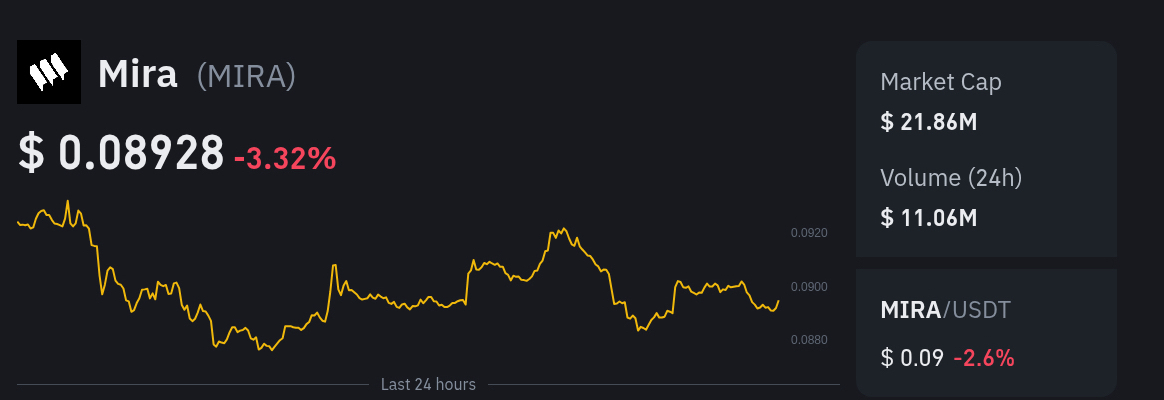
This price chart from Binance captures the trend notice the volume holding steady despite the dip? That’s a sign of underlying interest. If AI adoption keeps exploding projects like Mira could explode too. Think about it: verifiable AI for trading signals, medical advice, or even legal docs. No more “trust me, bro” from a black-box model.
But Mira’s not stopping at verification. The roadmap points to a “synthetic foundation model” basically, an uber AI that generates error-free outputs by baking in consensus from the get-go. Privacy features like sharding keep data secure, and it’s expanding to code, images, and beyond. I had a moment last week when I used a similar tool and caught a hallucination in real-time; Mira could make that the norm.
In my opinion, $MIRA is undervalued right now. It’s not just spec; it’s solving a real pain point in a trillion-dollar AI market. If you’re into crypto-AI plays like $TAO, add @Mira - Trust Layer of AI to your watchlist.
Stake some $MIRA run a node, or just hold the network’s growth could reward early believers big time.
What’s your take? Drop a comment below.
#Mira @Mira - Trust Layer of AI
