
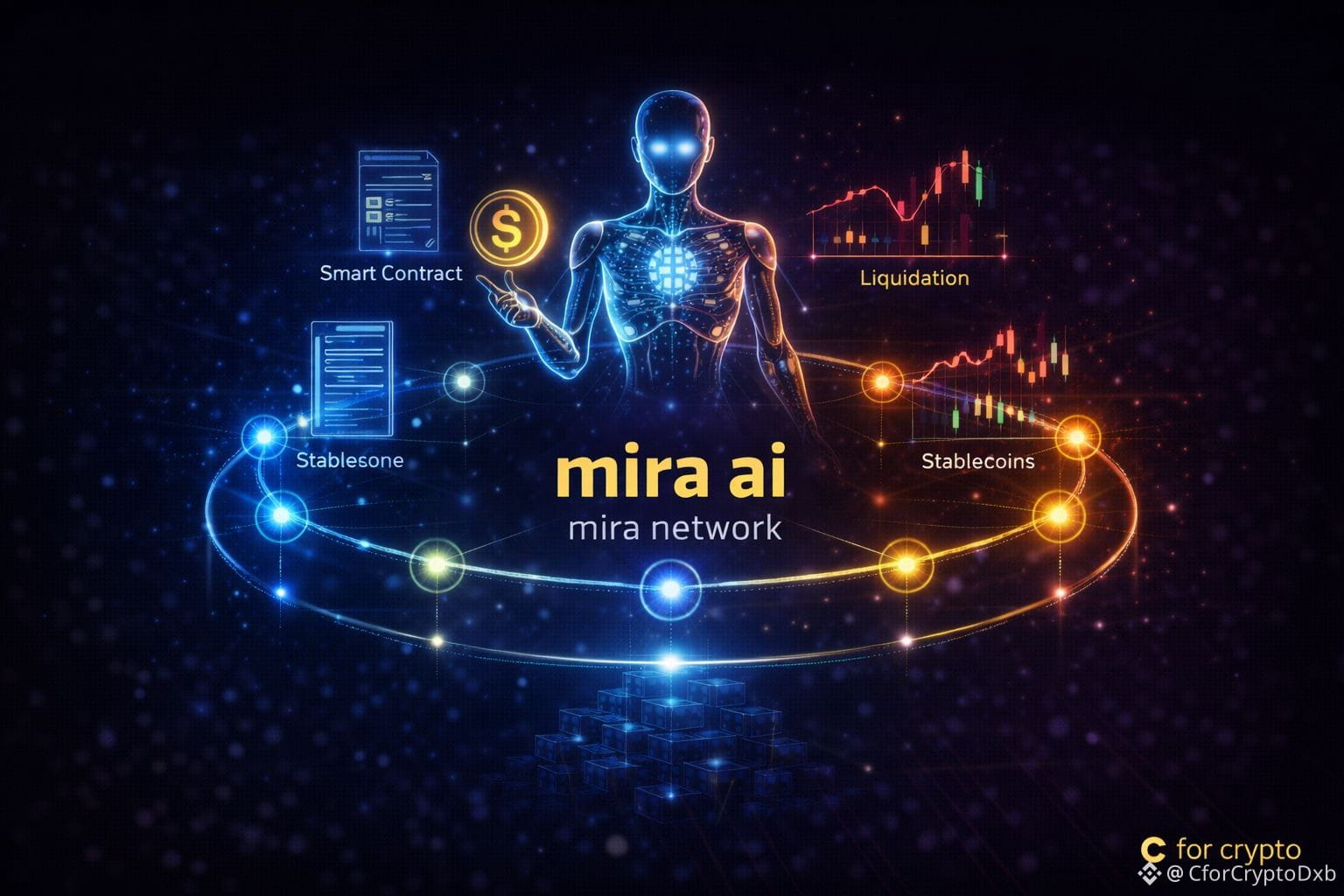
In the early days of the internet, information flowed faster than verification. The web democratized publishing, but it also introduced a persistent question: how do we know what is true? Today, as artificial intelligence systems generate text, images, financial analysis, and even medical insights at scale, that same question returns with renewed urgency. The difference is that the stakes are now far higher. When machines begin producing knowledge at industrial speed, verification becomes not merely a feature but an infrastructure.
This is the landscape in which Mira Network has begun to attract attention. Positioned as a “trust layer” for artificial intelligence, Mira is exploring how decentralized consensus mechanisms can verify the outputs of AI systems. Around it, an emerging ecosystem has begun to form, anchored by the digital asset MIRA, and increasingly energized by a growing community on platforms such as Binance Square.
The project exists at the intersection of several powerful technological currents: AI acceleration, decentralized infrastructure, and the search for reliable digital truth. For observers tracking the evolution of machine intelligence and blockchain coordination, Mira’s trajectory offers a compelling case study. It reflects a broader attempt to build what might eventually become a verification fabric for the algorithmic age.
Yet as with any ambitious infrastructure project, the story is not only about potential. It is also about the practical challenges of scaling trust in a decentralized world.
The Verification Problem in the Age of Generative AI
Artificial intelligence has advanced with extraordinary speed over the past few years. Large language models can produce essays, software code, market analysis, and legal drafts in seconds. Vision models generate photorealistic imagery that blurs the line between simulation and reality. These capabilities have unlocked enormous productivity gains, but they have also revealed a structural weakness in the current AI paradigm.
AI systems are not designed to guarantee truth.
Most generative models are probabilistic engines. They predict likely sequences of words or patterns based on training data. The results can be impressively coherent, but they are not inherently reliable. The phenomenon often described as “hallucination” emerges precisely from this architecture: the system generates plausible information without grounding it in verifiable facts.
In low-stakes contexts, such as casual conversation or creative writing, hallucinations are merely inconvenient. In high-stakes environments—financial decision-making, healthcare diagnostics, legal analysis—they become potentially dangerous.
This is where verification becomes a critical missing layer. If AI can produce knowledge at scale, then a parallel system must exist to test, validate, and dispute that knowledge. Without such a system, society risks building an economy atop information whose reliability cannot be consistently measured.
Mira’s core thesis is that decentralized consensus may offer one path toward solving this problem.
Mira’s Architectural Vision
At its conceptual core, Mira Network treats AI outputs as claims that require verification. When an AI model produces an answer, that answer can be broken into discrete assertions. Each assertion can then be evaluated by independent nodes across a distributed network.
Rather than trusting a single authority or model provider, verification emerges through consensus.
The approach borrows philosophical inspiration from blockchain systems. Just as decentralized ledgers rely on multiple validators to confirm transactions, Mira’s framework imagines a network of verification nodes assessing the truthfulness or accuracy of AI-generated claims. In effect, it attempts to transform verification into a collective process.
One might think of it as a mesh of evaluators surrounding machine intelligence.
Within this system, the token MIRA functions as an economic coordination mechanism. Participants who verify claims, challenge incorrect outputs, or contribute computational resources are incentivized through token rewards. The structure is designed to create a marketplace for truth validation, where accuracy becomes economically meaningful.
Such a system does not eliminate uncertainty entirely. But it introduces a mechanism for accountability—a way to transform subjective confidence into measurable consensus.
In theory, this architecture could scale across multiple AI applications: financial forecasting tools, automated research assistants, algorithmic trading systems, or even governance platforms.
If successful, the model could provide a blueprint for what some observers describe as the “verification layer” of the AI economy.
Community as Infrastructure
Technological architectures rarely succeed without communities that sustain them. Protocols are not only code; they are social organisms. They rely on users, developers, researchers, and creators who collectively experiment with their possibilities.
In this regard, the activity around Mira on Binance Square offers an interesting signal.
The platform has increasingly become a gathering point for discussion around emerging blockchain ecosystems. Within the Mira community, conversations often revolve around experimentation with AI verification, the role of decentralized validators, and the potential utility of the MIRA token.
This kind of engagement matters. Early-stage infrastructure projects frequently evolve through community feedback loops. Users test the system, identify weaknesses, and explore new applications. In doing so, they shape the protocol’s trajectory.
There is also a cultural dimension to this momentum. The crypto ecosystem has long been characterized by what might be called creator-driven experimentation. Individuals write research threads, build open-source tools, or design new token mechanisms. The energy resembles a decentralized research laboratory.
Mira’s growing community appears to be participating in that tradition. Whether the network ultimately scales will depend not only on its technology but also on the persistence of this collaborative ecosystem.
The Convergence of AI and Crypto
To understand why projects like Mira are attracting attention, one must look at the broader convergence between artificial intelligence and blockchain technology.
These two fields evolved along separate trajectories for many years. AI focused on computation and learning algorithms. Blockchain focused on decentralized coordination and cryptographic security. Yet increasingly, their paths are intersecting.
AI systems require trust in data, outputs, and decision processes. Blockchain networks specialize in trust minimization and distributed verification. When combined, they offer the possibility of building systems where machine intelligence is not only powerful but also accountable.
In this emerging paradigm, AI models may generate knowledge, while decentralized networks verify it. Data flows through a mesh of chains and validators, forming a federated architecture for information reliability.
Projects exploring this convergence are still early, but the conceptual shift is significant. Instead of treating AI as an isolated tool, the industry is beginning to imagine entire ecosystems where intelligence, verification, and economic incentives interact.
Within that landscape, Mira’s ambitions place it among a new class of infrastructure experiments attempting to redefine how trust operates in digital environments.
Optimism: The Case for a Decentralized Trust Layer
Supporters of Mira’s vision often emphasize the scale of the problem it seeks to address.
If AI becomes embedded in every domain—finance, governance, education, healthcare—the ability to verify machine-generated information could become foundational infrastructure. In such a world, decentralized verification networks might function similarly to today’s payment rails or cloud services.
Imagine a future in which autonomous agents negotiate contracts, conduct research, and manage supply chains. Each action would depend on data and analysis produced by AI systems. Without verification mechanisms, the reliability of these actions would remain uncertain.
A network like Mira Network could theoretically act as a trust intermediary. AI systems generate outputs. Verification nodes evaluate them. Consensus determines credibility.
Such a structure resembles a distributed court system for machine knowledge.
The economic layer provided by MIRA could further strengthen this framework. By rewarding accurate verification and penalizing incorrect claims, the network creates incentives aligned with truth discovery.
Proponents argue that this combination of cryptography, consensus, and economic signaling could produce something unprecedented: a decentralized marketplace for verified information.
If that vision materializes, the implications would extend far beyond crypto. Entire industries could rely on machine intelligence with greater confidence, knowing that outputs are continuously tested by a distributed network.
Skepticism: The Challenges of Scaling Truth
Yet the road from conceptual architecture to operational infrastructure is rarely straightforward.
One of the most difficult questions facing verification networks is scalability. AI systems generate enormous volumes of information. Verifying every claim through decentralized consensus could require substantial computational resources and coordination overhead.
There is also the challenge of subjectivity. Not all information can be easily categorized as true or false. Many AI outputs involve interpretation, probabilistic reasoning, or incomplete datasets. Designing mechanisms that handle such ambiguity remains an open research problem.
Another concern involves incentives. Token-based systems rely on carefully balanced economic structures. If incentives are poorly calibrated, participants may prioritize profit over accuracy. Attackers could attempt to manipulate verification outcomes or coordinate malicious behavior.
History offers cautionary lessons. Blockchain networks have experienced governance disputes, validator centralization, and incentive misalignments. Any verification network must confront these same risks.
Moreover, adoption presents another hurdle. For Mira’s model to function effectively, AI developers and applications must integrate the verification layer into their workflows. Convincing companies and developers to rely on decentralized infrastructure requires both technical reliability and economic efficiency.
In other words, the network must prove that its verification process is faster, cheaper, or more trustworthy than centralized alternatives.
These challenges do not invalidate the project’s vision. But they illustrate the complexity of building a decentralized trust system in a world where information flows at algorithmic speed.
Signals from the Ecosystem
Despite these uncertainties, the growing visibility of Mira Network suggests that the idea of an AI trust layer resonates with many observers.
Community discussions on Binance Square often focus on the practical applications that could emerge if decentralized verification becomes viable. Some speculate about AI research assistants whose outputs are automatically validated by network consensus. Others imagine financial analytics tools where predictions are continuously tested against distributed datasets.
The ecosystem surrounding MIRA is still in an exploratory phase. Yet these conversations reveal a broader curiosity within the crypto community: how might decentralized networks shape the next generation of intelligent systems?
Historically, crypto has often served as a laboratory for institutional experimentation. Concepts such as decentralized finance, token governance, and distributed identity emerged from early blockchain communities before spreading into broader technological discourse.
Mira’s experiment with AI verification may represent another such exploration.
Toward an Internet of Verified Intelligence
If the internet’s first era focused on connectivity, and the second on platforms, the coming era may revolve around intelligence. Machines increasingly generate insights, predictions, and decisions that influence human lives.
The question is whether society will build adequate systems to verify that intelligence.
Projects like Mira Network suggest one possible direction. Rather than relying on centralized authorities to determine truth, verification could become a distributed process—an evolving consensus formed by networks of independent participants.
In that sense, the architecture resembles a federation of evaluators woven into a global digital fabric. AI systems produce knowledge, while decentralized networks test its validity. Together, they form a feedback loop that continually refines reliability.
Whether this model ultimately succeeds remains uncertain. Yet its ambition reflects a deeper shift in technological thinking.
Trust is no longer assumed. It is engineered.
@Mira - Trust Layer of AI $MIRA #Mira