

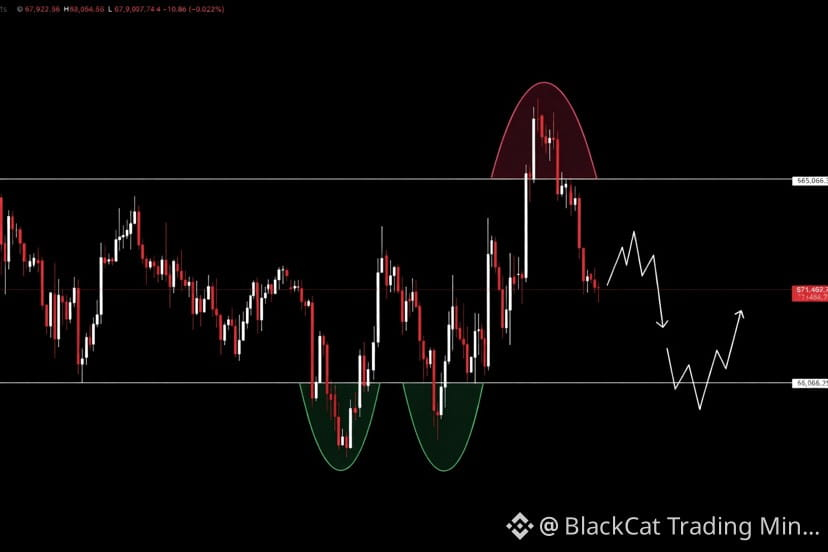
$BTC charts can tell part of the story, but when the market becomes uncertain, I tend to look at on-chain behavior. Large wallets often move earlier than the broader crowd, and their positioning sometimes reveals what price alone doesn’t show yet.
Earlier in the cycle, on-chain flows suggested that several large addresses accumulated aggressively when Bitcoin was trading near the 63,000 USD area. That zone appeared to act as a quiet accumulation pocket while sentiment across the market remained cautious.
Later, once price pushed beyond 70,000 USD, some of that supply began to move again. Distribution from large wallets during periods of stronger optimism is a behavior we’ve seen many times before. Smart money often builds positions while the market is uncertain and gradually releases supply when enthusiasm begins to rise.
What stands out recently is that signs of accumulation are starting to appear again. Certain on-chain metrics indicate that some large holders are adding Bitcoin after a previous phase of distribution. Structurally, this kind of shift often signals that the market may be entering another period of balance where supply is slowly being absorbed.
From a liquidity perspective, these phases tend to precede expansion rather than follow it. When large capital starts positioning again, the market frequently transitions into a quieter accumulation environment before volatility returns.
Psychologically, this stage is usually confusing for most participants. Price might not move aggressively, and sentiment remains mixed. But beneath the surface, positioning can already be changing as larger investors prepare for the next move.
Of course, on-chain signals are not a crystal ball. They don’t predict the future with certainty. But when looking back across previous cycles, renewed accumulation by large wallets has often coincided with periods where the market was quietly preparing for its next phase of volatility.
So the real question now is whether this accumulation marks the early preparation for a new upward expansion… or if the market still needs more time to absorb supply before the next major trend begins.
