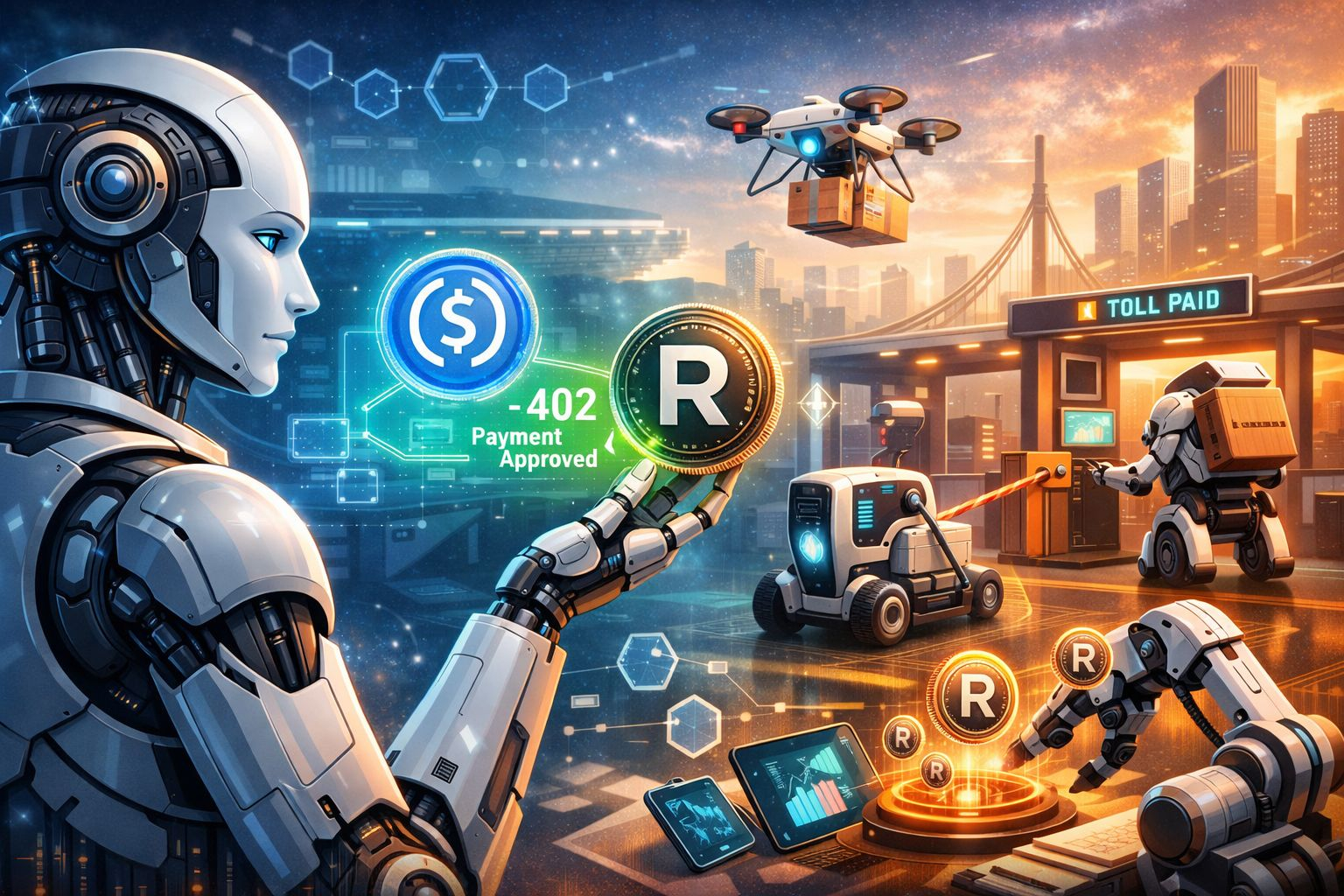
For a very long time, machines have lived a simple life in the human world. They were created to help us, to speed up work, to make difficult tasks easier. A robot in a factory could assemble thousands of parts in a day. A machine in a warehouse could lift heavy boxes that would exhaust a person. But no matter how advanced these machines became, they always remained tools. They worked because humans told them to work. They stopped when humans told them to stop. And when money was involved, it always passed through human hands first. Machines never earned anything themselves, and they never decided how resources should be spent.
But the world is slowly entering a moment where that old relationship between humans and machines is starting to change. Artificial intelligence is giving machines the ability to understand their surroundings, recognize objects, and even communicate with people. Robotics is becoming more flexible, allowing machines to move through environments that were once considered too complicated for them. At the same time, blockchain technology has created systems where identity, ownership, and payments can exist without needing a central authority to approve every action. When these different technologies begin to meet each other, something unexpected appears: the possibility that machines could participate in the economy themselves.
This idea might sound strange at first, almost like science fiction. Yet when you look closely, the foundations for it are already being built. One of the projects exploring this direction is Fabric Protocol and its ecosystem centered around the ROBO token. The goal is not simply to build another robot or launch another digital currency. The deeper idea is to create the infrastructure that allows intelligent machines to work, prove that they completed their work, and receive payment automatically. In other words, it is an attempt to create an environment where machines are not just tools but economic participants.
Interestingly, part of this story begins with something very small and almost forgotten. In the early days of the internet, engineers created a system of response codes for websites and servers. These codes are simple numbers that explain what happened when someone tried to open a page. Many people have seen the famous 404 error that appears when a page cannot be found. But there was another code created in the 1990s that almost nobody ever saw in action. It was called HTTP 402, and it simply meant “Payment Required.” The engineers who designed it imagined a future where websites and digital services could charge small automatic payments. Maybe reading an article would cost a few cents. Maybe accessing a piece of software would require a tiny payment before it responded. It was a clever idea, but at the time the internet simply was not ready. Online payments were slow and complicated, and the systems needed to support micro-transactions did not exist yet. So the code stayed there in the background of internet standards for almost thirty years, like an idea that arrived too early.
Now the world is different. Digital wallets exist. Blockchain payments can move instantly across the world. Programmable money allows software to send payments automatically. Because of these changes, the old idea behind that unused HTTP code is suddenly becoming possible again. Machines and software agents can now send payments to each other directly through the internet. It sounds like a small technical improvement, but it changes something fundamental. When a machine can pay for a service automatically, it begins to act less like a tool and more like an independent participant in a system.
Fabric Protocol is built around this realization. Instead of treating robots as isolated machines locked inside one company’s network, the protocol tries to create a shared digital environment where machines can communicate, coordinate work, and exchange payments. Today most robots exist inside closed ecosystems. A warehouse robot works only for the company that owns it. A delivery drone operates only within the system designed by its manufacturer. Even if there are thousands of robots in a city, they rarely interact with machines from other companies. Fabric imagines something more open. It tries to build a layer of infrastructure where robots from many different environments can connect to the same network, discover tasks, and cooperate with each other.
For that kind of system to work, machines first need something that humans already rely on every day: identity. A robot must be able to prove who it is, what capabilities it has, and what tasks it has completed in the past. In the Fabric ecosystem, robots receive cryptographic identities that exist on blockchain infrastructure. This identity allows the network to track the work performed by each machine and build a reputation over time. A robot that consistently completes tasks successfully becomes trusted by the system. Just like humans build reputations through their work history, machines can develop digital reputations that influence the kinds of jobs they receive.
At the center of the network is the ROBO token, which acts as the economic layer connecting all of these activities. The token is used for several purposes within the ecosystem. It allows robots and developers to interact with the network, pay for services, and participate in governance decisions about how the system evolves. Instead of economic activity flowing through a single centralized company, value can move through the network in a more open and distributed way. When robots perform useful work, payments can be handled automatically through the system. The token becomes part of the mechanism that allows machines, developers, and operators to exchange value without complicated intermediaries.
Once identity and payments exist inside the same system, an entirely new idea becomes possible. Machines could participate in a global marketplace for work. Imagine a robot finishing one task and immediately searching the network for another opportunity nearby. A delivery drone might complete a route and then accept a job inspecting rooftops or transporting a small package. A cleaning robot in a building might offer its idle time to perform tasks for another organization. Instead of being permanently tied to one company, machines could move between tasks based on demand, availability, and payment rates. The network would coordinate these interactions, verify that work was completed, and distribute payments automatically.
Of course, machines cannot operate in such an environment without advanced software that allows them to understand and navigate the real world. This is where the operating system called OpenMind OM1 becomes important. It is designed to give robots a flexible intelligence layer that combines multiple artificial intelligence models. Instead of relying on one single algorithm, the system allows robots to use different specialized models for different purposes. One model might help the robot see and recognize objects. Another might help it understand spoken language. Another might guide it safely through crowded spaces. Together these systems allow robots to interact more naturally with their surroundings and with the people around them.
What makes this operating system particularly interesting is the way it treats robotic abilities as modular skills. Developers can create new capabilities that robots can download and use, much like people download applications on their smartphones. One developer might design software that teaches robots how to sort packages efficiently. Another might create a skill for assisting elderly people in daily activities. Over time, these skills could form a global marketplace of robotic capabilities. When a robot uses a skill to complete a job, the developer who created that skill could receive part of the payment. This creates an incentive for developers to continuously improve the abilities of machines across the entire network.
There is also an important challenge that any robot economy must solve: proving that work was actually completed. If a robot claims it cleaned a building or delivered a package, the system must be able to verify that claim. Fabric explores cryptographic techniques that allow machines to prove they performed a task without revealing every detail about how it was done. These mathematical proofs can confirm the validity of work while protecting sensitive data. Because these calculations can be demanding, specialized hardware processors are being developed to perform them efficiently. The goal is to make verification fast and inexpensive so that millions of robotic tasks can be confirmed without slowing down the network.
Even with all these ideas in place, the path toward a true machine economy will not happen overnight. Technology evolves gradually, and robotics in particular depends on physical manufacturing, supply chains, and real-world testing. Building millions of intelligent machines that can safely operate in human environments is a challenge that takes time. Regulations, safety standards, and business adoption will all play roles in shaping how quickly these systems expand.
Still, the direction is becoming clearer. Machines are gaining intelligence, mobility, and connectivity at the same time. As these capabilities grow, the question is no longer whether robots will participate more deeply in economic activity. The real question is what kind of infrastructure will guide that participation. Some systems may remain centralized and controlled by large corporations. Others may experiment with open networks where many participants can contribute and benefit.
Fabric Protocol represents one attempt to imagine that more open future. It is an effort to build the digital foundation for a world where machines can work together, exchange services, and manage resources in ways that were previously impossible. In that future, robots might earn income from completing tasks, spend part of it on energy or maintenance, and save the rest to improve their capabilities. Humans would still play an essential role as creators, operators, and innovators, but the economic activity would extend beyond human workers alone.
It is still an early vision, and many pieces of the puzzle are still being built. Yet technological revolutions often begin quietly, long before they become visible to the rest of the world. The internet started as a small research network connecting a few computers. Today it connects billions of people. The idea that machines might one day connect to a shared economic network could follow a similar path. If the infrastructure continues to develop, the next transformation in technology may not just connect humans to information. It may connect machines to the global economy itself.
@Fabric Foundation #ROBO $ROBO