
Last month, I spotted a delivery robot freeze outside a loading bay. It had apparently arrived exactly on time. The bay door was automated, and the robot saw it. The door saw the robot. For seventeen minutes, they continued to not move as they engaged in a stare down, unable to pay each other to give access.
The door and robot were both functioning properly. The problem was just an economic protocol malfunction.
Stare enough times at the same economic protocol malfunction and you start to see the stalling gap behind it. It has become particularly visible as the world has become within reach for the AI systems for the first time.
AI now understands physical systems and environments and the hardware has progressed far enough to scale. It robs every sector. The modern robotics industry has reached an inflection point and is as labor lost as the AI systems. The secrets to their genius lie isolated within bodies that cannot economically interact.
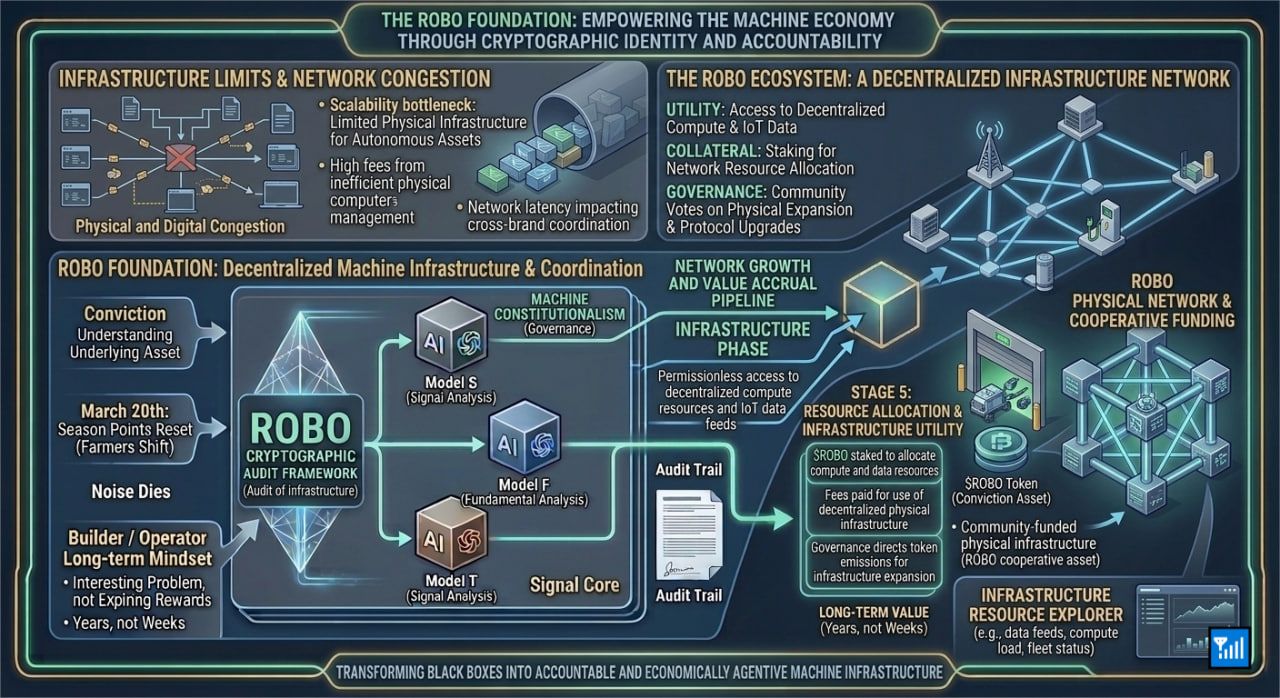
To be able to understand the model, we need to be able to understand what we are trying to control from the operational standpoint. From what we know, an operational model involves an owner/operator who single-handedly does the following: secures private funding, acquires the required technology, runs the business within their own company, performs direct bilateral contracting, and utilizes disjointed software to manage payment transactions. This in turn results in what is known within the industry as a structural mismatch, i.e. there is a global demand for automation, while access to robotic systems is limited to the financially privileged participants.
While humans are able to hold passports, open bank accounts, and contract, "robots" cannot do any of those things, and do not have the same rights. They have no means of banking, no means of having an identity, and no means of engaging in any of the economic activity that they "labor" to support.
What Robots Really Lack
Fabric Protocol is the first and only entity to figure out the real issue: what do machines need to be able to participate in an economy?
Three things. First, identity, and not just any identity, a globally recognized & verifiable identity so that all the world knows what kind of machine/robot it is, who the owner is, governance permissions and who the machine/operator is, what the historical activity (record) is. Second, an economy. This means for a machine robot to be able to participate in an economy, it needs a wallet. This is comprised of a set of cryptographic keys so that a machine/robot can receive payment, make payment, and enter into ( autonomous) self-executing contracts i.e. to code to sign without the need for a human to control it. Third, a means of facilitating self-control. This means that any robots/ machines of any kind can access the clearly defined (facilitated) governance, automated (self-operated) and position of control to all participants without the need for human oversight.
Also, a token, ROBO, that essentially provides all of the aforementioned control without required human oversight on all payments.
Why ROBO loses the Gap
The supply is capped at 10 billion, 24.3% goes to investors with a 12-month cliff and a 36-month linear vesting. The ecosystem receives 29.7% which rewards only through Proof of Robotic Work—verified not passive holders.
There are 3 structural demand drivers that create constant buying pressure that is related to real economic activity. Work bonds require $ROBO to be staked in order to register the hardware. The protocol revenue goes to buying the token on the open market. Governance participation requires ROBO be held for voting influence.
The people behind this have a very deep understanding of the gap. OpenMind was started by a Stanford University and Google DeepMind, by Stanford professor Jan Liphardt and MIT CSAIL researcher Boyuan Chen. With Pantera Capital, Ribbit Capital, Sequoia China and Coinbase Ventures, these are the builders of infrastructure who understand at the same time Robotics, AI and Crypto.
Robots don’t require better brains. They require better wallets and better identities to participate in the economy they are helping to scale.
$ROBO isn’t betting on more intelligent machines. They’re betting on machines that can finally transact.
The seventeen-minute stare was a preview of every bottleneck we haven’t yet learned to see. Fabric is building the infrastructure that makes those bottlenecks irrelevant.
The era of isolated machines is over. The era of autonomous, economically active robots has begun.