
In global financial markets, information moves prices. Every day investors analyze economic data to understand where the economy is heading. Among all economic indicators, employment data has one of the strongest influences on market behavior.
Sometimes job numbers are released and they look very different from what economists predicted. When this happens, markets react quickly and sometimes violently. Traders call this situation a JobsDataShock — a moment when employment data surprises investors and forces markets to rapidly reprice risk.
This phenomenon has become more visible in recent years because financial markets are now deeply connected to economic expectations and central bank policy.
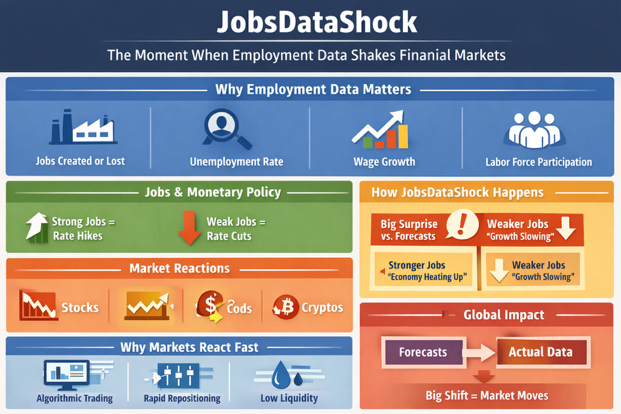
Why Employment Data Holds So Much Power
Employment reflects the real activity of an economy. When businesses hire workers, it usually means companies expect higher demand. More workers also means more income flowing into households, which increases consumer spending.
For this reason, job numbers provide a direct signal about the health of an economy.
One of the most closely watched labor reports is released every month and includes several key indicators that economists study carefully.
These indicators typically measure:
• how many jobs were created or lost
• the unemployment rate
• how wages are changing
• how many people are actively working or looking for work
Together these numbers create a detailed picture of the labor market. Because employment influences spending and production, the report becomes one of the most important economic signals for investors.
The Connection Between Jobs and Monetary Policy
Central banks closely watch employment conditions when setting interest rates.
Most central banks aim to balance economic growth with price stability. If the labor market becomes extremely strong, wages may rise quickly and push inflation higher. In this situation policymakers may increase interest rates to slow down economic activity.
However, if hiring begins to weaken and unemployment rises, central banks may lower interest rates to support economic growth.
Because interest rates influence borrowing costs, asset prices, and capital flows, even small changes in employment expectations can affect global markets.
This is why employment reports often trigger major market reactions.
How a JobsDataShock Happens
Before the employment report is released, economists and analysts publish forecasts based on available data. Financial markets gradually price in these expectations.
A JobsDataShock occurs when the actual report differs significantly from those forecasts.
If the numbers match expectations, markets may move only slightly. But if the data surprises investors, traders must quickly adjust their outlook.
There are generally two ways this shock appears.
Strong employment surprise
If job creation is much stronger than expected, investors may believe the economy is heating up. Strong growth could push inflation higher and force central banks to keep interest rates elevated.
Higher interest rates can reduce liquidity in financial markets, which sometimes puts pressure on risk assets.
Weak employment surprise
If hiring slows unexpectedly or unemployment rises, markets may interpret this as a sign that economic growth is weakening. Investors may begin to expect interest rate cuts to support the economy.
Both scenarios force markets to reprice expectations quickly, creating sudden volatility.
Market Reactions to JobsDataShock
When employment data shocks the market, the reaction spreads across multiple asset classes almost immediately.
Stock markets
Equity markets often move sharply because corporate profits depend heavily on economic activity. Weak job growth can raise concerns about slower consumer spending, while strong job growth may create fears of tighter monetary policy.
Technology and growth stocks are especially sensitive to these changes.
Bond markets
Government bonds react very quickly to employment surprises. If the data suggests economic weakness, bond yields may fall as investors expect interest rate cuts. Strong employment numbers can push yields higher if traders anticipate tighter policy.
Currency markets
Currencies also respond to changes in interest rate expectations. Strong labor market data can strengthen a country’s currency because higher rates attract global capital. Weak data can reduce currency demand.
Cryptocurrency markets
Digital asset markets have become increasingly connected to global liquidity conditions. When employment data suggests easier monetary policy, investors may increase exposure to risk assets such as cryptocurrencies. If interest rates are expected to remain high, crypto markets may experience pressure.
Why Markets React Within Seconds
Modern markets process economic information extremely fast. Several factors contribute to the speed of these reactions.
Algorithmic trading plays a major role. Many institutions use automated systems that instantly analyze economic releases. These systems compare the actual data with forecasts and execute trades within milliseconds.
Another factor is market positioning. Investors often take positions before the report based on expectations. If the numbers are different from what they predicted, traders must quickly change their strategies.
This sudden adjustment can amplify market movements.
Liquidity also matters. When fewer buyers and sellers are present, even small surprises can trigger large price swings.
Global Impact of Employment Surprises
Although employment reports are national statistics, their impact often spreads across global markets.
For example, changes in economic expectations in large economies can influence international capital flows and investor sentiment worldwide.
When employment data shifts expectations about interest rates in a major economy, investors across the globe adjust their strategies. Stock markets, commodity prices, and currencies can all react to these changes.
This interconnected system means that employment data released in one country can influence financial markets thousands of miles away.
Expectations Are What Move Markets
One important aspect of JobsDataShock events is that markets react to surprises rather than the numbers themselves.
If investors already expect strong employment growth, a strong report may not move markets much. But if the data turns out weaker than expected, the reaction can be significant.
The key factor is the difference between forecasts and reality.
When that difference is large, markets must rapidly adjust to new information.
The Future of JobsDataShock
The structure of the labor market is evolving as technology and automation reshape industries. Remote work, digital services, and artificial intelligence are changing how companies hire workers.
These changes may make employment trends more unpredictable. As forecasting becomes more difficult, the possibility of unexpected labor market data increases.
Because modern financial markets react instantly to new information, future employment surprises could continue to produce sharp market movements.
Conclusion
JobsDataShock reflects the powerful relationship between employment data and financial markets.
Labor market reports influence expectations about economic growth, inflation, and interest rates. When those expectations suddenly change, investors across the world respond immediately.
Stocks, bonds, currencies, and digital assets can all move within minutes of a single employment report.
In a financial system driven by information and expectations, employment data remains one of the most important signals shaping global market behavior.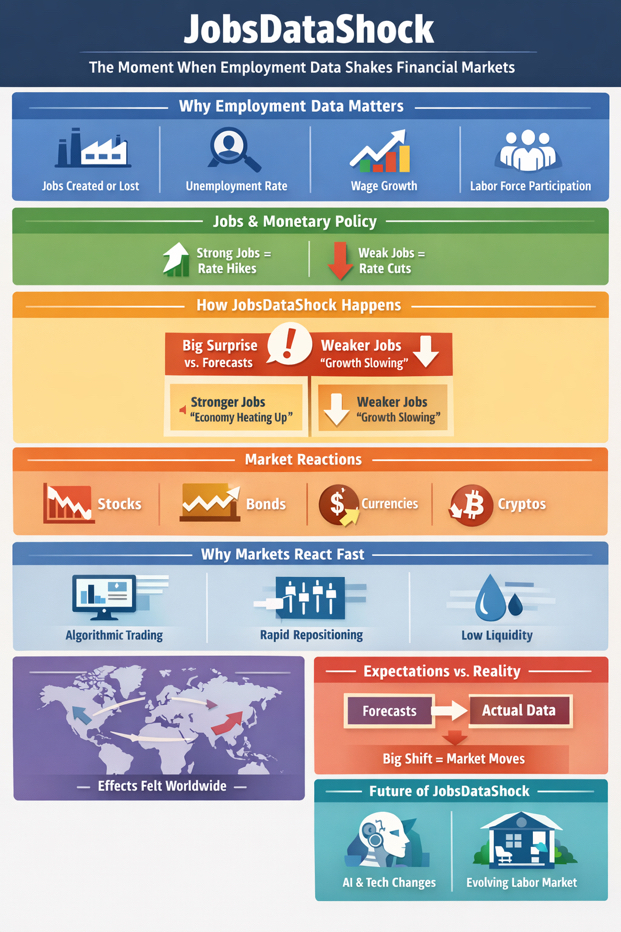
#JobsDataShock #CryptoShadowBull