
The conversation around artificial intelligence and robotics is getting louder every day. New breakthroughs appear constantly, and the idea of machines taking on more economic roles no longer feels like science fiction. But underneath all the excitement, there is a quiet structural problem that very few people are talking about.
Most discussions focus on what machines can do. We talk about smarter robots, autonomous agents, and AI systems capable of performing complex tasks. Yet capability alone does not build an economy. If intelligent machines are going to participate in real-world activity, they will need something deeper than software upgrades or hardware improvements. They will need an environment where their work can be coordinated, verified, rewarded, and trusted.
Right now, that environment barely exists.
Machines today mostly operate inside closed systems. A robot belongs to a company, an AI agent runs inside a private platform, and the value generated by those systems flows through centralized infrastructure. The result is a fragmented ecosystem where participation is limited, trust is dependent on private entities, and coordination between systems remains difficult. If the machine economy grows the way many people expect, this fragmentation could become one of the biggest barriers to progress.
That is the real problem hiding behind the current wave of excitement.
It is not simply about building better machines. It is about building the infrastructure that allows those machines to function within a broader economic system.
This is where Fabric Protocol begins to feel fundamentally different from most projects in the space.
Rather than approaching robotics as a standalone product story, Fabric approaches it as an ecosystem problem. The protocol is designed around the idea that intelligent machines will eventually need the same kinds of economic and coordination infrastructure that humans and digital platforms rely on today.
Machines will need identities.
They will need ways to receive tasks and prove that those tasks were completed correctly.
They will need payment systems that reward useful work.
They will need reputation systems that track reliability over time.
And they will need governance structures that keep the network open and trustworthy.
Fabric Protocol attempts to build that missing layer.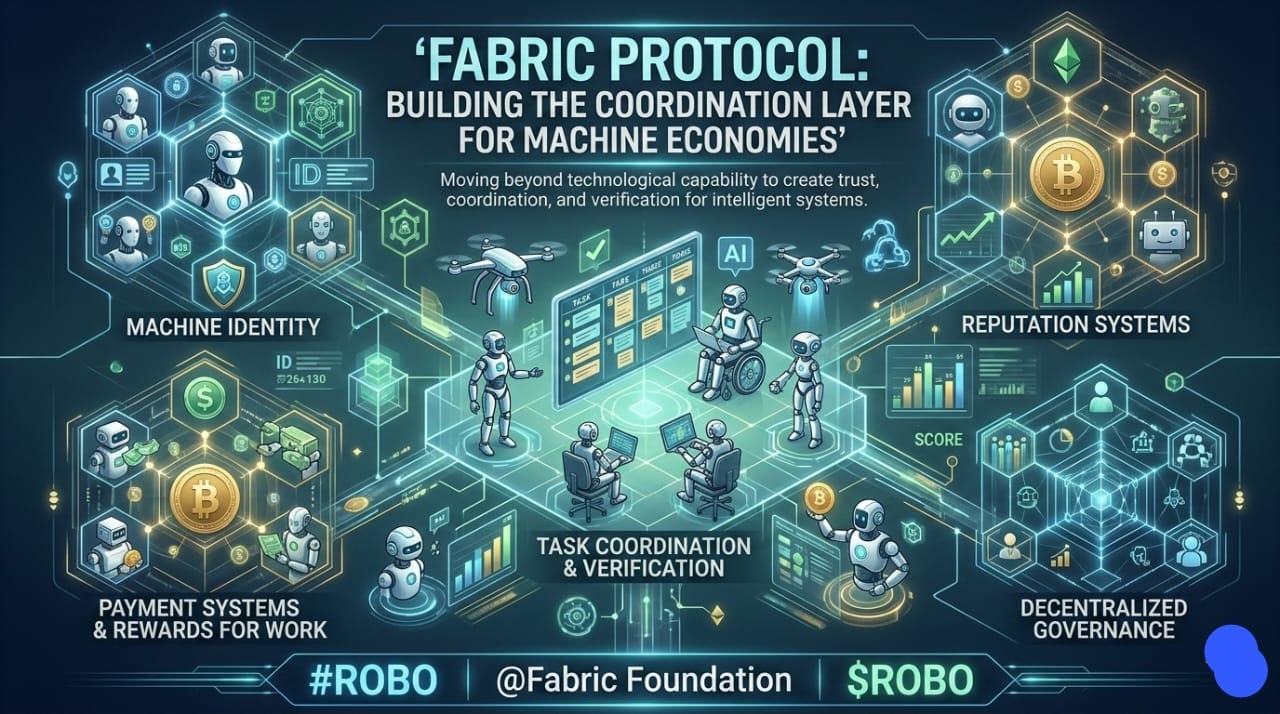
At its core, the project is not only about robots or AI agents themselves. It is about the system around them. It is about how machines interact with users, how work flows through a network, and how trust can be established in an environment where autonomous systems perform real economic activity.
In other words, Fabric is trying to build the coordination layer for machine economies.
That shift in perspective changes everything. Instead of focusing only on technological capability, the protocol focuses on economic structure. Builders, operators, contributors, validators, and users all become part of a shared network where value and information move through transparent infrastructure.
This approach treats machines not as isolated tools but as participants in a larger system.
And once machines start acting as participants rather than tools, new questions emerge.
Who verifies the work they perform?
How are rewards distributed across the network?
How do users trust the outputs of autonomous systems?
How do you prevent the entire ecosystem from being controlled by a few centralized platforms?
These are not flashy questions, but they are the ones that determine whether a technology ecosystem can scale in an open and sustainable way.
Fabric Protocol seems to recognize that early.
Instead of waiting for these coordination problems to appear later, the project is attempting to design infrastructure that anticipates them. The protocol combines ideas from decentralized systems, verifiable computation, and economic coordination to create an environment where machines and humans can collaborate within a transparent framework.
In that sense, Fabric feels less like an application and more like a set of rails — the underlying architecture that allows other systems to operate.
But building infrastructure is never easy.
The biggest ideas often come with the biggest execution risks. Designing a coordination layer for machine economies requires solving problems that are both technical and economic. The network needs to attract builders, developers, and operators while also maintaining trust and transparency as it grows. Incentives must be structured carefully so that useful work is rewarded and bad behavior is discouraged.
Adoption is another challenge.
Infrastructure only becomes valuable when people start building on top of it. Fabric will need a growing ecosystem of participants who see the protocol not just as an idea but as a foundation for real applications. That means creating tools, standards, and incentives strong enough to attract developers and contributors into the network.
These challenges should not be underestimated.
But they also highlight why the project stands out.
Many projects in the AI and robotics conversation focus heavily on narratives because narratives are easier to market. They promise revolutionary machines, futuristic automation, or dramatic technological leaps. Those stories capture attention quickly, but they often leave the deeper structural questions unanswered.
Fabric, by contrast, is engaging directly with those structural questions.
It is asking what kind of economic environment intelligent machines will need if they are going to operate at scale. It is asking how trust, accountability, and coordination can be maintained in a network where machines are performing tasks and generating value.
These questions push the conversation beyond technology and into system design.
And system design is where the long-term foundations of entire industries are built.
If the vision of machine-driven economies continues to evolve, the most important innovations may not come from the machines themselves. They may come from the infrastructure that allows those machines to interact with humans, exchange value, and operate within open networks.
Identity systems.
Task coordination layers.
Payment and reward mechanisms.
Verification and accountability frameworks.
All of these elements will become essential once machines are no longer isolated tools but active participants in both digital and physical economies.
That is the future Fabric Protocol appears to be preparing for.
The project is not simply betting on robots becoming more capable. It is betting on a world where intelligent machines become economic actors — systems that perform work, earn rewards, and interact with broader networks of users and contributors.
If that world emerges, the infrastructure behind it will matter just as much as the machines themselves.
That is why Fabric Protocol continues to attract attention.
Not because it fits neatly into a trending narrative, but because it is trying to build something deeper: the coordination layer that could allow machine economies to exist in the first place.
Whether the project fully succeeds will ultimately depend on execution, community growth, and real-world adoption. Those are the metrics that determine whether an infrastructure vision becomes reality.
But even now, the direction is clear.
Fabric is not just asking what intelligent machines can do.
It is asking what kind of system they will need in order to participate in the world.And that question might turn out to be one of the most important ones in the entire robotics conversation.
