
I have spent years working with blockchain systems and one question kept coming back to me in different forms. How do you create accountability in a decentralized network when there is no central authority to enforce it? In software, you can audit logs. In smart contracts, you can inspect transactions. But what happens when the actor is not a person or a program but a physical machine operating in the real world?
That question sat with me for a long time before I started looking at Fabric Protocol seriously.
Most people in this space focus on the token. I looked at the infrastructure problem first because that is where the actual design challenge lives.
Here is what the world looks like right now. Robots operate in closed loops. A warehouse robot from one manufacturer cannot share data, coordinate tasks, or transact with a robot from a different manufacturer. Every machine is a siloed asset. It completes a job and then its history disappears. There is no record that persists. There is no identity that travels with the machine. There is no economic layer that lets it participate in anything beyond the specific system it was built for. From an architecture perspective, that is a fundamental isolation problem and it scales badly.
Fabric Protocol is built entirely around solving that problem.
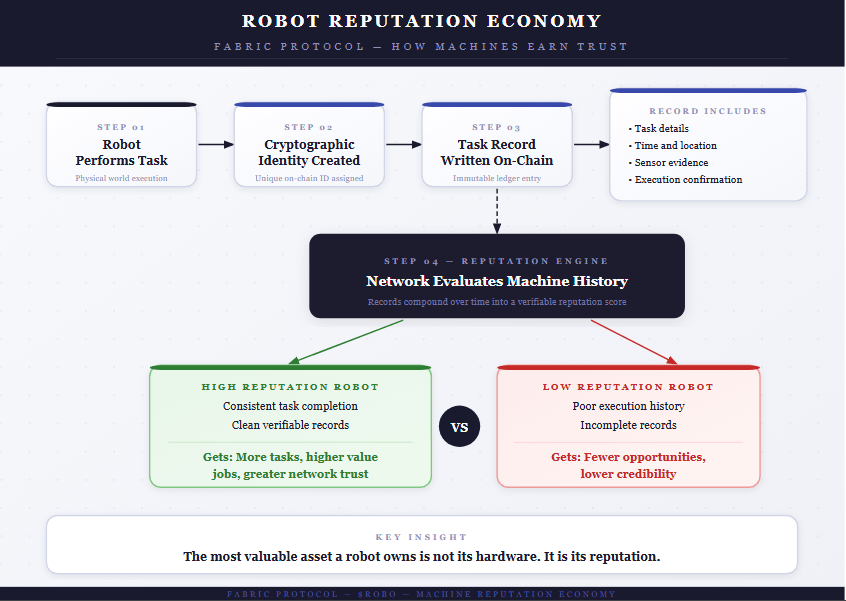
The foundation of what Fabric does is give every robot a cryptographic identity. Not a label. Not a database entry inside some company's closed system. A verifiable on-chain identity that persists globally and travels with the machine regardless of who owns it or where it operates. Every task that robot performs creates a record. Task details, time, location, sensor evidence, execution confirmation. All of it written into the network ledger, inspectable by other nodes, verifiable by anyone participating in the protocol.
Over time those records compound into something I find genuinely interesting from a systems design perspective. A reputation layer for machines.
In human economies, reputation is how trust scales without central authority. A contractor with ten years of verified project completions gets better jobs than one with no track record. A supplier with consistent delivery history commands better terms. Reputation is the infrastructure that allows economic coordination between strangers. Fabric is building the same thing for robots. A machine that consistently completes tasks correctly builds a verifiable score. One with incomplete records or poor execution history has lower credibility. Opportunities flow toward proven reliability. That is not a speculative feature. That is how mature economic systems actually work and nobody has built it for physical machines before.
The economic layer underneath this is what makes it durable. Fabric runs on a Proof of Contribution model, meaning rewards flow to verified real-world work: task completion, skill development, data contributions, compute, and validation. This is not passive staking against a theoretical future. It is incentive alignment tied to actual machine activity. Developers and businesses who want access to the robot network stake ROBO to participate, keeping their interests bound to the long-term health of the system. A portion of protocol revenue is used to acquire ROBO on the open market, creating consistent structural demand tied to network usage rather than speculation.
The OM1 universal operating system layer is where this becomes practically significant for builders. Different robot manufacturers, UBTech, AgiBot, Fourier, and others, can plug into the same coordination layer. They share intelligence, execute on-chain transactions, and verify their actions through the same protocol regardless of their underlying hardware. That interoperability is what breaks the isolation problem. It is the difference between a collection of siloed tools and an actual network.
I want to be honest about where this sits right now. Fabric recently listed on Binance in March 2026, graduated from the Alpha pool, and raised twenty million dollars led by Pantera Capital. The project is early. Real deployment at scale, operational maturity, insurance frameworks, and service reliability are still open challenges. Over eighty percent of the token supply is locked and subject to future vesting. The road to a machine-native Fabric L1 blockchain is still ahead. These are real risks and anyone treating this as a finished product is reading it wrong.
But here is what I keep coming back to. The problem Fabric is solving is not manufactured. It is structural. As robots move into warehouses, hospitals, logistics networks, and public spaces at scale, the question of who authorized this machine, what is its history, can its actions be verified, becomes urgent in a way that no existing system is equipped to answer. Current institutions and payment rails were not built for machine participation. Fabric is building the rails before the traffic arrives, which is exactly when infrastructure gets built if it is going to matter.
The most valuable asset a robot will carry in the next decade is not its sensors or its processing power. It is its verified record of reliable action. Fabric is the first serious attempt I have seen to make that record real, public, and economically meaningful.
That is why I am watching it.
Not financial advice. This is an architect thinking out loud about infrastructure that does not exist yet but probably needs to.
$ROBO #ROBO #FabricProtocol #BinanceSquare #DePIN #Blockchain