
Over the past few weeks, I’ve been spending time reading through the documentation and technical discussions around @Fabric Foundation , especially the ideas connected to $ROBO . One thing I’ve noticed is that the conversation around robotics and blockchain often gets framed in a very speculative way. In my view, the real question isn’t whether robotics will grow it clearly will. The deeper question is whether a protocol like Fabric can actually provide meaningful infrastructure for that ecosystem, or whether the narrative is simply being tokenized without delivering real operational value.
From what I’ve studied so far, the design thinking behind Fabric feels more infrastructure oriented than many projects I’ve seen. Instead of focusing purely on token demand, the protocol seems to explore how robotics networks could interact with verifiable systems of record. Robotics environments produce enormous amounts of operational data movement logs, sensor feedback, task verification, and machine performance metrics. My take is that the Fabric approach attempts to treat this data not just as information, but as verifiable economic signals. When these signals are anchored to an on chain structure, they can potentially create transparent ledgers of robotic activity that different actors developers, operators, and service providers can trust without relying entirely on centralized oversight.
Another detail I find interesting is how incentives are framed around accountability. Robotics systems operating in real environments introduce liability, reliability requirements, and verification challenges. Fabric’s architecture appears to explore mechanisms where actions can be logged, validated, and potentially bonded through economic guarantees. If implemented correctly, this could shift incentives away from pure speculation and toward measurable contribution within robotic infrastructure networks. Short term hype may still exist in the market, but the underlying mechanism aims at something more durable: aligning economic incentives with verifiable machine behavior.
Of course, I’m still approaching the thesis carefully. Robotics infrastructure is incredibly complex, and integrating it with decentralized systems introduces both technical and governance challenges. Still, the idea that protocols like @Fabric Foundation might act as coordination layers for robotic networks is worth examining seriously. If robotics becomes a core part of future economic systems, the question of who records, verifies, and governs machine activity will become increasingly important.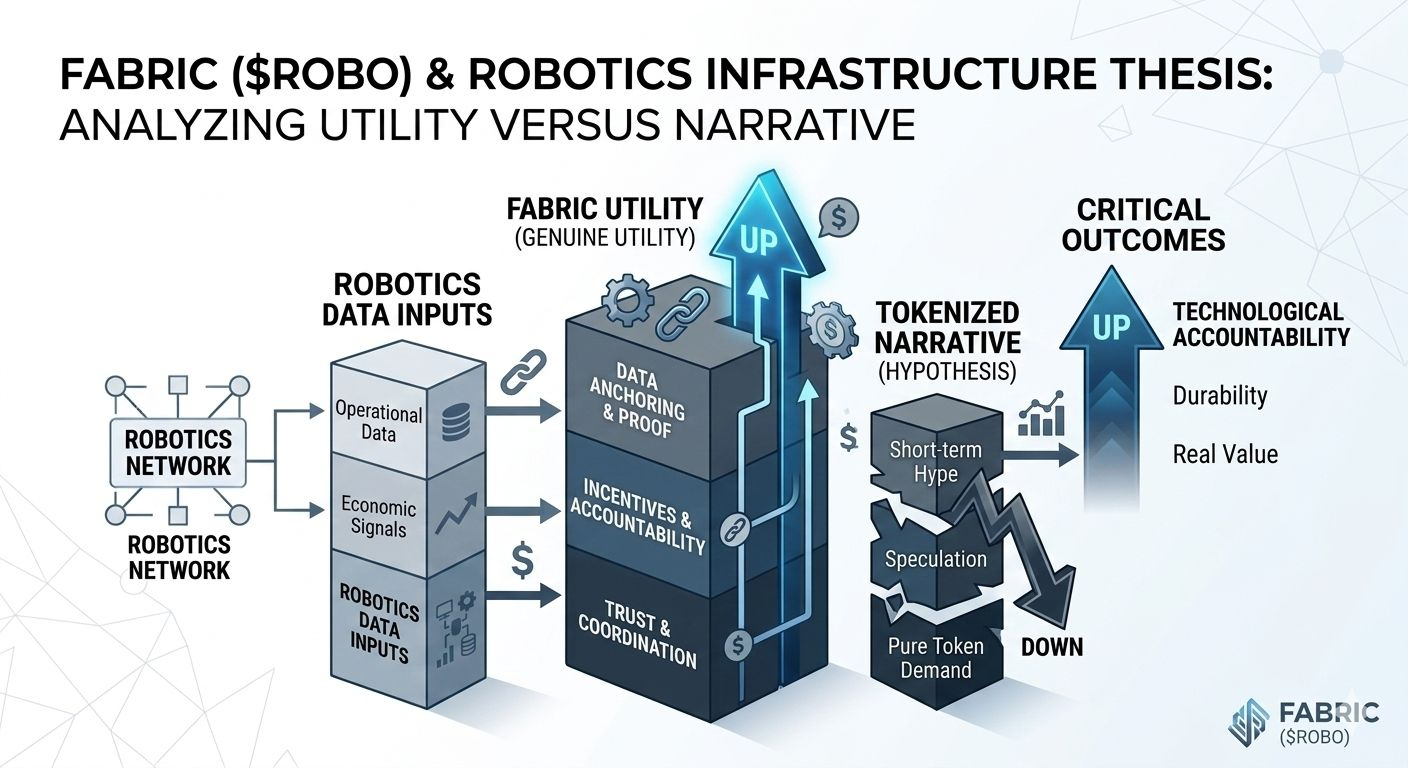
My broader reflection is this: trust in a machine driven world won’t come from marketing narratives alone. It will come from systems that make actions verifiable and responsibility traceable. If $ROBO and Fabric can contribute to that kind of infrastructure, the conversation moves beyond tokens and toward genuine technological accountability.
What do you think are we looking at the early foundations of robotic infrastructure, or just another narrative cycle forming around automation?