

I used to think permission was mostly a software problem, the kind of thing you solve with a role, a setting, or a clean audit trail. My view of it changes when I look at ROBO and the Fabric Protocol. In that setting, permission is not just about whether a person can open a file or query a table. It becomes a question of whether a machine can act in the world, who is allowed to authorize that action, what rights come with participation, and whether any of that can be checked later without asking people to rely on memory or trust alone. That is really where Fabric Protocol becomes relevant. The project is built around the idea that as intelligent machines move out of software and into physical environments, they need governance, identity, and coordination systems that are visible enough for humans to inspect, question, and shape. The whitepaper does not describe that as a side issue. It treats it as part of the core design. Fabric is presented as a public protocol for building, governing, and evolving ROBO, with data, computation, and oversight coordinated through immutable public ledgers rather than hidden inside closed systems.
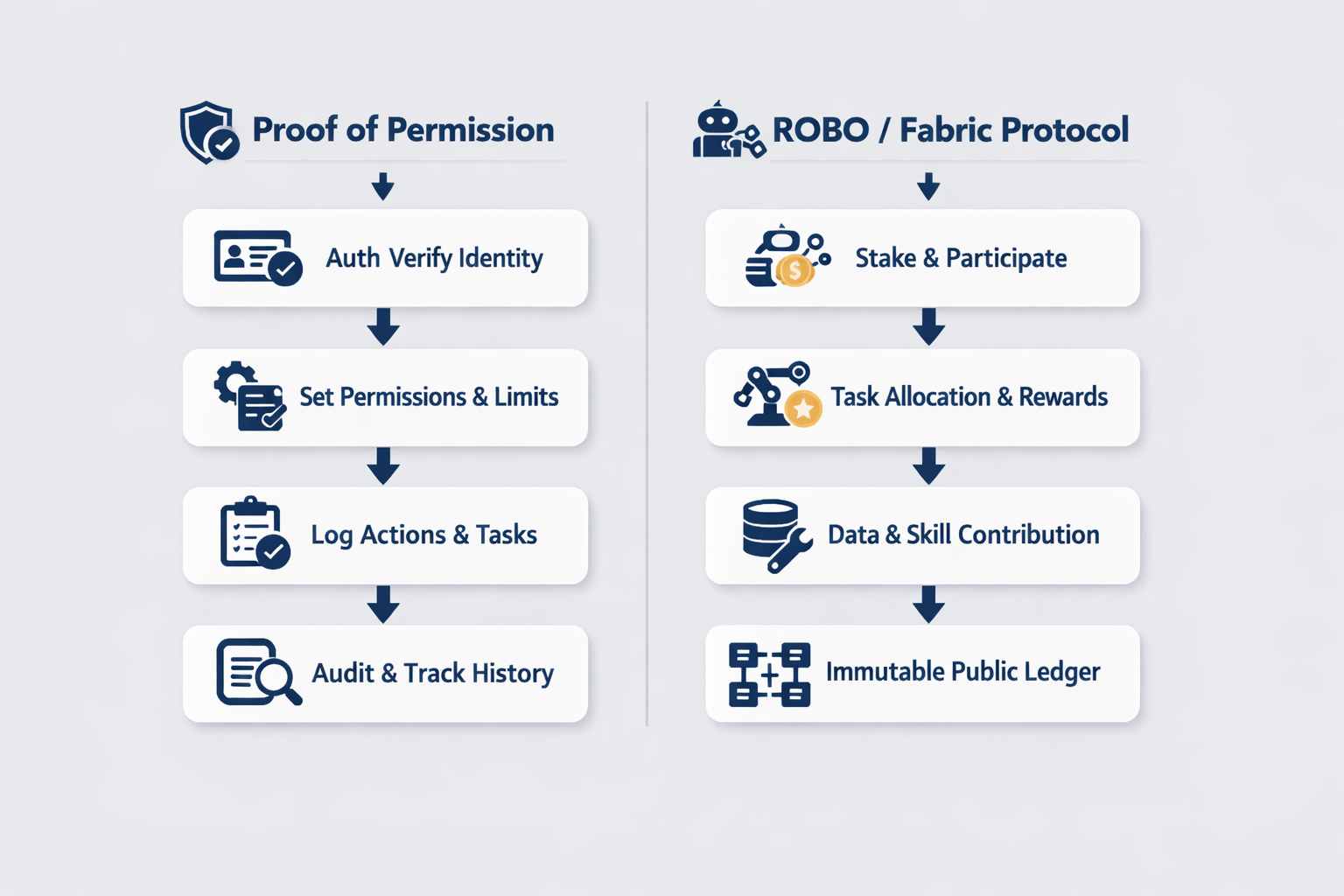
Once I look at it that way, “proof of permission” stops sounding like a narrow compliance phrase and starts sounding like a basic condition for trust. Fabric’s own framing is that robots need a persistent identity that can be verified globally. The world needs to know what the robot is, who controls it, what permissions it has, and what its historical performance looks like. I find that point unusually important, because it moves permission out of the background and makes it part of the public record of machine behavior. In Microsoft Fabric, proof of permission is mostly about proving who could access data. In Fabric Protocol, the stronger version is proving who or what can act, under which rules, with what history attached. That makes ROBO relevant not as a branding detail, but as the concrete object the protocol is trying to govern: a general-purpose robot whose capabilities, task rights, and evolution are meant to sit inside a system people can observe rather than merely trust.
The role of $ROBO fits into this more cleanly than people sometimes assume. It is described by the Foundation as the utility and governance asset for the network, used for payments, identity, verification, participation, and setting operational policies. What matters for this article is not the token price or market story. It is the fact that Fabric is trying to tie permission to verifiable participation. Builders may need to stake in order to enter the ecosystem. Participants who help coordinate early robot deployment can receive priority access weighting for task allocation. Rewards are meant to flow to verified work such as skill development, task completion, data contributions, compute, and validation. That creates a chain between approval, contribution, and consequence. At the same time, the protocol also draws hard limits around what permission does not mean. The Foundation states that participation does not equal ownership of robot hardware, revenue rights, or equity in the legal entities behind the network. I think that distinction matters a lot. It is the difference between access to protocol functions and a vague promise people can read too much into.
What makes this angle timely is that the Fabric Foundation is openly responding to a shift people can already see: AI is no longer staying inside chat windows and code tools. It is moving into machines that operate in warehouses, hospitals, streets, and other real environments. The Foundation’s public materials say current institutions and payment rails were not built for machine participation, and that without new governance frameworks we risk misalignment, concentration of power, and poor accountability. I think that is why permission now gets discussed in a more serious way. When software makes a mistake, the damage is often contained. When a robot acts with the wrong authority, the question becomes physical, economic, and social all at once. Fabric’s answer, at least in design, is to make identity auditable, participation structured, contribution traceable, and oversight more public than private systems usually allow. It is still early, and the Foundation says as much. Real deployment, operational maturity, insurance, and service reliability are still open challenges. But if you want ROBO/Fabric Protocol to matter in this article, that is the strongest way to frame it: permission is no longer just an admin setting. It is becoming the evidence trail that tells us whether machines are acting with legitimate authority, within real limits, and under rules humans can still examine.
@Fabric Foundation #ROBO #robo $ROBO
