
I noticed something odd the first time I watched ROBO start trading on centralized exchanges. The charts looked energetic, almost impatient. Candles moving fast, liquidity jumping between price levels, traders clearly curious. But underneath that energy was a quieter question that kept returning: how do you trade a brand-new token safely when the market itself is still trying to understand what it is?
Right now ROBO is trading around $0.039, with a market cap near $88 million and about 2.23 billion tokens circulating out of a 10 billion supply. Those numbers sound simple, but they reveal structure. A circulating supply of roughly 22% means most tokens are still locked or scheduled for release later. That creates a subtle pressure in the background. Even if price looks stable in the short term, future unlocks can quietly reshape supply.
Price behavior since listing shows how fragile early liquidity can be. Within its first active trading window the token moved between roughly $0.033 and $0.042, which is about a 25% range inside a single day. On the surface that looks like normal crypto volatility. Underneath, it usually means order books are still thin. When liquidity is shallow, even a few hundred thousand dollars of market orders can push price several percent in seconds.
That leads to the first quiet rule of trading new listings on centralized exchanges: the order book matters more than the chart.
Most traders focus on the candle chart because it feels familiar. But in early markets the real story sits inside the bid and ask layers. If you open the depth chart on exchanges where ROBO is listed and you see only a few hundred thousand dollars supporting each level, that tells you something important. A single aggressive buyer can lift price quickly, and a single large seller can unwind that move just as fast.
Volume statistics reinforce that point. Recent data shows about $65 million in 24-hour trading volume, which is unusually high relative to the project’s $88 million market cap. That means nearly three-quarters of the market cap traded in a single day. High turnover like that often appears in newly listed tokens. It signals speculation more than long-term positioning.
On the surface, high volume looks healthy. It suggests interest and liquidity. Underneath, it can also mean traders are flipping positions quickly rather than building conviction. Understanding that distinction helps explain why prices often spike and retrace repeatedly during the first weeks after a listing.
Centralized exchange listings amplify that effect.
When a token appears on platforms like Bybit, KuCoin, Gate, or HTX, visibility increases instantly. Thousands of traders who never interacted with the project before suddenly see the ticker in their markets list. That creates what you might call discovery volatility. People are not just trading the token. They are trying to figure out what the token should be worth.
Compare that with something like Bitcoin or Ethereum. Their price ranges are wide, but the underlying liquidity is deep. A $5 million market order barely moves those markets. With newer assets like ROBO, that same order could shift price several percentage points.
Understanding this difference is the foundation of trading safely.
One practical approach many experienced traders use is position sizing. Instead of entering a full position immediately, they build exposure gradually. If a trader wants $10,000 worth of ROBO, they might start with $2,000. If the market stabilizes and liquidity thickens, they add more. This isn’t about predicting the market. It’s about respecting uncertainty.
Another layer of safety involves the type of order you use.
Market orders look convenient. You click buy and the trade executes instantly. But in a thin order book that convenience can become expensive. If the nearest sell orders sit several price levels higher, your trade will climb those levels automatically. Suddenly the execution price is several percent above the chart’s last candle.
Limit orders avoid that problem. You choose the exact price you are willing to pay. The trade executes only if the market comes to you.
There is also a quieter structural risk many traders ignore in new tokens: liquidity rotation.
Right now the broader crypto market is still rotating capital between themes. Some weeks AI tokens attract attention. Other weeks it shifts back to infrastructure or layer-2 ecosystems. The robotics narrative that surrounds ROBO sits somewhere between AI and machine infrastructure. That narrative can attract sudden bursts of capital, but it can also fade temporarily if the market’s attention moves elsewhere.
If that rotation happens, even strong projects can drift sideways.
And that brings up the most important context for any discussion about trading ROBO right now. The token is newly listed and extremely volatile. Early price discovery periods often exaggerate both optimism and fear. A rally might look like the start of a long trend, when in reality it is just the market exploring liquidity pockets.
Early signs suggest that discovery phase is still underway. The fully diluted valuation sits near $394 million, while the circulating market cap is about $88 million. That gap exists because most tokens have not entered circulation yet. If unlock schedules accelerate later, the market will have to absorb additional supply.
None of this makes the project weak. It simply means the structure is still forming.
Interestingly, the broader robotics token sector currently holds a total market capitalization of roughly $736 million, placing ROBO among the more visible assets in a relatively small niche. That context matters because narrative markets tend to expand together. If the robotics narrative grows, liquidity could spread across the entire category.
But if the sector cools, smaller tokens feel it first.
So trading ROBO safely on centralized exchanges is less about finding the perfect entry and more about understanding the environment you are operating in. Thin liquidity, high turnover, incomplete supply distribution, and narrative-driven capital flows all exist at the same time.
When those forces interact, the market becomes unpredictable.
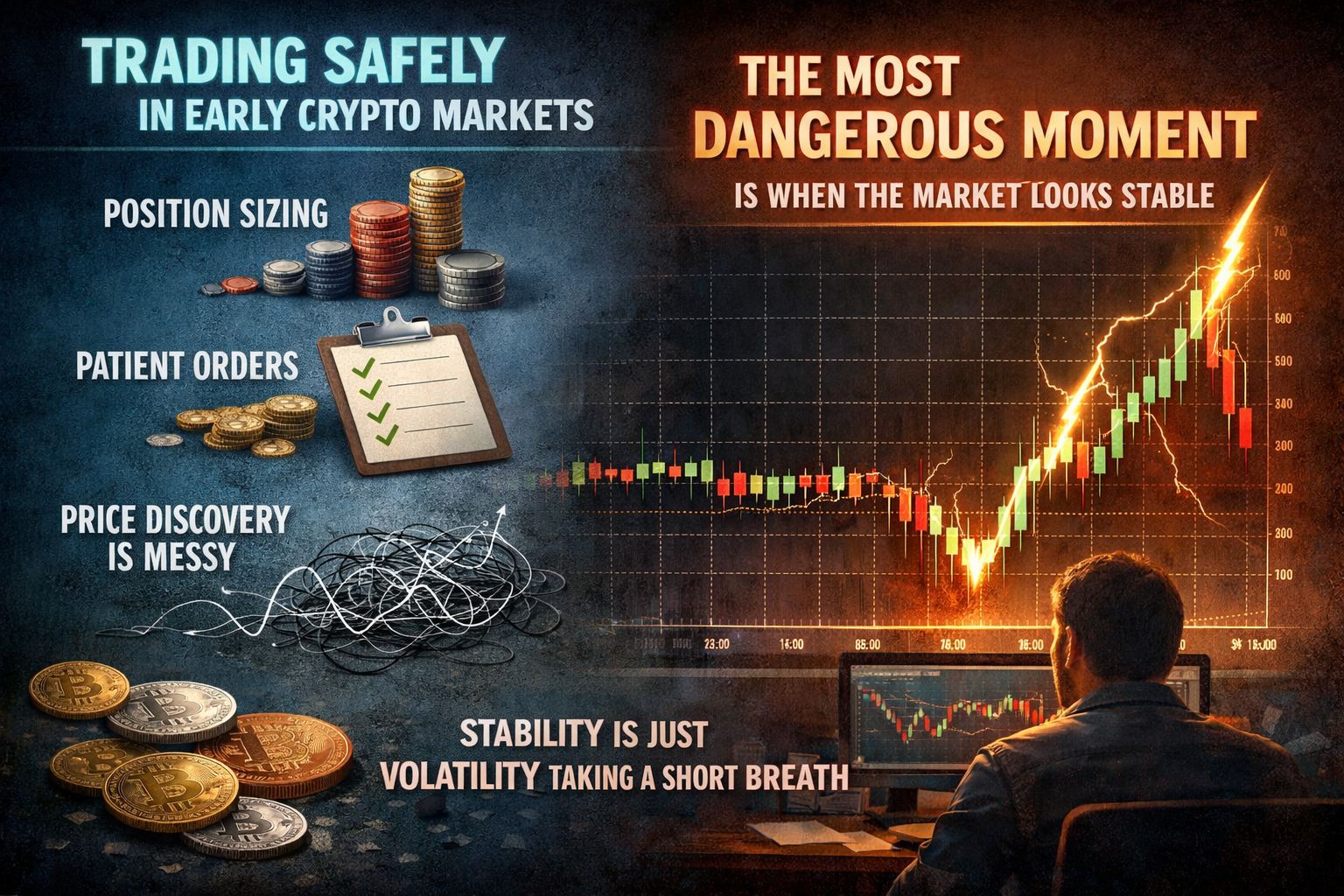
And maybe that’s the real insight hidden inside the question of trading safely. In early crypto markets, safety rarely comes from certainty. It comes from structure. Position sizing, patient orders, and a willingness to accept that price discovery is messy.
After watching the chart for hours, the conclusion feels almost obvious. The most dangerous moment in a new listing is when the market starts looking stable. Because stability, in the early life of a token, is often just volatility taking a short breath.#robo $ROBO @Fabric Foundation $PEPE $ALCX