
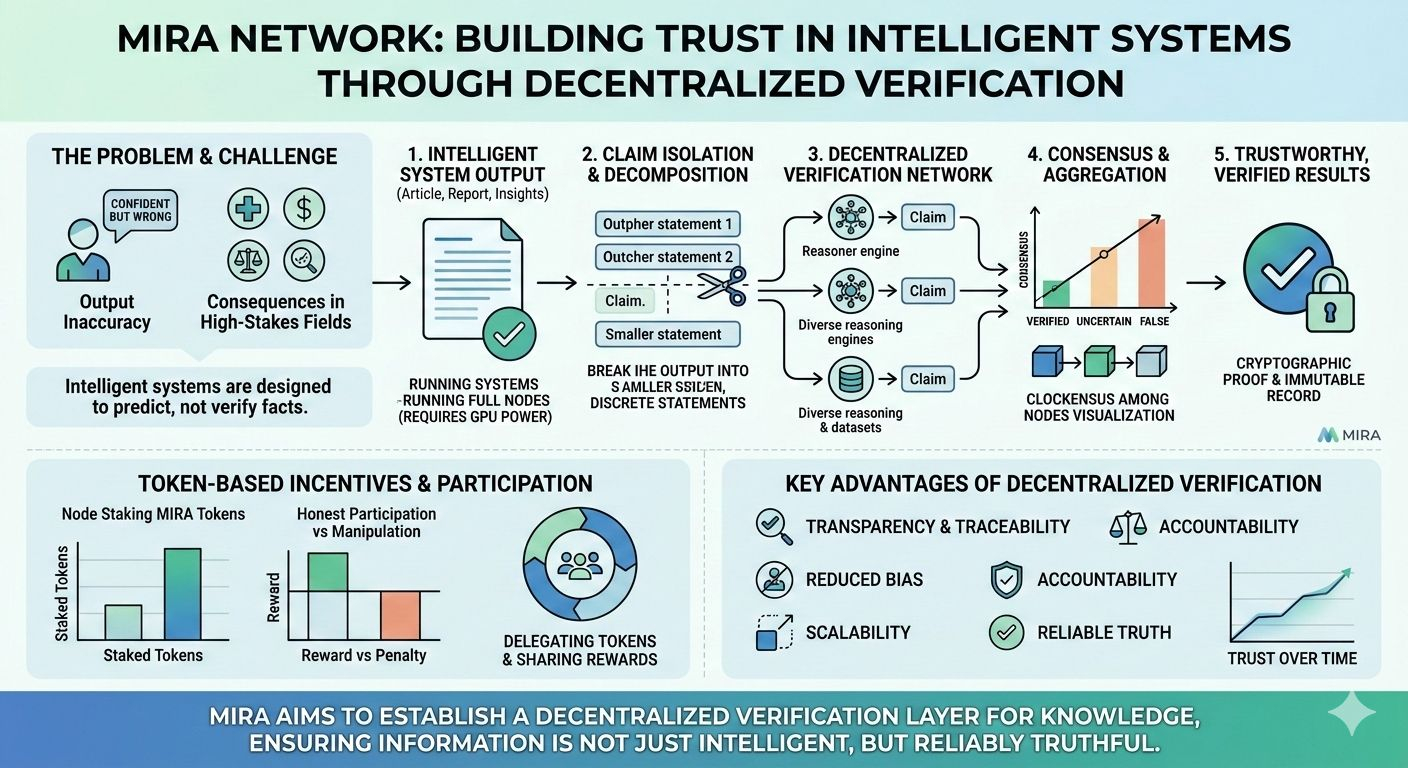
In the past few years, intelligent systems have quietly woven themselves into the fabric of our daily lives. They help draft emails, summarize complex reports, generate fresh ideas, analyze markets, and even assist in research or medical studies. It can feel like having an invisible, tireless assistant ready to answer whenever needed. Yet beneath this impressive capability lies a subtle, uncomfortable reality: these systems do not inherently understand truth. They are designed to predict patterns, not verify facts. That means they can sometimes produce answers that sound confident, detailed, and persuasive, yet contain inaccuracies or even entirely fabricated details. Many of us have experienced that strange moment of reading a polished, logical response only to later discover that some of the “facts” don’t hold up.
This challenge of reliability is critical. In high stakes environments healthcare, finance, law, and research an error, however small, can ripple into serious consequences. A wrong medical insight, a misinterpreted market signal, or an invented research reference can create real-world harm. Because of this, organizations hesitate to rely entirely on automated reasoning without some form of human oversight.
Mira Network was created to address this fundamental problem from a bold new angle. Instead of just building bigger, faster, or more complex systems, Mira constructs a decentralized verification layer a trust infrastructure for intelligent outputs. In essence, it brings the principles of blockchain consensus into the world of knowledge verification. Rather than depending on a single authority, model, or company to determine what is true, Mira relies on a distributed network where multiple participants collectively verify claims.
Here’s how it works. Normally, when a system generates a response, it delivers it immediately to the user, regardless of its factual accuracy. Mira adds a crunchy verification step in between. Before any information is presented, it is broken down into smaller, discrete claims. A single paragraph may contain multiple statements, and each is extracted and treated as a standalone fact that can be independently examined. By slicing complex content into verifiable pieces, the network creates a foundation for precision and scrutiny.
Once these claims are isolated, they are dispatched across a decentralized network of verification nodes. Each node, often running diverse reasoning engines and datasets, evaluates the claims independently. This multi node, multi model process ensures a diversity of perspectives and reduces the risk of centralized bias or error. Each node records its judgment on whether a claim appears credible, uncertain, or false.
The network then aggregates these assessments to form a consensus. If most nodes agree a claim is solid, it is marked as verified. Disagreement or insufficient consensus flags a claim as uncertain or unreliable. This process mirrors blockchain logic: just as a ledger confirms transactions only when consensus is reached, Mira confirms pieces of knowledge only when multiple independent participants validate them.
Transparency is central to the system. Every verified claim carries cryptographic proof, creating an immutable record of how it was evaluated, which nodes participated, and how consensus was achieved. Users no longer need to rely solely on polished-sounding responses; they can trust in a traceable, accountable process.
To encourage integrity, Mira integrates a token-based incentive structure. Verification nodes stake the network’s native token, MIRA, as collateral. Nodes that consistently deliver accurate verification are rewarded, while those that attempt to manipulate outcomes risk losing their stake. This alignment of economic incentives with truth seeking ensures the system remains honest and resilient.

Participation in Mira is flexible. Running full verification nodes demands significant computational power, including GPUs capable of heavy workloads. Some participants operate these nodes directly, while others support the network by delegating tokens or resources. Rewards are shared among contributors, fostering a community driven, decentralized ecosystem that scales organically.
Beyond the technical mechanisms, Mira represents a philosophical shift in how society interacts with intelligent systems. For decades, the focus was solely on making machines more capable, faster, and smarter. Now, as these systems increasingly influence critical decisions, intelligence alone is insufficient. Society also requires mechanisms that ensure outputs are trustworthy, verifiable, and accountable.
Mira is building this trust infrastructure. Just as the internet connected the world and blockchain revolutionized decentralized finance, Mira aims to establish a decentralized verification layer for knowledge. Outputs from intelligent systems are no longer isolated answers; they become traceable, verified facts, backed by a network of independent evaluators.
If fully realized, this model could transform how autonomous systems operate. Intelligent agents could analyze complex datasets, manage supply chains, negotiate digital contracts, or conduct research while continuously verifying their conclusions through a decentralized consensus framework. Human oversight would remain important, but the system itself would be built around accuracy, accountability, and transparency.
Of course, the road ahead is complex. Truth is fluid, sources conflict, and decentralized networks face risks from manipulation or inefficiency. Continuous refinement, research, and robust testing will be essential.
Yet Mira captures a pivotal moment in technological evolution. Power without reliability can only take us so far. As machines influence more decisions in society, the ability to trust what they produce becomes paramount. Mira Network is a first step toward building that trust combining decentralized verification, economic incentives, and multi perspective validation to create a system where information is not just intelligent, but reliably truthful.
