
When I first started researching @Mira - Trust Layer of AI I began to treat AI as an economic system rather than a miracle. I ran experiments and I read the protocol notes and the whitepaper. I watched small queries go to lightweight models and I watched complex problems escalate only when consensus required deeper compute. That change in perspective made me stop chasing raw GPU counts and start measuring unit economics. It made me see where real profit hides inside verification fees and routing efficiency.
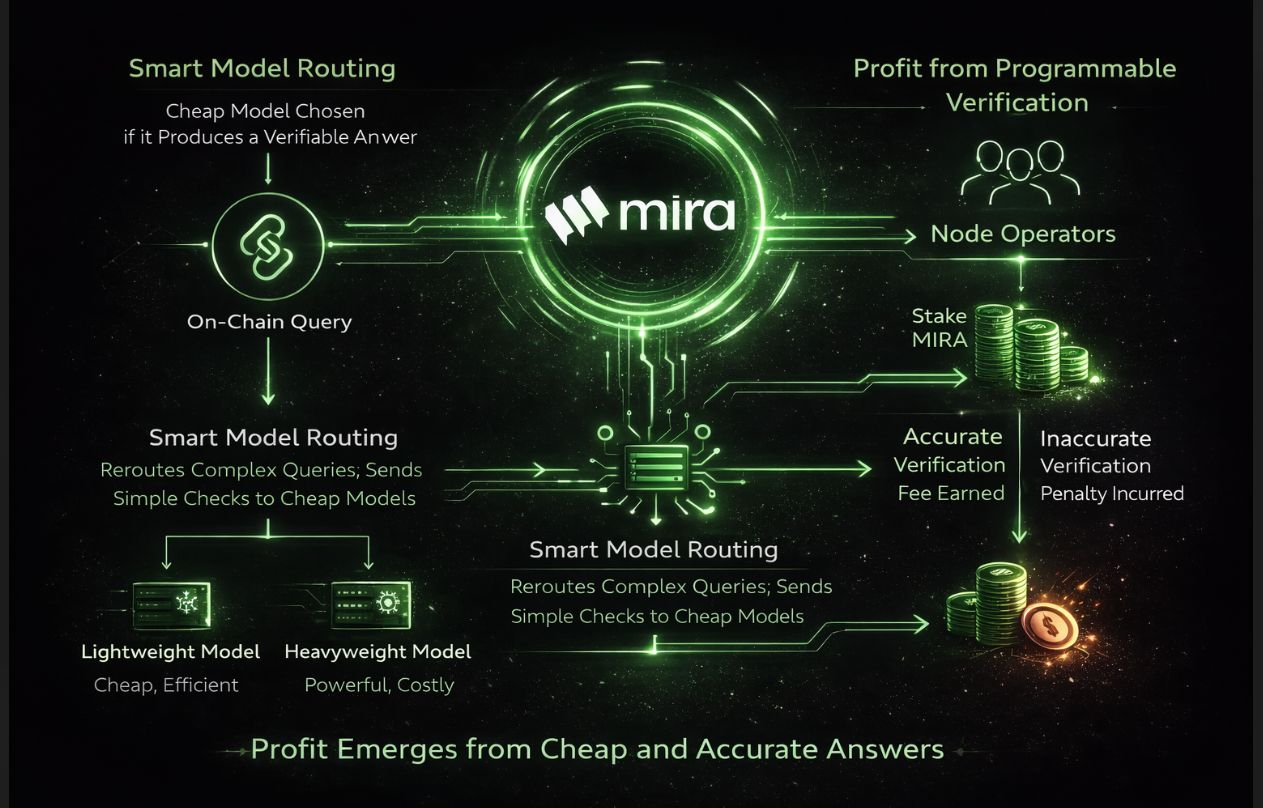
Real profit in crypto isnt won with the biggest supercomputers its won by answering questions cheaply and correctly. This is the hook that matters to anyone who runs infrastructure or studies onchain economics. Running a huge model all the time wastes capital and energy. The operators who win are the ones who treat each query like a small business decision. They ask what is the cheapest model that still produces a verifiable answer. They design routing that reserves heavyweight compute for a tiny fraction of traffic that truly needs it. This is not guesswork. Mira implements smart model routing and load balancing so operators can program those choices into the network and measure the savings.
Profit emerges from margin not from headline compute. Node operators stake $MIRA to participate. They earn fees when their verifications are accepted by consensus. They face slashing when their outputs deviate from the network consensus. That means accurate honest verification is rewarded and lazy or random responses are costly. This economic design forces operators to optimize their cost per verified claim. When they route simple checks to cheap models they lower electricity bills and overall compute spend while preserving the integrity of the verification process. The result is higher net margins even when token price is volatile.
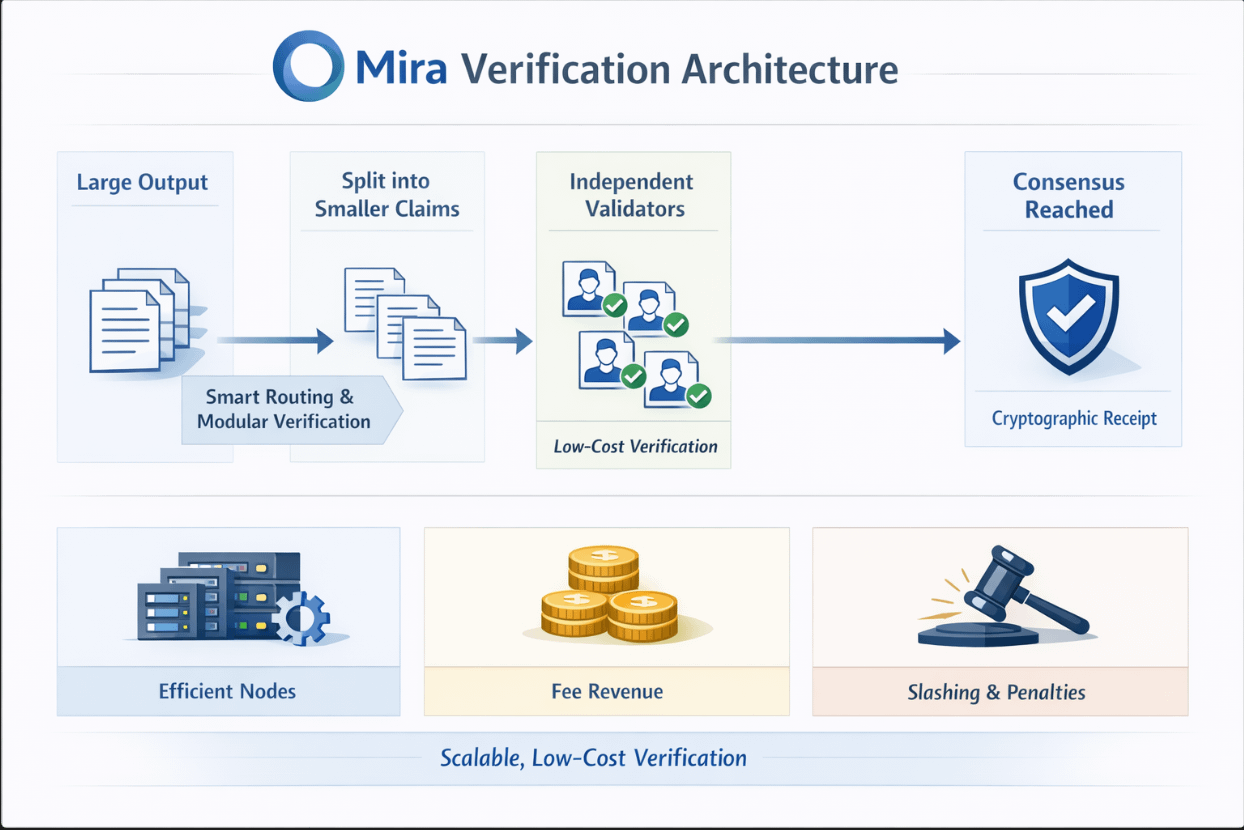
Smart routing and modular verification are the safety valves. Mira breaks larger outputs into smaller verifiable claims. Independent validators check those claims and consensus forms a cryptographic receipt. This architecture makes it possible to treat many checks like low cost tasks and only escalate when a claim fails simple verification. It also makes slashing credible because bad actors can be identified across many small claims rather than hidden inside a single monolithic output. The incentive layer aligns honest behavior with direct revenue from users who pay for verified outputs.
If you are thinking like a trader you look at token charts. If you are thinking like an operator you look at unit economics. Which is why the sustainable opportunity in Mira is not simply price appreciation of $MIRA . It is running efficient nodes and capturing fee revenue at low cost. It is building routing policies and automation that shrink compute spend per verification while keeping slashing risk negligible. It is designing operations that scale horizontally across many small cheap checks rather than vertically with a few expensive runs.
So I ask the Binance Square audience this question to close with a provocation. Are you positioning to trade the token or to capture the real yields that come from running the network correctly Are you building systems that treat verification as an industrial service or are you still chasing the biggest GPU Farm as the answer How you answer that will determine if you profit from Mira or if you merely watch its growth from the sidelines @Mira - Trust Layer of AI $MIRA #Mira