
@Fabric Foundation Why This Feels Timely to Me
What keeps drawing me back to Fabric Protocol is that it is not really starting from the usual robotics question. It is not asking only how to make robots smarter. It is asking something larger, and honestly more uncomfortable: what kind of infrastructure is needed if machines begin to do economically meaningful work in the real world? Fabric’s own framing is quite direct. The Foundation describes itself as an independent non-profit focused on governance, economic, and coordination infrastructure so humans and intelligent machines can work together safely and productively. It also says today’s institutions and economic rails were not designed for machine participation. I think that point matters more than it first appears. We already know machines can perform tasks. The harder problem is how they are identified, coordinated, rewarded, observed, and constrained once they start operating across public life.
Fabric feels timely because the Foundation is presenting it not as a distant theory but as something entering an execution phase. Its February 24, 2026 post says robotics is at an inflection point because AI capability, cheaper and more reliable hardware, and chronic labor shortages are converging. The white paper, published in December 2025, goes even further and describes Fabric as a global, open network to build, govern, own, and evolve general-purpose robots through public ledgers. That is a big ambition, but it is at least clearly stated. 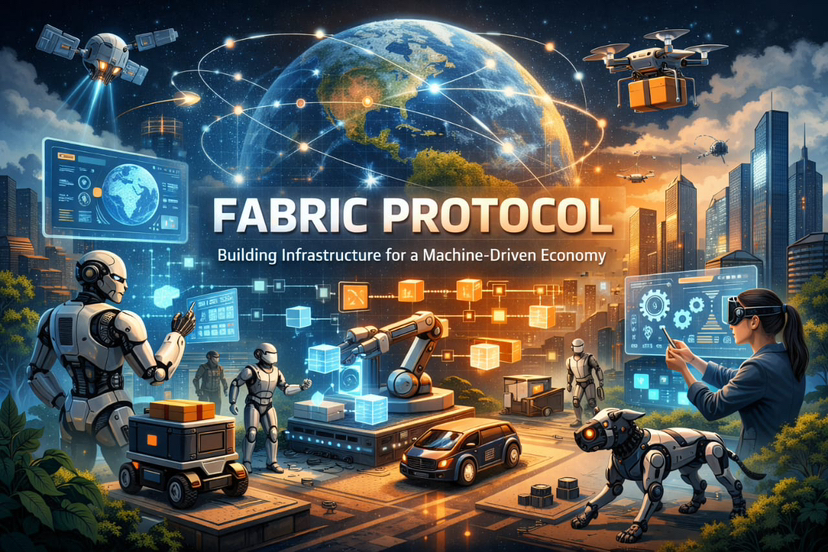
What Fabric Is Actually Trying to Build
The simplest way I can explain Fabric is this: it wants robots to have the missing institutional layer that humans already take for granted. In Fabric’s own materials, that layer includes identity, task settlement, verification, coordination, and governance. The Foundation says it wants open systems for machine and human identity, decentralized task allocation and accountability, location-gated and human-gated payments, and machine-to-machine communication. The protocol paper adds that Fabric coordinates data, computation, and oversight through public ledgers so anyone can contribute and be rewarded.
That is where the project becomes more than a token story or a robotics slogan. Fabric is trying to make robot activity legible. If a machine is working in a warehouse, on a delivery route, or in a care setting, the network should know what the machine is, who controls it, what permissions it has, and how it has performed over time. The Foundation’s blog argues that robots need persistent identity, wallets, and transparent coordination if they are to act as economic participants rather than remain locked inside closed fleet systems. I think that is one of the stronger parts of the thesis. It treats robotics as a coordination problem, not just an intelligence problem.
Governance, Incentives, and the Role of $ROBO
Fabric’s economic layer is built around $ROBO, which the Foundation describes as the core utility and governance asset of the network. Official materials say all transaction fees are paid in $ROBO, and the token is used for operational bonds, settlement, governance signaling, and participation in robot coordination mechanisms. The white paper lists six operational functions for the token, including access and work bonds, transaction settlement, device delegation bonds, governance signaling through veROBO, crowdsourced robot genesis, and token-based rewards tied to contribution. It also repeatedly states that $ROBO does not represent equity, debt, profit share, or ownership of any legal entity or physical asset.
I find the governance design interesting because it is narrower than many crypto projects pretend to be. Holders may lock tokens to obtain veROBO, which gives onchain voting and signaling rights over limited protocol parameters and improvement proposals, including quality thresholds, verification and slashing rules, parameter adjustments, and network upgrades. But those rights do not extend to ownership claims over treasury assets or legal entities. That boundary is important. It suggests Fabric is trying to separate protocol operations from corporate-style ownership expectations.
There are also some concrete numbers that help make the design legible. The white paper sets total $ROBO supply at 10 billion tokens. Allocation is listed as 24.3% to investors, 20% to team and advisors, 18% to foundation reserve, 29.7% to ecosystem and community, 5% to community airdrops, 2.5% to liquidity provisioning and launch, and 0.5% to public sale. The paper also proposes a buyback fraction of 20% of protocol revenue and a governance lock range from 30 days to 4 years, with up to 4x voting power at maximum lock. Whether one likes the structure or not, at least the Foundation has published the parameters rather than hiding them behind vague language.
Ecosystem, Community, and Real Use Cases
Fabric’s ecosystem story is broader than token launch mechanics. The Foundation says it supports research, public-good infrastructure, public understanding, and global participation, including tele-operations, education, and local customization of robotics models. Its partners page highlights OM1, an open-source AI robotics platform, and describes Fabric itself as a decentralized AI collaboration platform for secure flow of data, tasks, and value. The funding page also shows the Foundation is actively inviting projects to apply, which suggests it wants to cultivate an external builder layer rather than operate as a sealed system.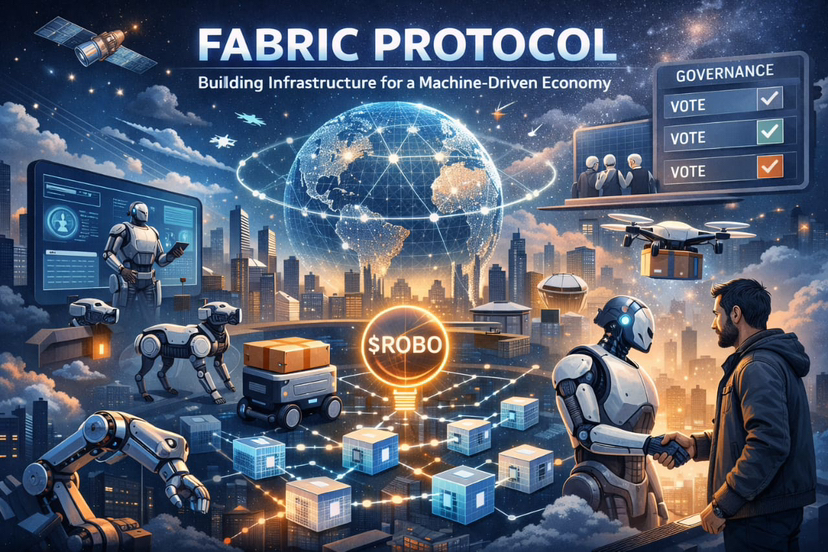
The white paper’s use cases are probably the clearest window into how Fabric imagines real utility. It describes a global robot observatory where humans critique machine behavior, a robot skill app store where modular “skill chips” can be added or removed, non-discriminatory payment systems with fast irreversible settlement, developer support funded by robot service revenue, and markets for skills, data, compute, and power. It also talks about “mining immutable ground truth” and communities collaborating to build and deploy robots. I read these not as mature products today, but as the operating map Fabric wants to grow into.
What Still Feels Open
One reason I take Fabric more seriously than many early-stage protocol narratives is that the white paper openly admits unresolved governance questions. It says community input is still needed on how sub-economies should be defined, how the initial validator set should be selected, and how the network should reward outcomes beyond simple revenue. It even acknowledges the tension between permissioned launch choices and long-term credible neutrality. That honesty helps. It tells me Fabric is still being designed in public, not pretending to be complete already.
The roadmap also makes the current stage plain.
In 2026, Fabric plans to start with the basics like identity, task payments, and organized data in the first part of the year. After that, it wants to reward contributions, collect more data, support more advanced workflows, and prepare for bigger real-world use. In the longer run, the aim is to build a machine-focused Fabric Layer 1 shaped by how the network is actually used
My Closing View
What I find most compelling about Fabric is not that it promises amazing robots. Plenty of projects do that. Fabric is more interesting because it is trying to answer the boring but decisive questions: who verifies the work, who sets the rules, how payments clear, how contribution is tracked, how communities participate, and how machine power stays observable instead of disappearing into private silos. The Foundation’s own success definition says AI should be safe, observable, aligned, widely participatory, and decentralized in power. If Fabric can move even part of that from white paper language into working infrastructure, it will have touched something real.