Artificial intelligence has become incredibly powerful, but reliability still remains its biggest weakness. Anyone who regularly uses modern AI tools has probably seen it happen: a model confidently explains something that sounds convincing, yet the information is partially wrong, outdated, or completely fabricated. These so-called “hallucinations” are not rare mistakes—they are a natural side effect of how most AI systems work. They predict language patterns rather than verify truth. As AI begins to influence financial decisions, research, automation, and even autonomous software agents, the question becomes more serious: how do we actually trust what AI says?
This is the problem Mira Network is trying to solve. Instead of assuming that an AI model’s answer is correct, Mira treats every AI output as something that should be tested and verified. The idea is simple but important. Rather than relying on a single model to generate a response, the system introduces a decentralized layer where multiple independent models examine the information and determine whether it holds up. In other words, AI responses stop being final answers and start becoming claims that need to be validated.
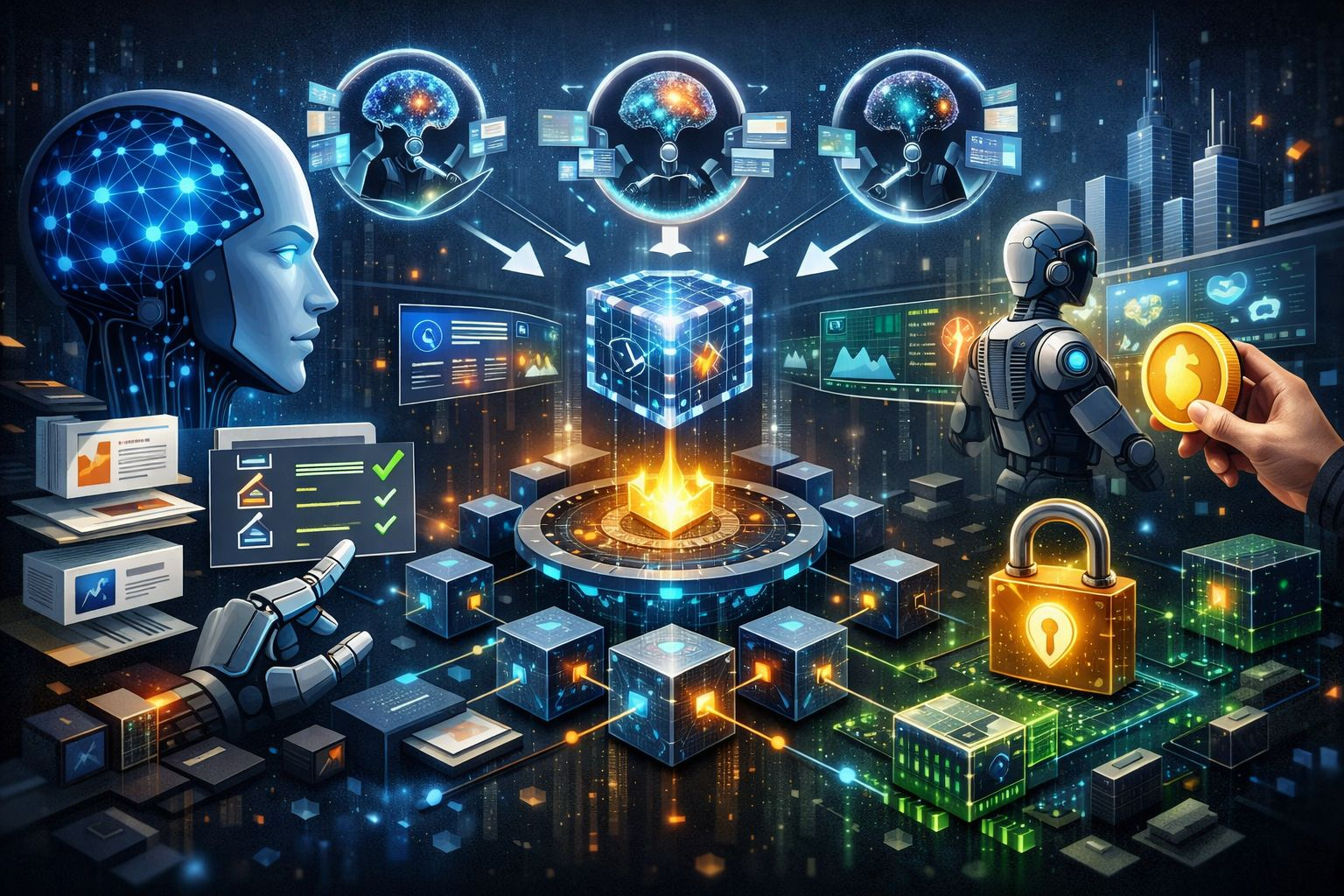
The process begins by breaking down AI-generated content into smaller pieces of information. A paragraph written by an AI might contain several different claims—facts, numbers, logical conclusions, or references to existing knowledge. Mira’s infrastructure separates these elements and converts them into structured verification tasks. Each claim can then be checked individually, which makes it easier to identify which parts of an AI response are reliable and which parts might be questionable.
Once these claims are extracted, they are sent across a distributed network of validators. These validators are themselves AI models, but importantly they are not all identical. Different models may have different architectures, training data, or reasoning methods. This diversity matters because it reduces the risk that the same bias or error appears across the entire network. Each validator independently evaluates a claim and returns a judgment about whether the information appears correct.
The network then compares these judgments and reaches a form of consensus. Instead of blindly trusting a majority vote, Mira uses performance history and economic incentives to weigh the responses. Validators that consistently make accurate evaluations gain more influence over time, while unreliable validators gradually lose credibility. This introduces a reputation system where trust is earned through consistent accuracy.
Economic incentives play an important role in making this system work. Validators must stake tokens in order to participate in the network. When they contribute to accurate verification, they earn rewards. If they repeatedly provide poor judgments or attempt to manipulate results, they risk losing part of their stake. This creates a financial motivation for validators to behave honestly and maintain strong performance.
The token within the Mira ecosystem also connects the network to real demand. Developers or applications that want their AI outputs verified submit verification requests and pay fees to the network. Those fees are distributed among the validators who perform the verification work. As more AI systems begin using verification, the activity of the network increases and so does the economic role of the token.
Another interesting part of Mira’s design is the use of blockchain for recording verification results. Once a claim is verified, a cryptographic record can be stored on-chain. This creates a transparent audit trail showing that the information passed through decentralized validation. For systems that require accountability—financial models, research tools, or autonomous agents—this type of proof could become extremely valuable.
Recent activity around Mira suggests that the project is focusing heavily on building practical infrastructure rather than simply presenting a theoretical concept. Efforts have been directed toward expanding the validator network, experimenting with integrations involving autonomous AI agents, and providing tools for developers who want to plug verification directly into their AI workflows. These developments hint at a broader ambition: making verification a standard step in how AI systems operate.
In the wider landscape of AI and crypto, many projects focus on providing computing power, training data, or platforms for AI agents. Mira approaches the ecosystem from a different angle. Instead of concentrating on creating smarter models, it concentrates on making AI outputs more trustworthy. This distinction may seem subtle, but it addresses a problem that could become increasingly important as AI systems begin to operate with greater independence.
If autonomous AI agents start managing digital assets, running businesses, or conducting research without constant human supervision, the ability to verify their reasoning will become essential. Systems will need a way to confirm that the conclusions produced by AI are not simply convincing, but actually reliable. That is the gap Mira is attempting to fill.
What makes this approach interesting is that it shifts the conversation about AI from intelligence to accountability. Building smarter models will always be important, but intelligence alone does not guarantee trust. Trust usually comes from transparency, verification, and the ability to challenge conclusions. By turning AI outputs into verifiable claims and allowing multiple independent systems to evaluate them, Mira introduces a structure where machine-generated knowledge can be questioned rather than blindly accepted.
If AI continues moving toward autonomous decision-making, the infrastructure that proves whether those decisions are correct may become just as important as the systems generating them. Mira Network represents an early attempt to build that verification layer, and in a world increasingly shaped by machine intelligence, the ability to verify AI might quietly become one of the most valuable tools we have.
@Mira - Trust Layer of AI $MIRA #Mira