
When I first came across ROBO, it didn’t strike me as just another token trying to surf the AI trend. What caught my attention was the bigger idea behind it. Most crypto projects tend to focus on moving money, sharing data, or coordinating activity online. ROBO seems to be aiming at something far less typical. It revolves around the concept that robots might eventually need their own economic framework, a system where machines can perform work, earn value, be accountable for what they do, and operate within an open network rather than a closed corporate environment.
That’s a bold direction, and honestly it’s one of the few crypto narratives lately that actually made me pause and look more closely.
Many projects rely on futuristic language, but when you slow down and look more closely, there often isn’t much substance underneath. ROBO feels a bit different because the concept isn’t simply “robots plus blockchain” packaged as a catchy slogan. The team behind Fabric Protocol seems to be wrestling with a tougher question: if robots eventually become real economic actors in the world, what kind of infrastructure will they need to interact with each other, with people, and with markets? That question matters because we’re moving toward a world where machines are no longer just tools sitting in warehouses or on factory floors. They’re becoming more autonomous, more connected, and increasingly capable of producing valuable output. Once that shift happens, the old systems used to manage them start to feel limited.
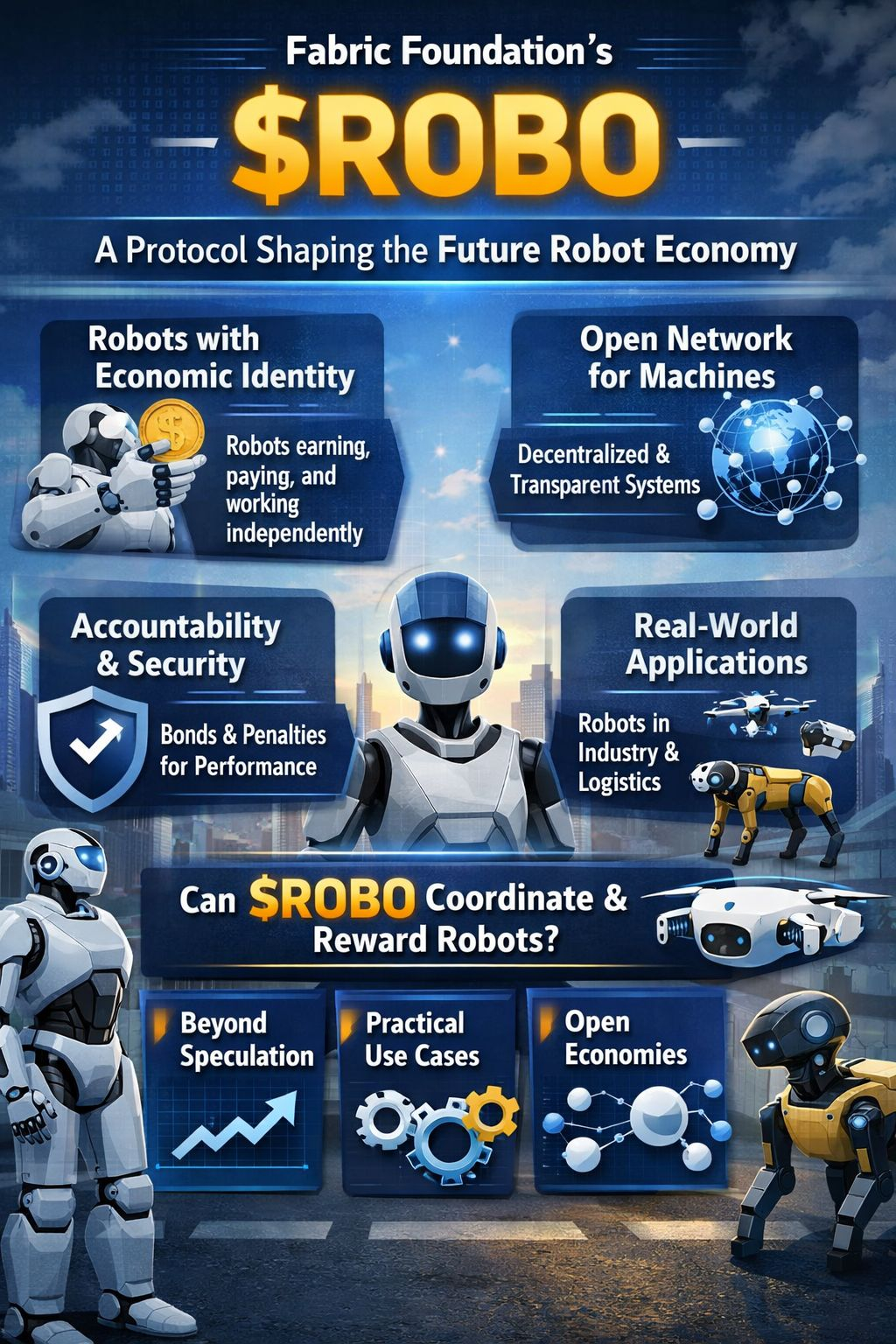
Right now robots can carry out tasks, gather data, and support physical operations, but financially they remain confined inside traditional structures. Most of the time they rely on a company, a platform, or a human operator to control everything around them. Fabric’s vision suggests that this could change. Instead of existing only inside closed systems, robots could eventually participate in a more open economy. ROBO is meant to be part of that transition. It isn’t framed as a token people hold simply because they hope the price goes up. The idea is that it should actually function within the network, supporting things like bonding, participation, fees, and coordination.
That’s a big part of why the project stands out to me. One of the oldest issues in crypto is that many tokens end up feeling unnecessary. A project launches, the branding looks polished, the community gets excited, but when you look past the surface, the token often exists simply because the market expects one, not because the system genuinely depends on it. ROBO at least tries to avoid that pattern. Its role is tied directly to activity. Operators are expected to commit value, secure their participation, and take on responsibility through the token. That already makes the design feel more grounded than the typical narrative driven launch.
What caught my attention even more is how much focus the project places on accountability. That aspect matters far more than the flashy vision. Anyone can describe a future where robots operate inside decentralized networks, but the harder question is how to make that work without the system sliding into chaos. Machines in the physical world don’t behave like neat lines of code. They fail. They go offline. They can be misused. Data can be manipulated. Service quality can decline. Operators may try to exploit incentives. Fabric seems to recognize that this is exactly where the real challenge begins.
The way the project approaches this is by giving participation real economic weight. Operators are expected to post bonds using ROBO, and those bonds are not just symbolic deposits. If performance drops or someone behaves badly, penalties can follow. That detail changes the tone of the whole idea. It shows the team is not only imagining what robots might do in the future, but also thinking carefully about what happens when things go wrong. That kind of practical thinking is often missing in early crypto projects, especially the ones built around whatever narrative happens to be trending.
This is where the idea of a “robot economy” begins to feel more tangible. Not proven, not guaranteed, but real enough to take seriously. If robots are going to perform meaningful work in open networks, trust cannot rely on branding or promises alone. There has to be a system that can verify actions, assign risk, and create consequences when standards are not met. Fabric is trying to embed that structure directly into the protocol. In that framework, ROBO stops being just another tradable token and starts acting as part of the mechanism that keeps the network accountable.
That doesn’t mean the project is already where it wants to be. Not even close. One of the most common mistakes in crypto is mistaking a strong concept for a finished reality. ROBO is still very early. The vision is ambitious, but the real challenge will always be adoption. Writing a whitepaper is one thing. Bringing real machines, real operators, and real workflows onto the network is something entirely different. That’s the stage where serious ideas either prove themselves or start to fall apart. If the protocol can attract meaningful participation and support genuine robotic activity, the token begins to make sense on a deeper level. If it can’t, even the most thoughtful design risks remaining mostly theoretical.
That’s why I think ROBO deserves to be viewed with both curiosity and caution. There’s enough here to take seriously, but not enough yet to assume the outcome is guaranteed. Markets tend to move faster than reality, especially when a project ties itself to themes like AI, automation, or robotics. A token can gather huge attention simply because the story sounds exciting. That can create momentum, but it can also distort expectations. Prices can rise long before the network behind them has truly earned that enthusiasm. ROBO isn’t immune to that dynamic. If anything, because the narrative is so strong, it may be even more exposed to it.
Still, I think there’s a reason the project has started drawing attention. It’s pointing toward a category that still feels early and not fully explored. The crypto market has already gone through multiple waves of AI related tokens, but most of them remain confined to purely digital use cases. ROBO is trying to move the discussion closer to the physical world. That alone gives it a slightly different energy. It doesn’t feel like a direct copy of earlier ideas. Whether it eventually becomes a leader or not, it’s at least attempting to define a new path rather than forcing itself into an old one.
There’s also an ideological layer here that I find interesting. Fabric isn’t simply saying that robots will need payments or incentives. It’s making a broader argument that the future of robotics shouldn’t be controlled entirely by closed systems. That idea echoes the original spirit that drew many people into crypto in the first place. Open networks were meant to challenge centralized control. In this case, that same instinct is being applied to machines. If robotics becomes one of the defining industries of the coming years, then the question of who controls the infrastructure around it becomes a serious one. Fabric is essentially arguing that open economic rails should have a place in that future.
Of course, a strong philosophy doesn’t guarantee strong execution. That’s where the project still has everything left to prove. Building something like a functioning robot economy isn’t just difficult, it’s difficult on several levels at the same time. The technical work is complex. Coordinating participants is complex. Designing incentives that actually hold up under pressure is complex. Creating real token demand tied to genuine usage is complex. Bringing all of that together inside one system is the kind of challenge that looks elegant in a document but becomes messy once it meets the real world. That doesn’t mean it’s impossible. It simply means the path from vision to reality is much longer than many investors prefer to admit.
Even so, I’d rather spend time studying a project like this than watch ten shallow launches built on recycled hype. At least ROBO is trying to address a meaningful problem. At least it’s asking a question that hasn’t already been exhausted. Can crypto help coordinate machines in ways that produce real value? Can robots operate within open networks while carrying financial accountability? Can token systems move beyond speculation and become part of real operational infrastructure? Those are interesting questions. And they matter far more than another round of recycled buzzwords.
My view is that ROBO is best seen as an early experiment with real potential rather than a finished solution. That might sound cautious, but it feels like the most honest way to look at it. There’s enough substance here to deserve attention. The framework is more thoughtful than what we usually see from narrative driven projects. The token appears to have a defined role. The design shows some awareness of the risks involved in coordinating machines. Those are all positives. But none of them replace the need for real proof.
If the network begins supporting actual robotic activity, if operators start using it because it solves a genuine problem, and if demand for the token grows from real usage instead of pure speculation, then ROBO could become one of the more important early projects in this space. Not because it had the loudest launch, but because it tried to tackle something many teams were either too early, too shallow, or too cautious to attempt.
And if it ends up falling short, that doesn’t automatically make the idea meaningless. It may simply mean the market arrived before the infrastructure was ready. That situation happens often in crypto. Sometimes the first serious attempt matters not because it succeeds immediately, but because it reveals where the next real opportunity might appear.
That’s why I keep returning to ROBO. Not because it’s easy to believe in, but because it’s difficult to ignore. In a market filled with projects that feel predictable within seconds, this one at least pushes the discussion somewhere new. It asks what happens when machines require open coordination, economic identity, and programmable trust. That’s a far more interesting question than most tokens ever bring to the table.
And right now, being genuinely interesting already puts ROBO ahead of much of the market.
@Fabric Foundation #ROBO $ROBO
