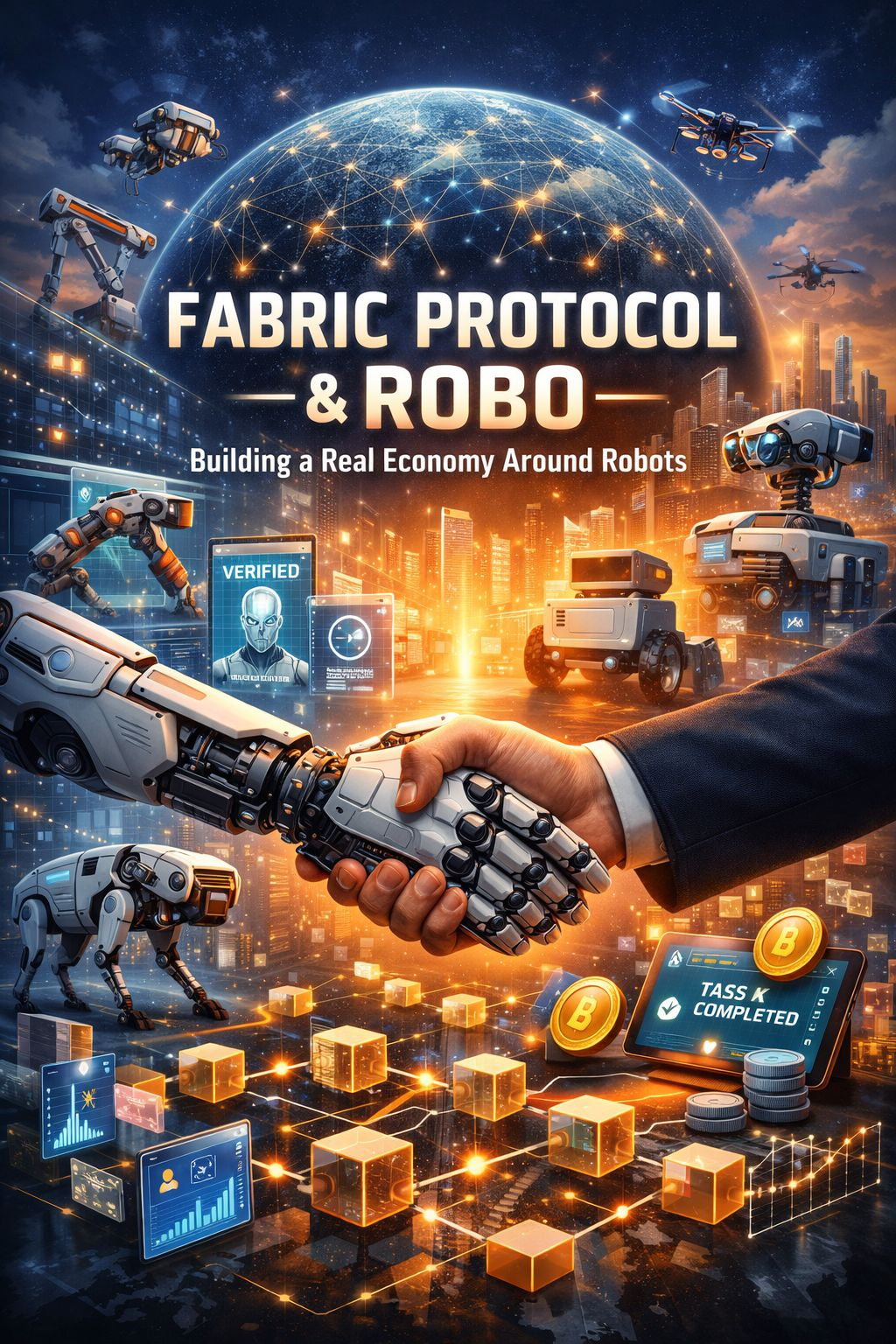
Most AI and crypto projects talk about the future in a way that sounds exciting but still feels distant. Fabric Protocol feels different because its idea is more grounded. It is not just trying to ride the robotics trend or attach a token to the word “AI.” It is trying to solve a deeper problem: if robots become part of everyday economic life, what kind of system will coordinate them?
That question sits at the heart of Fabric. As machines become smarter and more useful, the challenge is no longer only about whether a robot can perform a task. The bigger issue is how that robot fits into a wider network. Who verifies its work? Who sets the rules? How is it paid? How do people trust what it is doing? Fabric approaches this as an infrastructure problem. It sees robots not as isolated machines, but as participants in a shared economy that needs accountability, incentives, and clear coordination.
That is what gives the project real substance. Fabric is built around the idea that a robot economy cannot run on intelligence alone. It also needs structure. Data, computation, payments, and governance all need to connect in a way that is transparent and enforceable. Fabric’s answer is to use a public ledger and verifiable systems to create that shared layer. In simple terms, it wants to build the rules and rails that allow humans and machines to work together at scale.
What makes this interesting is that it goes beyond the usual crypto story. A lot of projects in this space stop at big words like decentralization, autonomy, or machine economies. Fabric tries to go one step further and ask what actually has to exist for such an economy to function. Robots need identity. Their work needs to be checked. Their performance needs to be measured. Payments need to move through a trusted system. And when something goes wrong, there has to be a clear way to respond. Fabric seems to understand that without these basic pieces, the entire idea of tokenized robotic work would fall apart very quickly.
Its architecture reflects that thinking. At one level, the protocol is creating a registry and identity layer for machines, so robots can have a trackable presence inside the network. At another level, it is trying to verify work and ensure machines are judged by actual performance. It also includes settlement infrastructure, so services, data, and compute can move through an economic system instead of staying trapped inside closed platforms. On top of that, it adds governance, giving participants a role in shaping how the network evolves.
This may sound technical, but the logic behind it is very human. If people are going to rely on robots, they need more than promises. They need visibility. They need rules. They need confidence that the machine on the other side of the system can be trusted and that poor behavior has consequences. Fabric’s use of bonds, slashing, and performance standards shows that it is trying to create that sense of discipline. In other words, it is not imagining a future where robots simply appear and everything works. It is imagining a future where machines earn their place through accountable participation.
That is where ROBO starts to make sense. In many crypto projects, the token feels like an extra layer added after the idea is already finished. Here, ROBO is more tightly connected to the protocol itself. It is designed to be used for participation, settlement, governance, and securing activity on the network. Operators use it to register and support machines. Participants use it inside the system as robotic services and resources are coordinated. Governance uses it to shape the protocol’s rules over time.
That gives ROBO a more practical role than many AI-related tokens. It is not just there to represent community interest or speculation. It is supposed to sit inside the actual flow of the network. That matters because the token only has real value if it becomes part of real machine activity. Fabric at least tries to make that connection clear. The token is tied to the protocol’s purpose, not just its branding.
Of course, that does not remove the risks. A token can have a clean design on paper and still struggle in reality if actual demand never forms. Fabric’s long-term success depends on whether robotic work on the network becomes meaningful enough for ROBO to matter beyond trading. That is the real test. The stronger the relationship between machine output and token demand, the stronger the project becomes. If that relationship stays weak, then the token risks being driven more by narrative than by genuine utility.
The economics of the project reflect both ambition and uncertainty. The supply is fixed, and allocations are spread across investors, the team, reserves, ecosystem incentives, and community distribution. That structure is familiar in crypto, but what matters more is how Fabric wants the token to behave inside the network. Its economic design tries to connect token demand with network usage, operator bonding, and service activity. More importantly, it attempts to reward contribution instead of idle holding. That is one of the most thoughtful parts of the model. A protocol focused on robotic labor should reward useful work, reliability, and quality. Fabric seems to understand that clearly.
The challenge is that all of this still has to be proven in practice. The market can react quickly to a story, especially one tied to AI and robotics. Exchange listings, visibility, and trading activity can create early momentum. But those things do not prove that the deeper system works. The real proof would be seeing robots use the network in a meaningful way, seeing services settled through the protocol, and seeing ROBO function as part of an active machine economy rather than as a purely speculative asset.
That is why Fabric’s role in the broader ecosystem feels so important. It is not trying to be just another AI application or another robotics product. It is aiming to become the coordination layer between machines, humans, developers, and capital. That is a much more valuable role if it works. The technologies that last are often the ones that help fragmented systems connect. Robotics today is fragmented in almost every way: hardware, software, ownership, standards, and data. Fabric is trying to build a common structure that sits above those divisions.
This is also why the project feels bigger than its token. The real idea here is not just about launching ROBO. It is about preparing for a world where machines generate economic value and need to be organized in a fair and transparent way. Fabric is making a bet that robots will eventually need open infrastructure, not just private platforms. It is betting that if machines become economically important, the systems governing them should not be invisible or controlled entirely by a few large players.
That is a bold idea, but also a sensible one. The future of robotics will not only be shaped by better hardware or smarter AI. It will also be shaped by the rules that define ownership, coordination, trust, and value. Fabric is trying to enter that conversation early. It is not offering a perfect answer yet, but it is asking the right question.
That, to me, is the strongest reason to pay attention to the project. Fabric is not interesting because it adds crypto language to robotics. It is interesting because it treats robotics as something that will eventually need public coordination, not just private innovation. If that view turns out to be right, then the protocols built today could shape how machine economies actually function tomorrow.
In the end, Fabric is not just betting on robots becoming more useful. It is betting that once they do, society will need open systems to manage how those robots work, earn, and interact. That is where ROBO becomes relevant. Its value will not come from hype alone. It will come from whether Fabric can help turn robotic activity into something visible, accountable, and economically connected. If it can do that, then the project will matter for far more than its token price. It will matter because it helps define who gets to participate in the next layer of the economy.
@Fabric Foundation $ROBO #Robo