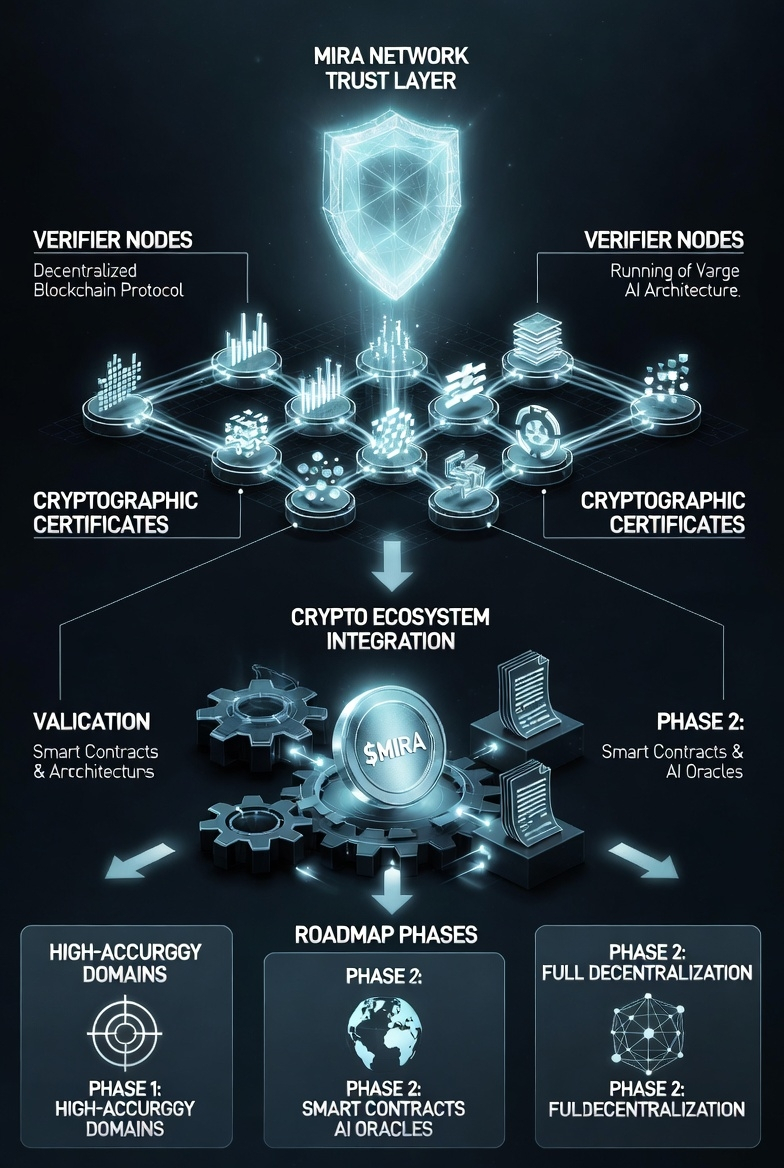
Mira Network is a decentralized blockchain protocol designed as the foundational trust layer for artificial intelligence. It addresses the core limitations of modern AI systems—hallucinations (fabricated information), biases, and probabilistic errors—by enabling cryptographically verifiable outputs. Instead of relying on a single centralized model, Mira transforms AI-generated content into granular, independently verifiable claims. These claims are distributed across a network of independent verifier nodes running diverse large language models (LLMs) such as GPT-4o, Llama, and others. Through multi-model consensus, the network aggregates results and issues tamper-proof cryptographic certificates recorded on the blockchain. This creates mathematically provable, trustless intelligence that removes the need for human oversight.
The protocol uses a hybrid Proof-of-Work (honest inference) and Proof-of-Stake mechanism. Node operators stake $MIRA tokens and earn rewards for accurate verification, while dishonest behavior triggers slashing penalties. Claims are sharded for privacy and efficiency, with progressive decentralization phases including duplication for collusion detection and random sharding. Mira’s flagship app, Klok, demonstrates real-world application, allowing users to experience verified AI workflows. Founded in 2024 by ex-AI leaders from Uber and Amazon, the project raised $9 million from investors including BITKRAFT, Framework Ventures, and Accel. Its mainnet launched in late 2025, bringing live verification to millions of users.
Role in the Crypto Ecosystem
In the crypto ecosystem, Mira functions as the missing verification oracle for AI, much like Chainlink provides reliable data feeds for DeFi. It enables trustless, autonomous AI agents to power smart contracts, decision-making protocols, and on-chain applications without single points of failure. High-stakes sectors—decentralized finance (risk assessment), healthcare (diagnostic verification), legal services (contract analysis), and gaming—can now integrate AI with cryptographic guarantees. Verified facts accumulated on-chain evolve into new primitives such as AI oracles, deterministic fact-checking systems, and value-backed knowledge bases. By bridging AI reliability with blockchain immutability, Mira accelerates the shift toward fully autonomous decentralized economies, reducing reliance on centralized AI providers and unlocking billions in secure AI-driven value transfer.
Mira Token ($MIRA)
The native utility and governance token, $MIRA, powers the entire network with a fixed total and maximum supply of 1 billion tokens. As of early 2026, circulating supply stands at approximately 244.87 million. Token holders stake $MIRA to operate verifier nodes, securing the network and earning rewards proportional to honest performance. Users pay $MIRA fees for verification APIs and services, while governance participants vote on protocol upgrades, fee structures, and expansions. This cryptoeconomic design aligns incentives: honest majority stake ensures security, and slashing deters attacks. Initial circulation at TGE was around 19%, with gradual unlocks supporting long-term sustainability—no aggressive insider dumps in year one.
Roadmap and Future Vision
Mira’s roadmap, detailed in its whitepaper, follows a clear evolution toward comprehensive autonomous AI infrastructure. Phase one focuses on high-accuracy domains (healthcare, law, finance) with vetted nodes. Subsequent phases introduce full decentralization through model duplication, anomaly detection, and random sharding. Expansion covers complex content types—code, structured data, and multimedia—plus private data handling via secure layers. Advanced stages integrate verification directly into generation, paving the way for a synthetic foundation model that produces error-free outputs in real time. Long-term goals include building an on-chain repository of verified facts for derivative applications like next-generation oracles and fully autonomous AI systems. Community campaigns, exchange listings (Binance, MEXC, others), and ecosystem grants continue driving adoption. By 2026 and beyond, Mira aims to become the standard trust layer enabling AI to operate reliably at global scale.
In summary, Mira Network is not merely another AI project—it is the decentralized infrastructure layer that makes trustworthy, autonomous intelligence a reality, deeply intertwined with crypto’s future of permissionless innovation.