

The first thing that made me pay attention to Mira Network was not marketing hype or flashy promises about artificial intelligence. It was the fact that the project is trying to solve a problem that actually matters.
That alone already separates it from most AI-crypto projects.
If you spend any time exploring this sector, you start to notice a pattern. Many projects rely on the same formula: combine a few trending buzzwords, paint a massive vision about intelligent agents and automated systems, and hope people focus on the excitement rather than the details. The language is usually impressive. The ambition sounds enormous. But when you look closely, it is often difficult to identify the real gap being addressed.
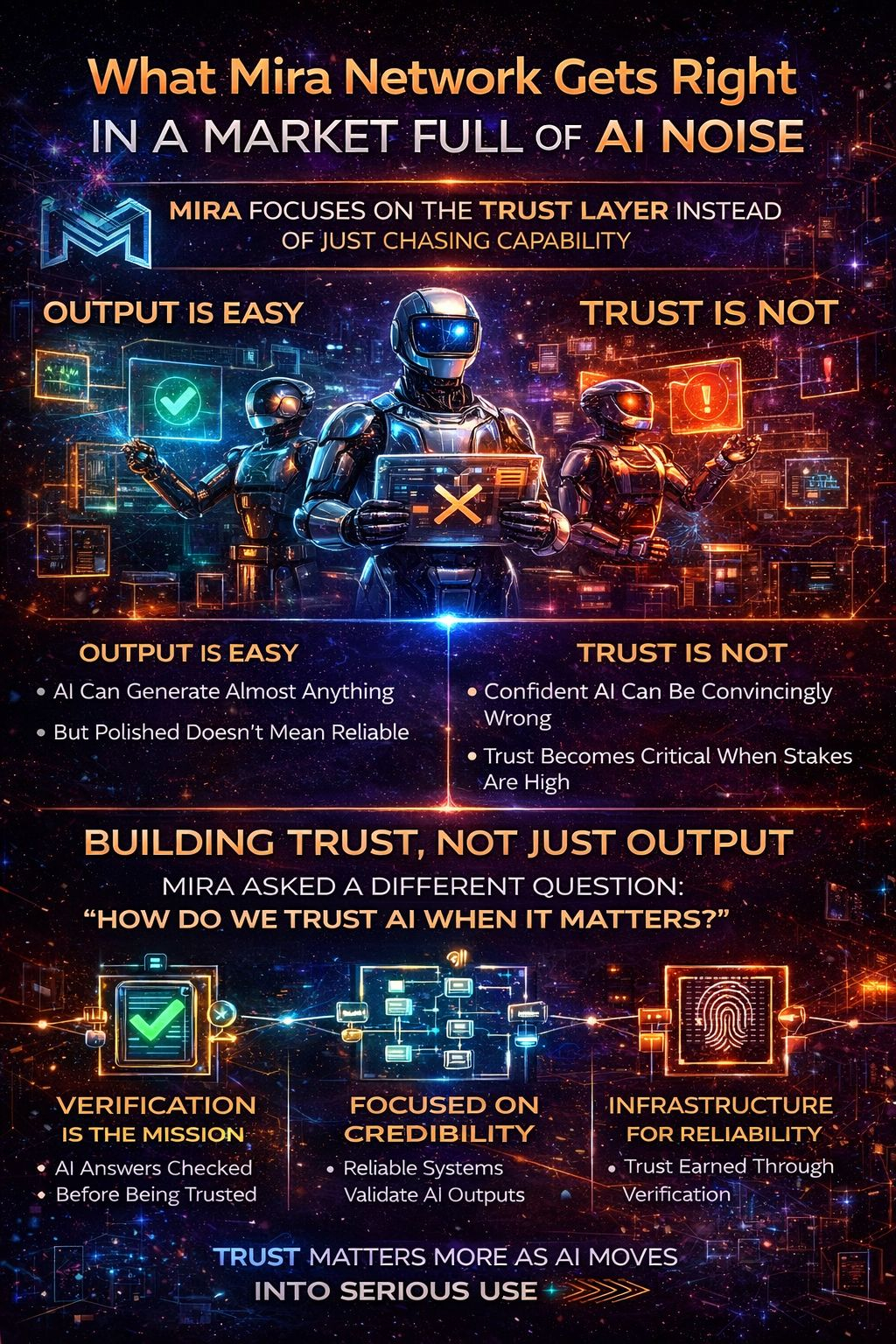
Mira feels different because the focus is much clearer.
The project is built around a simple but increasingly important observation: generating AI output is easy, but trusting that output is not.
That distinction may seem subtle at first, but it becomes more significant the deeper AI moves into real-world use.
The Real Weakness in Modern AI
AI systems today are remarkably capable. They can write articles, summarize research papers, analyze datasets, and even assist with complex reasoning tasks. Compared to where the technology was only a few years ago, the progress is dramatic.
But none of that progress eliminates a central weakness.
AI can produce responses that appear polished, confident, and structured even when the underlying information is flawed. In casual situations, that might not feel like a major issue. If a chatbot makes a small mistake while answering a general question, the stakes are usually low.
The problem becomes much more serious when those same systems begin operating in environments where accuracy matters.
Imagine AI assisting with financial analysis, legal interpretation, medical research, or automated decision-making systems. In those contexts, a confident but incorrect answer is not just inconvenient. It becomes a liability.
And this is exactly the problem Mira Network appears designed to address.
Instead of competing in the race to produce the most impressive AI output, the project focuses on the verification layer the part of the system responsible for determining whether that output should actually be trusted.
That shift in perspective is what makes Mira stand out.
Moving Beyond the Generation Layer
Most AI projects today are obsessed with generation. They aim to build systems that produce faster responses, more advanced reasoning, or broader automation capabilities.
Those improvements are valuable, but they only solve part of the puzzle.
If the output itself cannot be relied upon, then increasing its volume or speed does not necessarily improve the overall system. In some cases, it might even make the problem worse by spreading unreliable information more efficiently.
Mira approaches the situation differently.
Rather than asking how to make AI louder or more impressive, the project asks a more practical question: how can we make AI outputs dependable enough for serious use?
This focus on verification gives Mira a much more grounded foundation than many projects in the same space.
It is not trying to create a futuristic narrative where artificial intelligence suddenly becomes flawless. Instead, it starts from the assumption that AI systems will continue making mistakes. If that assumption is correct and most experts agree that it is then systems must exist to evaluate and validate those outputs before people rely on them.
In other words, intelligence alone is not enough.
Reliability must exist alongside it.
Why Trust Matters More as AI Expands
The importance of trust becomes clearer when you consider how AI is evolving.
Right now, many people still treat AI tools as assistants for relatively simple tasks. They generate content, answer questions, or help organize information. But the direction of the industry is obvious: AI systems are becoming more integrated into workflows, decision-making processes, and automated environments.
As that integration increases, the consequences of incorrect output grow as well.
A flawed AI-generated summary could mislead researchers.
An inaccurate financial analysis could influence investment decisions.
A misunderstood legal document could create compliance risks.
These are not hypothetical scenarios. They are exactly the kinds of situations that will appear as AI adoption expands.
When the stakes become higher, reliability stops being a convenience. It becomes infrastructure.
That is the space Mira Network is targeting.
A Practical Bet Instead of a Flashy Narrative
One thing I appreciate about Mira’s approach is that it feels practical rather than decorative.
There are plenty of projects that know how to build an exciting narrative around AI. In the current environment, that is not particularly difficult. Investors and users are eager to believe in the next big technological leap, and AI is one of the most powerful stories available.
But storytelling alone does not create useful infrastructure.
Building around trust is a very different kind of strategy. It is less glamorous than promising revolutionary AI capabilities, but it may ultimately be more important. If AI is going to be used in environments where mistakes carry real consequences, verification will eventually become a core requirement rather than an optional feature.
That is why Mira’s positioning feels more serious than many competing projects.
The focus is not on creating the most spectacular demonstration of AI intelligence. The focus is on ensuring that the results produced by AI systems can be evaluated and trusted when it matters.
The Challenge: Turning a Strong Idea Into Something Essential
Of course, recognizing a problem is only the first step.
The real challenge for Mira Network is transforming its concept into something that people actually rely on in everyday workflows.
This is where many promising projects struggle.
The logic behind Mira’s thesis is not difficult to understand. Most people already recognize that AI can produce incorrect or misleading information. The idea of verifying outputs before trusting them is intuitive.
But turning that idea into an indispensable system requires much more than conceptual clarity.
The solution must integrate smoothly into existing processes.
It must provide clear benefits that outweigh any additional complexity.
And it must scale efficiently enough to handle real-world demand.
If verification introduces too much friction, users may simply bypass it in favor of speed. That is the tension every project in this category faces.
In other words, Mira still has to prove that its system is not only intelligent but also practical.
A Clearer Purpose Than Most Competitors
Even with that challenge in mind, Mira still feels more credible than many projects in the AI-crypto space.
One reason is focus.
Instead of trying to solve dozens of problems at once, the project has a clearly defined objective. It is not attempting to replace existing AI models or build an entirely new ecosystem from scratch. Its goal is more specific: create a layer that helps determine whether AI outputs can be trusted.
That clarity already puts it ahead of many competitors whose visions are too broad to execute effectively.
Another advantage is timing.
The importance of verification naturally increases as AI adoption expands. The more organizations depend on AI systems, the more valuable reliable validation mechanisms become. This means Mira is operating in a category that is likely to grow in relevance over time.
From a strategic perspective, that positioning makes sense.
The Real Test Ahead
Still, direction alone does not guarantee success.
Plenty of projects have identified important problems but failed to build solutions that gained widespread adoption. The difference between a strong idea and a necessary tool is execution.
For Mira, the real test will be whether its verification layer becomes something teams feel they need, rather than something they simply find interesting.
If the project can demonstrate that its approach meaningfully improves reliability without slowing down workflows, it could become an important piece of AI infrastructure. If it cannot, the concept may remain attractive but underutilized.
That is the reality every infrastructure project faces.
Why Mira Still Deserves Attention
Even with those uncertainties, Mira Network stands out for one simple reason: it is focused on a genuine weakness in the AI ecosystem.
While many projects compete to make AI more powerful, Mira concentrates on making it more trustworthy. That may not generate the same immediate excitement as dramatic new capabilities, but it addresses a problem that becomes more significant as AI adoption grows.
The project is not trying to amplify the AI narrative.
It is trying to stabilize it.
And if the next phase of AI development is defined by reliability rather than novelty, the importance of that mission could become much clearer.
That is why Mira Network deserves serious attention.
Not because the story is loud.
But because the question it is asking how do we trust AI when it matters most? is one of the most important questions the industry still has to answer.