

@Fabric Foundation The more I learn about Fabric Foundation, the more I realize it’s not just about cool robots moving around warehouses or delivering packages. At first glance it might seem like another robotics project trying to automate the physical world. But when you look a little deeper Fabric Protocol is actually trying to solve something much bigger: how robots exist behave, and interact inside a digital network.
And that’s where things start getting interesting.
Most technology systems today treat robots like tools. A robot receives instructions from a centralized system performs a task and sends data back. It’s useful but it’s also limited. The robot itself isn’t really part of the network it’s just an extension of it.
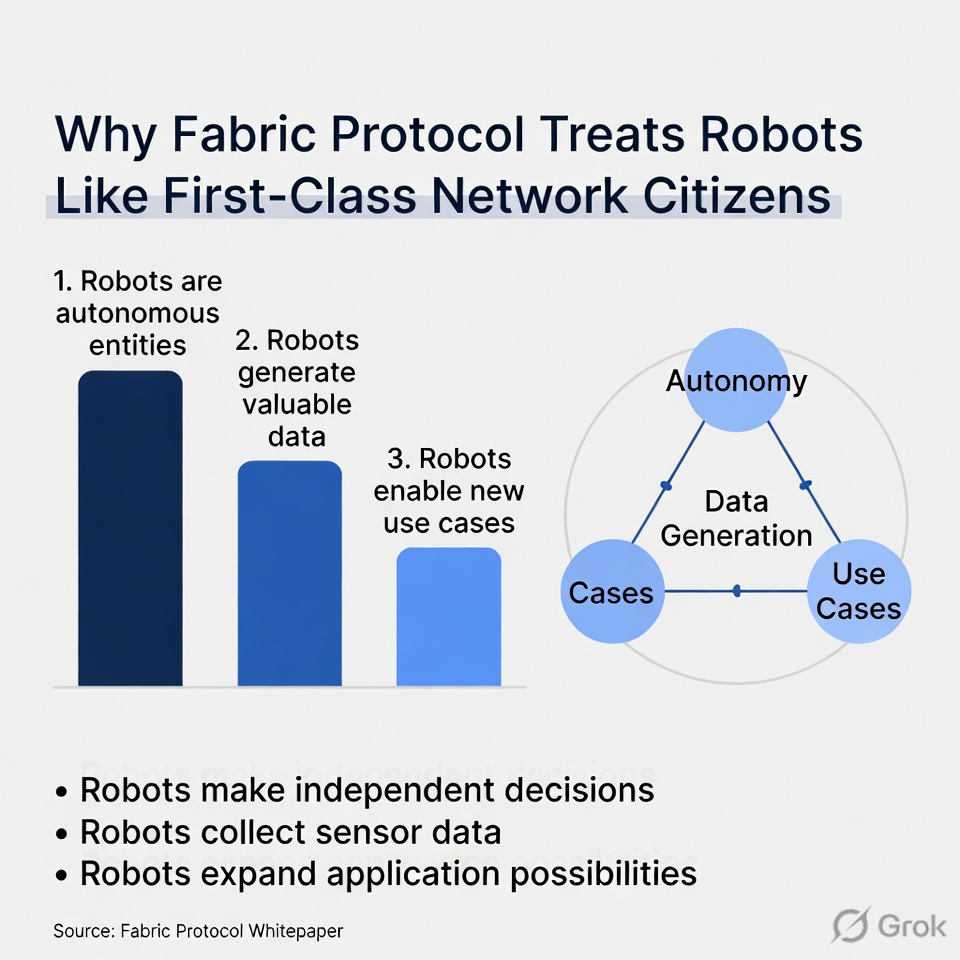
Fabric Protocol flips that idea completely.
Instead of treating robots as tools controlled by platforms, Fabric treats them as first-class network citizens. That phrase might sound technical but the idea is surprisingly simple: robots aren’t just devices anymore. They become participants in a decentralized system.
Think about how computers work on the internet. Every computer has an identity, can communicate with other machines, and can verify information. Fabric is applying a similar concept to robots.
In Fabric’s model, robots can have their own identity, their own record of actions, and their own verifiable behavior. Every action a robot performs can potentially be logged verified and proven on the network. That means the robot isn’t just doing a task it’s leaving behind a cryptographic receipt that proves what happened.
The more I think about this, the more it feels like the missing layer in robotics.
Right now, one of the biggest problems with autonomous systems is trust. When a robot says it delivered a package, cleaned a floor inspected a pipeline or scanned a warehouse shelf we usually rely on the company operating the robot to confirm it. There’s no neutral record.
Fabric introduces the idea that robot actions themselves can become verifiable network events.
Imagine a delivery robot completing a route. Instead of simply reporting back to a centralized server, the robot could generate a verifiable proof of its route, the time it completed it and the task it performed. That information could be checked by other participants on the network.
In other words, the robot becomes accountable.
And accountability changes everything.
Once robots become accountable network participants, new economic models start to appear. A robot could theoretically perform tasks and receive payment automatically. It could interact with smart contracts negotiate jobs, or prove that it completed a service.
It sounds futuristic, but the concept isn’t that far from what blockchain already does with financial transactions. Fabric is basically asking: what if physical actions worked the same way?
Another thing that stood out to me while exploring Fabric is how it treats robot behavior as something that should be auditable.
In today’s robotics world, if something goes wrong, it’s often difficult to trace exactly what happened. Did the robot misinterpret a sensor reading? Was the software faulty? Did the operator give the wrong instruction?
With a system like Fabric, actions could leave behind a trail of verifiable data. That trail could help developers debug problems help businesses trust automation more, and even help regulators understand how autonomous machines operate.
It’s almost like giving robots a digital memory that anyone can verify.
But there’s another subtle idea behind Fabric Protocol that I think people underestimate. By making robots network citizens Fabric is also creating a shared infrastructure for robotics.
Right now, robotics development is extremely fragmented. Every company builds its own stack, its own systems, and its own closed ecosystem. That slows innovation because robots can’t easily interact across platforms.
Fabric is trying to build something closer to a robot operating system for the global network.
If that works, robots from different manufacturers could potentially communicate, coordinate tasks, and verify each other’s behavior through the same protocol layer.
The internet did something similar for computers. Before the internet standardized communication protocols, networks were isolated. After shared protocols emerged, everything became connected.
Fabric seems to be applying that same philosophy to robots.
Of course, none of this is guaranteed to succeed. Robotics is notoriously difficult, and building infrastructure that connects physical machines to decentralized networks is an enormous challenge.
But the idea itself is powerful.
Instead of asking how robots can simply become more advanced, Fabric is asking a deeper question: what if robots were treated as independent actors within a networked economy?
The difference might sound small but it changes the entire architecture.
Tools follow orders.
Citizens participate.
And if Fabric Protocol manages to make robots true participants in a decentralized network, the future of robotics might look very different from the one we imagine today. #ROBO $ROBO