The convergence of artificial intelligence, robotics, and blockchain is opening an entirely new technological frontier. For decades, robots have existed as isolated machines owned by private companies, factories, or research laboratories. They were capable of performing tasks, but they could not independently collaborate, verify their work in an open environment, or participate directly in a global digital economy.
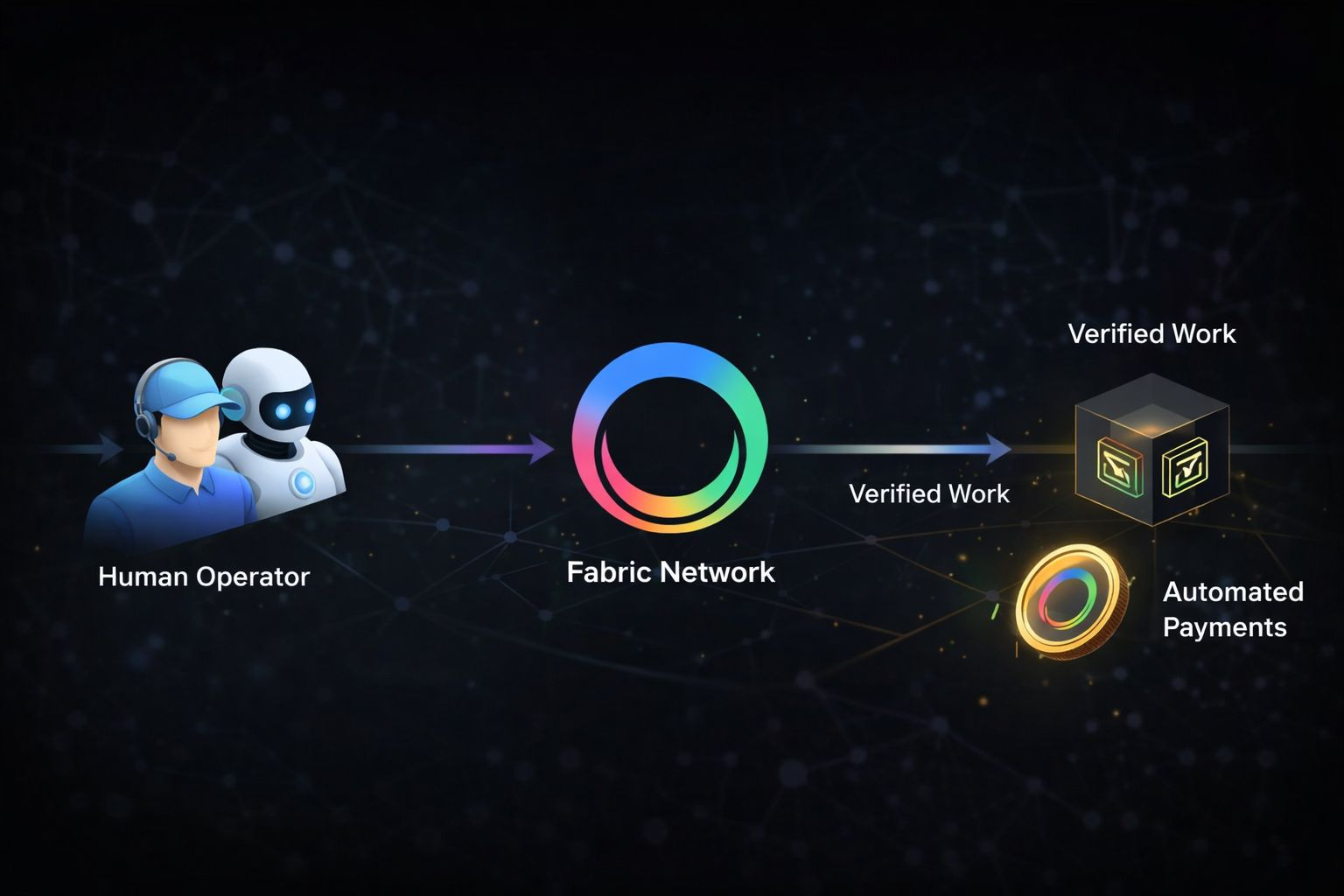
Fabric Foundation is attempting to change that model. It supports the development of Fabric Protocol, a global open network designed to coordinate robots, AI agents, and machines through blockchain infrastructure and verifiable computing. The protocol acts as a shared coordination layer where machines can register identities, perform tasks, prove their work, and interact economically with other machines and humans.
Instead of robotics systems operating as closed ecosystems owned by large corporations, Fabric introduces the idea of an open robotic network where machines can collaborate through decentralized infrastructure. Data, computation, and governance are coordinated through a public ledger that allows transparent verification of machine activity. This approach creates a new framework for safe and scalable human–machine collaboration.
One of the biggest problems in robotics today is trust. When a machine performs a task, there is usually no universal method to verify what actually happened. Fabric Protocol addresses this challenge by introducing verifiable computing, which allows machines to produce cryptographic proof that a task was completed correctly. Physical actions performed by robots can be validated through the network and recorded on-chain, transforming mechanical work into verifiable digital records.
This concept fundamentally changes how machine labor can be measured and rewarded. A warehouse robot could prove it moved inventory across a facility. A delivery robot could confirm that it reached its destination. A drone collecting environmental data could validate the accuracy and time of its measurements. Once verified, these actions become trusted records that can trigger automated payments, reputation updates, or new tasks across the network.
The Fabric ecosystem is built around an agent-native architecture, meaning the infrastructure is designed specifically for autonomous agents rather than traditional applications. AI agents and robots can register unique identities, access shared datasets, interact with decentralized services, and execute tasks defined by programmable contracts. This transforms machines from passive tools into active participants within a digital economic system.
To maintain decentralization and neutrality, governance of the protocol is supported by the Fabric Foundation, an independent non-profit organization focused on ecosystem growth and open development. The foundation helps coordinate research, development, and global collaboration while ensuring that the protocol remains open and accessible to developers, operators, and communities building robotic systems.
The economic layer of the Fabric network is powered by $ROBO, the native token that aligns incentives across the ecosystem. The token can be used to reward machine operators, compensate developers building robotic applications, pay for robotic services, and participate in governance decisions that shape the future direction of the network. By introducing programmable incentives, Fabric creates a structure where machines, builders, and infrastructure providers can coordinate around shared economic interests.
Fabric also sits at the center of a rapidly emerging sector that combines artificial intelligence, robotics, and decentralized infrastructure. This new category is sometimes described as decentralized physical AI, where physical machines operate inside open economic networks rather than centralized platforms. As autonomous machines become more capable, the need for coordination layers that allow them to communicate, verify work, and exchange value will become increasingly important.
The architecture of Fabric enables robots to share knowledge, operational data, and learned behaviors across the network. Instead of every robotics company building isolated systems, machines connected through Fabric can contribute to a collective learning environment where improvements propagate across the network. This has the potential to significantly accelerate innovation in robotics and machine intelligence.
In practical terms, Fabric could support many types of real-world infrastructure. Autonomous delivery networks could coordinate logistics between cities. Manufacturing robots could collaborate across different facilities. Environmental monitoring drones could continuously collect and sell valuable data. Smart city infrastructure could coordinate maintenance robots, traffic systems, and urban services through programmable economic incentives.
Each verified action performed by machines becomes part of a larger network economy. Mechanical work, data collection, and machine intelligence can all be represented digitally and integrated into decentralized systems. This creates a new paradigm where robots are not simply tools owned by companies but participants in global computational and economic networks.
Most blockchain networks today focus on coordinating financial transactions and digital assets. Fabric expands this concept into the physical world by creating infrastructure that verifies and rewards real-world machine activity. Instead of only moving money, the network allows physical labor performed by machines to become part of a programmable economic system.
As artificial intelligence and robotics continue advancing, systems like Fabric Protocol may become essential infrastructure for the next phase of technological development. The future may not only involve decentralized finance or decentralized data. It may also include decentralized networks of machines working together, verifying their contributions, and participating directly in a global machine economy powered by open protocols like Fabric.