


Something I’ve been thinking about lately is how the role of robots might change once they start operating inside open networks.
Right now most robots work in very controlled environments. A warehouse robot moves packages. A factory robot performs repetitive assembly. A delivery robot follows a fixed route. Everything is usually managed by one company and one system.
But if robots become more autonomous and more connected, that structure could change.
Instead of working inside a single organization, machines could start interacting with broader networks where different robots perform different services.
And when that happens, another question naturally appears.
How do we decide which robot should do the job?
At the moment that decision is usually made by software systems designed by companies. But in a decentralized environment, where robots from different operators may exist on the same network, the selection process becomes more complex.
This is where Fabric Protocol becomes interesting to me.
Fabric is building infrastructure that allows machines to coordinate through a public ledger and verifiable computing. At first glance this looks like a system for connecting robots and allowing them to collaborate. But if you look a little deeper, another possibility appears.
Competition.
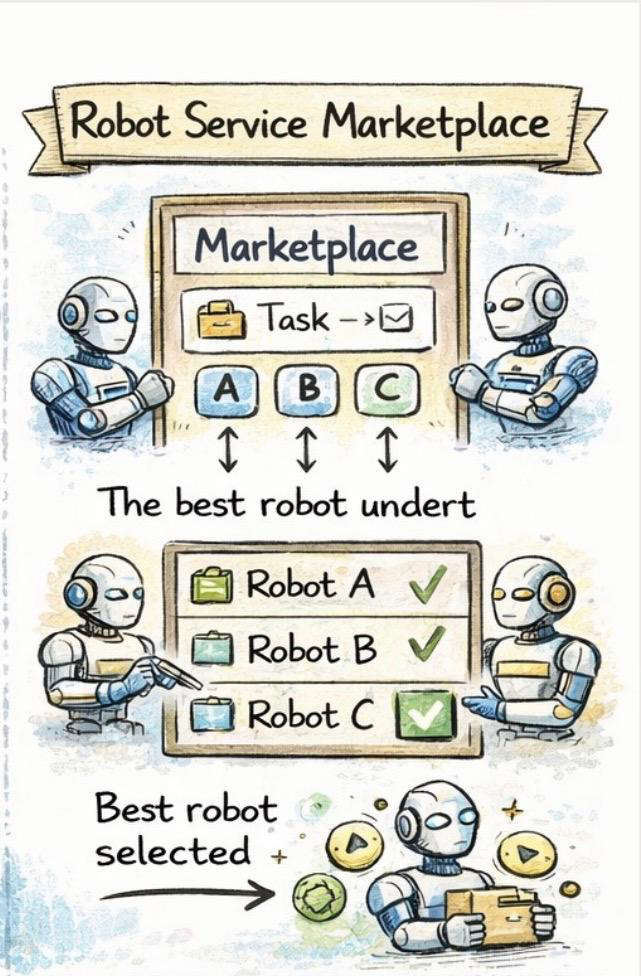
Imagine a network where robots can perform tasks for different users. A maintenance robot, a delivery robot, or a logistics machine could all offer services through the same protocol. Instead of assigning tasks manually, the system could evaluate available robots and determine which one is most suitable.
That decision might be based on several factors.
Performance history. Reliability. Cost efficiency. Completion speed.
In other words, machines could start building reputation and performance records.
And once that information exists, something interesting happens.
Robots stop being interchangeable tools.
They become participants in an economic system.
A robot that consistently performs tasks well could develop a strong reputation on the network. Another robot that frequently fails tasks might lose opportunities. Over time the system begins to reward reliability and efficiency automatically.
This idea sounds unusual at first, but when I think about how digital platforms already work, it doesn’t feel that strange.
Ride-sharing platforms rank drivers based on ratings and performance. Freelance platforms track the success rate of contractors. Delivery networks evaluate couriers based on reliability and speed.
Those systems already exist for humans.
Fabric’s infrastructure makes it possible to imagine something similar for machines.
Because the protocol records computation and coordination events through a public ledger, it becomes possible to track how robots perform over time. Tasks completed, tasks failed, reliability patterns — all of it can become part of a verifiable history.
And once that history exists, a network can begin to allocate work based on measurable performance.
That’s the moment where automation starts to evolve into something larger.
Not just machines executing instructions, but machines participating in competitive service environments.
From my perspective this raises a lot of fascinating questions.
Will certain robots become highly trusted on the network because of consistent performance? Will different types of machines specialize in specific tasks? Will operators begin improving robot designs simply to gain better reputation scores?
These dynamics start to look less like traditional robotics and more like a digital marketplace.
Fabric Protocol doesn’t create that marketplace on its own, but it provides the infrastructure that could support it.
The protocol coordinates data, computation, and governance through an open ledger. That means machine actions can be verified and recorded, which is essential if robots are going to interact with each other in shared economic environments.
Without that transparency, coordination becomes difficult.
With it, systems can begin to measure and compare performance.
And once performance becomes measurable, competition naturally follows.
What I find interesting is that the conversation around robotics still focuses mostly on hardware and intelligence. Faster robots, smarter algorithms, more advanced sensors.
Those things matter.
But the moment robots begin operating in open networks, the conversation may shift toward something else entirely.
Economic participation.
When machines start performing work that carries measurable value, systems will need ways to track reliability, allocate tasks, and reward performance.
Fabric Protocol looks like an early attempt to build that type of infrastructure.
Not just a network for robots to communicate, but a framework where machines can coordinate, prove their actions, and gradually build reputations over time.
And if the robot economy ever becomes real, the machines that perform best might not just work more efficiently.
They might simply get more opportunities to work.