
There's a moment every robotics engineer faces, usually late at night when deployment plans are being finalized. Someone asks a simple question that doesn't have a simple answer: how do we know this robot will behave the same way six months from now, after it's been transferred between facilities, updated by different teams, and exposed to situations we haven't anticipated yet?
The question sounds technical, but it's really about trust. And trust requires memory.
Fabric Foundation started from that exact place. Not from tokenomics or blockchain architecture, but from the understanding that robots operating across different organizations need something humans take for granted—a consistent identity that carries their history with them, regardless of who owns them or where they're deployed.
Think about how passports work. When you cross a border, officials don't call your previous country to verify your identity. They check your passport, which holds stamps and records accumulated over time. The document travels with you. Your history is portable.
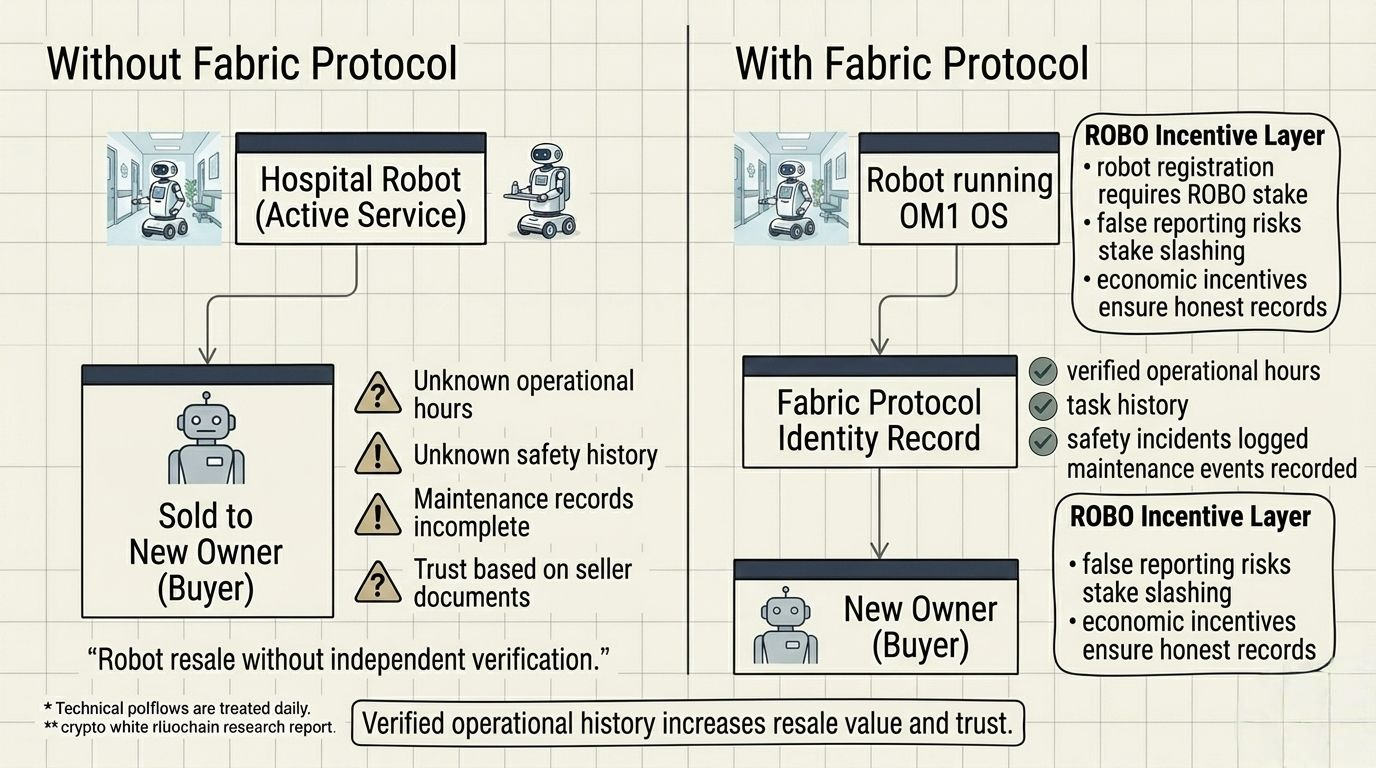
Robots don't have that yet. When a rehabilitation robot moves from a hospital in Berlin to a manufacturing facility in Jakarta, its operational history lives in the hospital's database. The new owner gets a PDF export, maybe some maintenance logs, and has to trust that the information is complete and accurate. There's no independent way to verify any of it.
Fabric Foundation built what amounts to a passport system for machines. Every robot running the OM1 operating system gets registered on Fabric Protocol with an identity that can't be erased or manipulated. Task completions, safety incidents, maintenance events, software updates—all recorded in a way that anyone can verify but no single party controls.
The elegance is in what this enables quietly. A factory considering used robots can check their operational history directly, without negotiating access to the previous owner's internal systems. An insurance company can verify safety records before issuing coverage. A logistics coordinator can confirm a robot's capabilities match the job requirements.
These aren't flashy use cases. They're the mundane infrastructure questions that determine whether robotics deployment scales beyond isolated proof-of-concept projects into actual industrial adoption.
ROBO shows up in this system not as a speculative vehicle but as a coordination mechanism. When someone registers a robot on Fabric Protocol, they stake ROBO as a bond. If they later submit false information about that robot's performance, the stake gets slashed. The economics create a disincentive for dishonesty that doesn't require trusting the operator's intentions.
It's similar to how security deposits work when renting an apartment. The landlord doesn't need to trust that you'll maintain the place properly. The deposit creates aligned incentives. Return the apartment in good condition, get your deposit back. Damage it, lose the deposit.
Fabric Foundation applied the same logic to robot identity verification. The stake amount isn't public yet, which makes modeling difficult, but the mechanism is straightforward. Economic consequences for false claims, economic rewards for accurate record-keeping.
What makes this interesting is how it interacts with the Circle partnership announced in February. Enterprises can pay for robot services in USDC, which they're comfortable holding, while the protocol handles conversion to ROBO for settlement with operators. The user experience stays familiar even as the backend runs on tokenized coordination.
There's something quietly clever about that design. It removes friction without removing functionality. Hospitals and factories don't need to think about ROBO volatility. They pay in stable currency. But the verification layer underneath still requires ROBO for its incentive alignment.
Most people think about robots as capital equipment purchased new and operated until obsolete. But that's not how markets usually develop. Cars have robust secondary markets. Industrial machinery gets resold regularly. Even aircraft change hands multiple times over their operational life.
Robots will follow the same pattern, assuming the verification problem gets solved. A hospital might deploy rehabilitation robots for two years, then upgrade to newer models with better capabilities. The previous generation still works fine, just not cutting-edge anymore. Selling them to smaller clinics or facilities in different markets makes economic sense.
But only if buyers can verify what they're purchasing. A used robot with 3,000 verified operational hours, zero safety incidents, and documented maintenance is worth substantially more than an identical model with unknown history. The difference might be thirty or forty percent of purchase price.
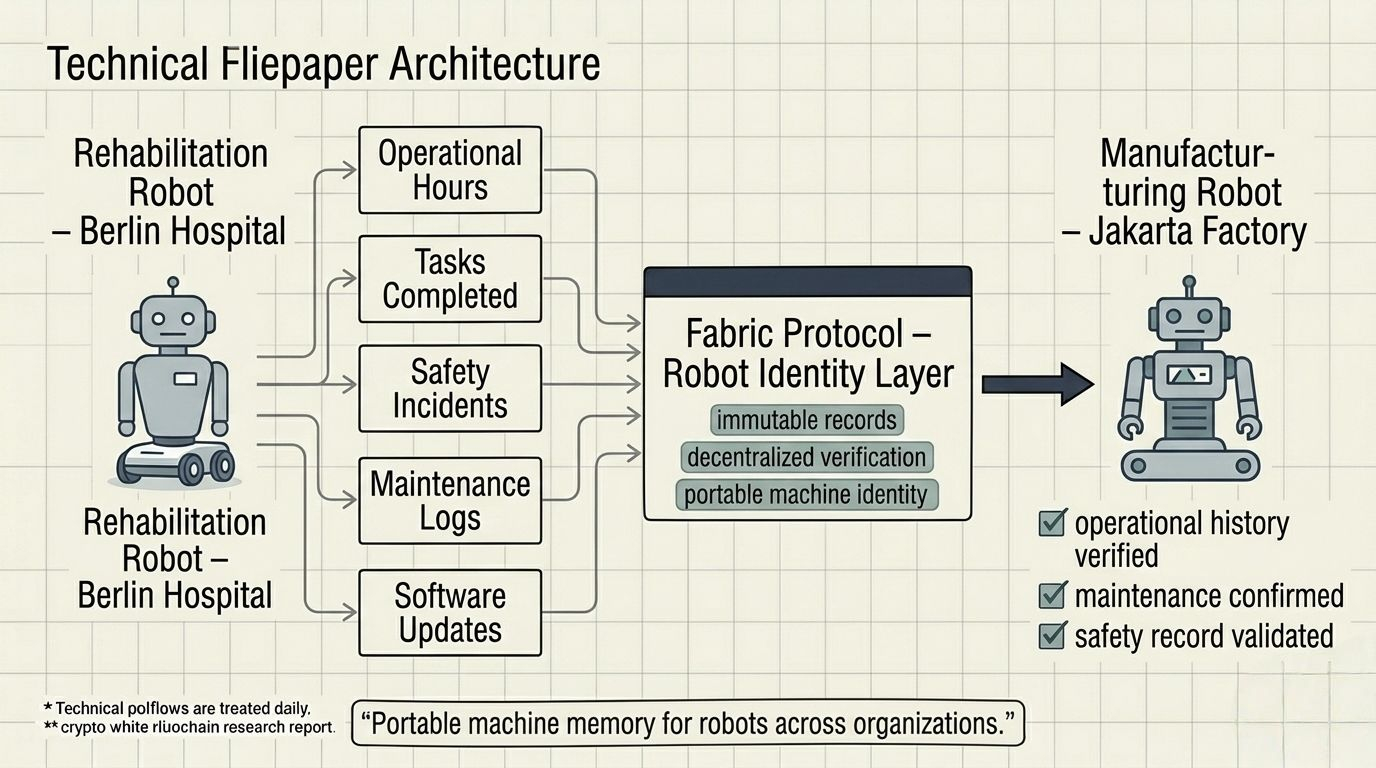
Fabric Foundation's identity system creates that verification layer. Not through corporate databases that buyers have to trust, but through public records that anyone can audit. The robot's history lives on Fabric Protocol, travels with the robot regardless of ownership changes, and can't be retroactively altered.
That's infrastructure. Not exciting, just essential.
Right now, we don't know how many robots are registered on Fabric Protocol with persistent identities. OpenMind delivered their first units in September 2025, and they've announced partnerships with UBTech, AgiBot, Fourier Intelligence, and Unitree. Those are real manufacturers shipping commercial hardware.
But partnership announcements and actual deployment numbers are different things. Ten robots prove the technology works. A hundred robots suggest early adoption. A thousand robots indicate real market traction.
The volume patterns around ROBO are unusual enough to notice. Trading volume consistently above market cap suggests either genuine network usage creating constant conversion flows, or sophisticated accumulation before metrics get published, or possibly both happening simultaneously.
Without transparency on registration numbers, task settlement volume, and x402 transaction flow, we're interpreting signals rather than analyzing data. That gap matters because it's the difference between validating a thesis and speculating about potential.
Fabric Foundation would strengthen their position considerably by publishing regular metrics. How many robots registered this month compared to last month? What percentage are actively settling tasks? How much USDC is flowing through x402 for autonomous payments?
Those numbers would clarify whether the infrastructure is being used or just being built.
The robotics industry has a coordination problem that gets worse as more manufacturers enter the market. Tesla builds Optimus, Boston Dynamics ships Atlas, Figure develops humanoid platforms, and Chinese manufacturers produce increasingly capable hardware at falling prices.
Each manufacturer has incentive to build proprietary ecosystems that lock in customers. That's standard competitive strategy. But it creates fragmentation that slows industry-wide adoption. Buyers hesitant to commit to one vendor's closed system delay deployment decisions. Insurance companies struggle to develop coverage models when every manufacturer uses different safety standards and reporting formats.
Neutral infrastructure helps everyone. Not by being altruistic, but by being useful to multiple competing interests simultaneously. Fabric Foundation doesn't compete with robot manufacturers. They provide coordination services those manufacturers could build individually but benefit from sharing collectively.
Whether that thesis actually plays out depends on adoption speed relative to competitors. If Tesla decides to build identity systems for Optimus and captures significant market share before Fabric Foundation gains traction, the neutral infrastructure advantage diminishes. If fragmentation persists long enough for buyers to demand interoperability, Fabric Foundation's positioning strengthens.
The timeline matters as much as the technology.
There's a simple test for whether Fabric Foundation built something the market needs. If registration numbers grow month over month without marketing hype driving them, that's organic demand. If task settlement volume increases as more robots come online, that's genuine usage. If enterprises choose Fabric Protocol for identity verification despite having proprietary alternatives available, that's validation.
The inverse signals matter too. If registration stalls, if operators find ways to coordinate without using the protocol, if manufacturers build competing standards that gain traction, the thesis breaks regardless of how elegant the architecture is.
Right now we're in the watching phase. The technology launched. The partnerships exist. The infrastructure is live. What happens next depends on whether robots actually need portable identity systems enough to adopt them, and whether Fabric Foundation's implementation serves that need better than alternatives.
The volume anomaly is interesting. The Circle integration is substantial. The manufacturer partnerships are real. But adoption metrics will answer the questions that matter.
Sometimes infrastructure gets built before markets are ready for it. Sometimes it arrives exactly when needed. The difference becomes clear when usage data emerges.
For now, the system exists. Robots can have memory that travels with them. Whether enough of them use it to make ROBO essential rather than optional—that story is still being written.
#ROBO @Fabric Foundation $ROBO
