Over the past week I’ve been running a small personal experiment. Not trading $ROBO aggressively, not predicting prices just watching how the idea behind it behaves when exposed to the market. And something interesting appears again and again: people rush to the price chart, but very few pause to ask how the system itself is supposed to work.
As of March 7, 2026, $ROBOUSDT continues trading around the $0.09–$0.10 range on Binance Futures. Open interest has been fluctuating between roughly $41 million and $45 million, while daily derivatives volume repeatedly pushes above $100 million. That tells us traders are active. But trading activity alone does not explain why the project is being discussed more widely across AI and DePIN circles.
The real conversation sits deeper in the architecture of the Fabric ecosystem.
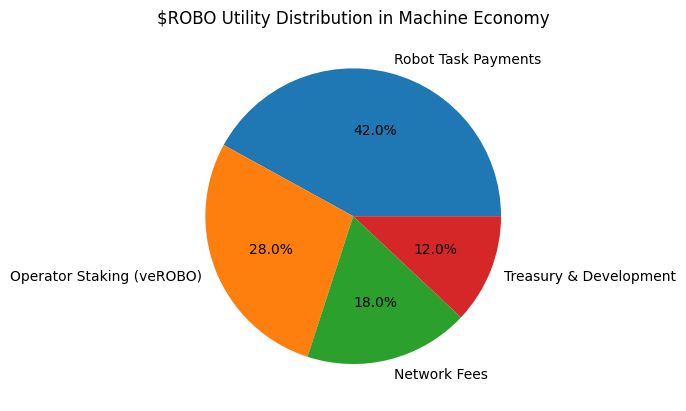
Fabric proposes something unusual in crypto: a network where machines can prove they completed real-world tasks and receive economic rewards through blockchain verification. The mechanism behind this is called Proof of Robotic Work. In simple terms, the system records robotic activity delivery runs, inspections, data collection and verifies that activity on-chain so the network can reward the machine operator with $ROBO tokens.At first glance it sounds futuristic. But when you break it down, the logic is surprisingly simple.A robot performs a task. The network verifies that task happened. The system logs the work permanently. Payment follows verification.What makes this possible is the identity layer known as RID, or Robot Identity. Each machine receives a verifiable digital identity inside the network. Without that identity, the system cannot track performance, assign jobs, or evaluate reliability. Think of it like a passport for machines operating in an economic environment.Why does this matter to investors?Because blockchain systems only become valuable when they coordinate activity. In early crypto cycles, the activity was financial transactions. Later it expanded to NFTs, governance voting, and decentralized finance. Fabric is attempting to extend coordination into physical robotics.That is an ambitious direction. But ambition alone does not guarantee success.From a risk perspective, several uncertainties remain. Hardware adoption is one. Robots must actually connect to the network for Proof of Robotic Work to generate meaningful activity. If machine participation stays low, the economic loop cannot mature.Another challenge involves incentive design. The ROBO token plays multiple roles: rewarding work, supporting staking, and helping govern network upgrades. If those incentives do not align with real productivity, the system risks becoming speculative rather than functional.This is why I approach the project more like a research subject than a quick trade.Markets tend to compress complex ideas into short narratives. AI tokens, robotics tokens, infrastructure tokens. But real systems develop slowly. Developer tools must mature. Integration frameworks must stabilize. Data pipelines must prove reliable.Over the past few days, I’ve noticed developers discussing robot task frameworks and identity verification modules within the ecosystem. These are not headline events. They are small building blocks. But building blocks are what infrastructure actually looks like.At the same time, market volatility reminds us how early the experiment still is. Price swings of 20–30 percent within days are not unusual for new infrastructure tokens. That volatility reflects both curiosity and uncertainty.
So the question becomes simple.
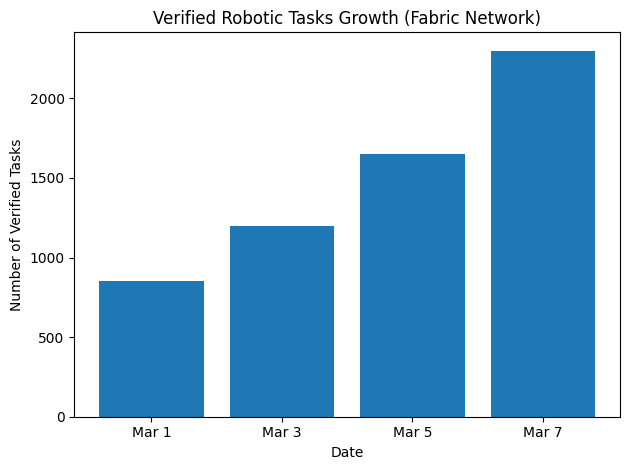
Is Fabric building a real coordination layer for machines, or is the market temporarily fascinated with the narrative?The answer will not come from price charts alone. It will come from adoption metrics: how many machines register identities, how many tasks are verified, and whether real economic activity begins flowing through the protocol.Personally, I find the concept intellectually compelling. But experience in crypto has taught me something important. Technology becomes meaningful only when it leaves the whitepaper and survives contact with reality.
And that process takes time.
For now, ROBO sits in that quiet stage between vision and proof. Traders see volatility. Researchers see an experiment. Builders see a potential infrastructure layer forming slowly in the background.
Sometimes the most valuable observation is simply patience.Because the future of machine economies if it arrives at all will not appear suddenly in a single bull run.
It will emerge piece by piece, one verified task at a time.
@Fabric Foundation #ROBO $ROBO