Introduction
Artificial intelligence is rapidly transforming industries around the world. From healthcare and finance to education and cybersecurity, AI systems are being used to generate information, automate decisions, and assist humans in solving complex problems. However, one major challenge continues to limit the reliability of artificial intelligence: trust in AI-generated outputs. AI models sometimes produce incorrect or fabricated information, commonly known as “AI hallucinations.”
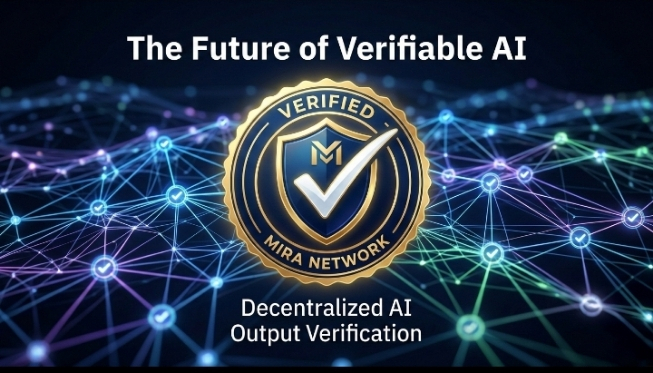
To address this challenge, @Mira - Trust Layer of AI has emerged as a blockchain-based project that aims to create a decentralized verification layer for artificial intelligence. By combining blockchain technology with AI infrastructure, Mira Network intends to ensure that AI outputs can be verified, audited, and trusted by users across different industries.
What is Mira Network?
Mira Network is a decentralized infrastructure designed to verify and validate AI-generated results. Instead of relying solely on a single AI model to produce accurate outputs, Mira introduces a system where multiple validators review and confirm AI responses through a blockchain-based consensus mechanism.
In simple terms, Mira Network acts as a “trust engine” for artificial intelligence systems. When an AI model produces information, the network verifies whether the result is reliable before it is accepted or used by applications. This mechanism can significantly reduce the risks associated with misinformation, inaccurate predictions, or misleading AI-generated content.
The ecosystem is powered by the $MIRA token, which functions as the native digital asset used to support the network’s operations. The token enables economic incentives for validators, developers, and participants who contribute to maintaining the reliability of the verification system.
The Role of the MIRA Token
The MIRA token plays several important roles within the ecosystem. It helps coordinate participation and maintain the security of the network.
One of its primary functions is staking. Validators must stake MIRA tokens to participate in verifying AI outputs. This mechanism encourages honest behavior because participants risk losing their staked tokens if they attempt to manipulate the system.
Another key use of the token is governance. Token holders can participate in decision-making processes related to network upgrades, protocol improvements, and future development strategies. This allows the Mira ecosystem to evolve through community participation rather than centralized control.
The token also serves as a payment mechanism for AI verification services. Developers or organizations that want their AI models verified can pay fees using MIRA tokens to access the network’s validation infrastructure.
Why Mira Network is Important
As artificial intelligence becomes deeply integrated into society, ensuring the accuracy and reliability of AI systems becomes increasingly important. Many industries cannot afford to rely on unverified AI outputs.
For example, in healthcare, an incorrect AI recommendation could lead to serious consequences for patients. In finance, unreliable AI analysis could affect investment decisions or risk assessments. Similarly, misinformation generated by AI systems can spread quickly across digital platforms.
Mira Network aims to solve this problem by creating a neutral and transparent verification framework where AI outputs can be validated before being trusted. Blockchain technology ensures that verification records remain immutable and transparent, which further increases confidence in the system.
This approach could help bridge the gap between AI innovation and public trust, enabling organizations to adopt AI technologies more safely.
Future Development and Growth
The long-term vision of Mira Network extends beyond simple verification. The project aims to develop a complete ecosystem where AI models, developers, and verification nodes interact through decentralized infrastructure.
Future development may include advanced tools that allow developers to integrate AI verification directly into applications. This could make Mira Network an essential layer for AI-driven services such as autonomous systems, data analytics platforms, and decentralized AI marketplaces.
Another potential development is the expansion of cross-chain compatibility, allowing the network to interact with multiple blockchain ecosystems. This would make Mira Network accessible to a broader range of decentralized applications and Web3 platforms.
As artificial intelligence continues to evolve, the demand for reliable AI systems will likely grow. Projects that focus on AI transparency and trust, such as Mira Network, could become fundamental components of the future digital economy.
Conclusion
Mira Network represents an innovative attempt to address one of the most critical challenges in modern technology: trustworthy artificial intelligence. By combining blockchain security with AI verification mechanisms, the network aims to ensure that AI-generated information can be validated and relied upon.
With the support of the MIRA token and a decentralized validation system, the project seeks to build a trustworthy environment where developers, organizations, and users can safely interact with AI technologies.
Although the project is still in its early stages, its concept aligns with the growing need for transparent, accountable, and reliable AI systems. If the ecosystem continues to develop and gain adoption, Mira Network could play an important role in shaping the future relationship between artificial intelligence and blockchain technology.
#MarketPullback #JobsDataShock #USJobsData #Mira #MİRA