
I started thinking differently about Fabric Foundation when I noticed how little of the robotics conversation is really about robots. Most of it is still about interfaces, uptime, telemetry, and orchestration. Then I looked at Fabric through a more operational lens, and it stopped feeling like a better software layer and started feeling like an attempt to solve a harder problem: what happens when a machine works across organizations that do not share one boss, one risk team, or one legal perimeter.
The public debate usually frames robotics infrastructure as a race toward more autonomy. Better models. Smarter agents. Faster loops between perception and action. I used to think that was the center of gravity too, until I watched more of the serious discussion move toward liability, permissions, compliance, and machine identity. The missing layer in cross-organizational robotics is not more visibility. It is governable authority.
That is why Fabric protocol reads as a more mature posture to me. A project signals its risk culture by what it treats as core infrastructure rather than future polish. Plenty of systems are happy to show what a robot did. Far fewer systems are built to prove who was allowed to make it do that, when the authority changed, and how that decision can be audited later. What looks like slower product design from the outside often turns out to be a tighter understanding of what breaks first in real deployment.
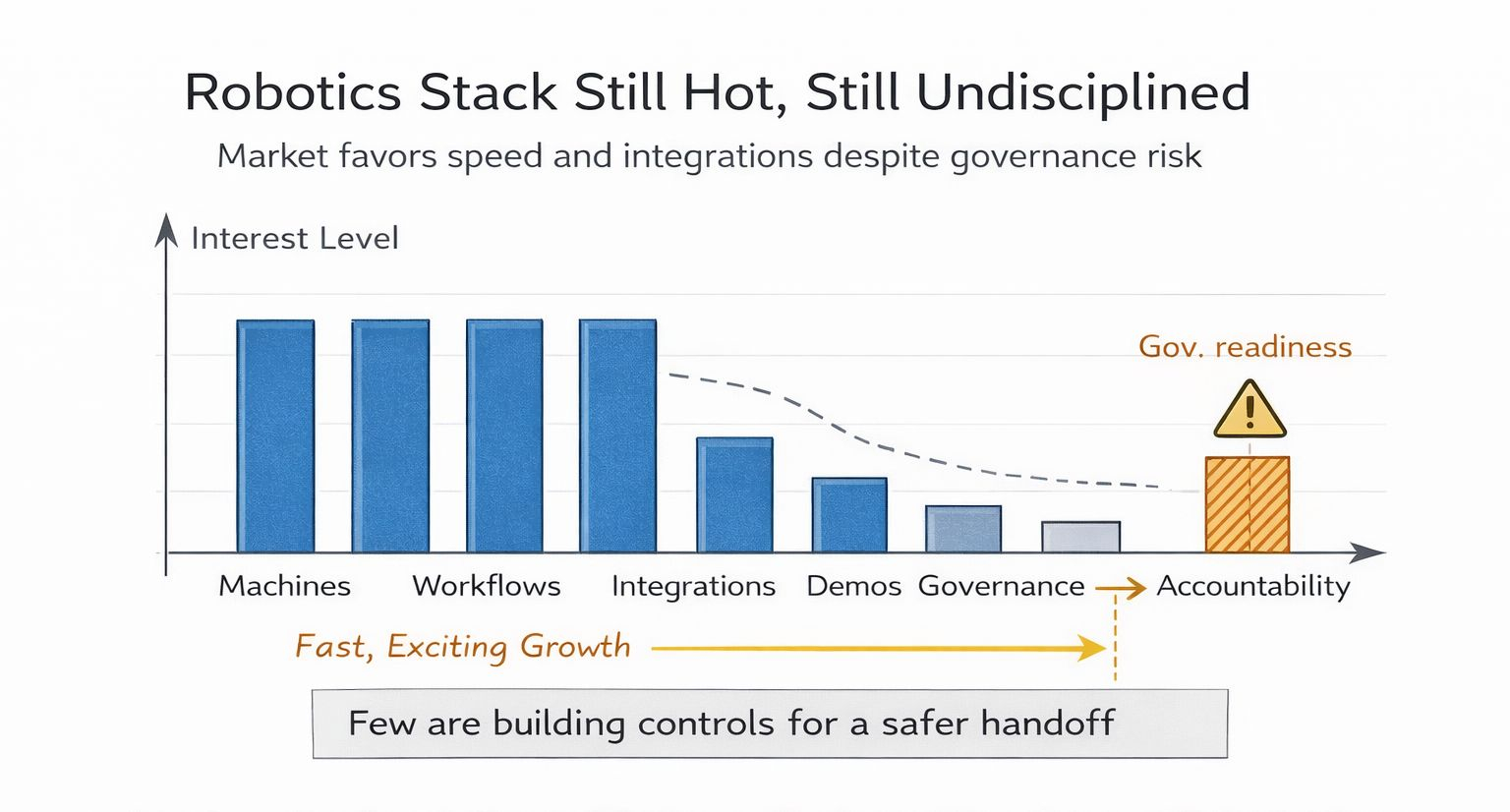
The broader market still feels like a manufacturing floor running hot with no inspection discipline. Everyone wants more machines, more integrations, more workflows, more demos that look like progress. But motion is not governance, and access is not accountability. Every time I look at the current robotics stack, it feels less like an operating model and more like a relay race where nobody wants to hold the baton for the handoff. The industry is still acting as if shared-machine operations can be managed with admin panels, chat approvals, and loose service contracts stitched together after the fact.
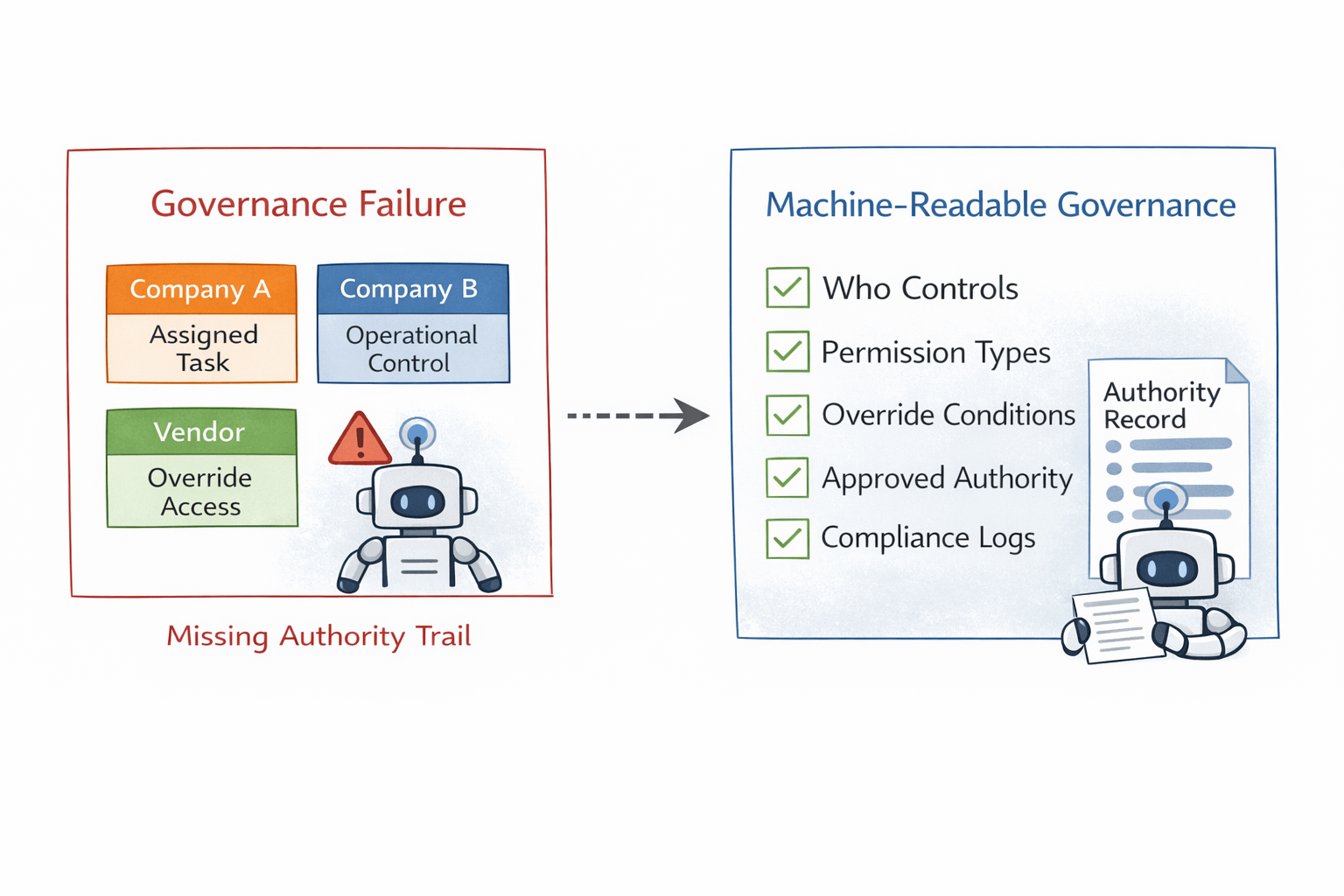
Fabric’s stance seems to be warning against exactly that. I once watched a routine multi-party pilot fail in the most boring way possible: not because the robot crashed, but because a warehouse task went wrong and nobody could prove who had control at that exact moment. One company had assigned the job. Another had temporary operational access. A third-party maintenance vendor had override privileges from the night before. The logs existed, but the authority trail did not. That is the kind of failure Fabric foundation appears to take seriously. Instead of treating governance as a committee layer above the machine, it treats governance as machine-readable infrastructure: who controls the robot, what permissions exist under that control, what conditions can trigger overrides, how shared authority is approved, and how compliance evidence survives after the task is done. This is not governance as branding. It is governance as execution discipline.
This is a move from centralized robot management to shared-control infrastructure.
The market is often cold to what Fabric Foundation is really building because governance does not photograph well. I did not really understand why infrastructure names with stronger controls often trade like homework until I thought about who they are building for. Dashboards are easy to demo. Governance systems are harder because the value only becomes obvious when something goes wrong, when a regulator asks questions, or when two institutions need to trust the same machine without trusting each other. In early markets, people tend to pay for visible throughput and assume the control layer can be added later. That reaction is normal. It is the same reason audit trails, treasury controls, and permissions frameworks usually look unexciting right before they become non-negotiable.
But the logic still holds. The first serious buyers will not be people chasing novelty. They will be operations teams, compliance leads, enterprise procurement, insurers, and regulators who need machine actions they can actually defend. When I first looked at Fabric foundation from that angle, it did not feel like a protocol trying to out-market everyone. It felt like a system being designed for the uncomfortable meeting after deployment, when somebody asks who approved what, who inherited authority, and whether the machine was even allowed to act under those conditions. Those are not edge questions. In shared robotics environments, they are the product.
Looking out over the next 12 to 24 months, I think this becomes harder for the market to ignore. More robots will move into environments where one operator, one owner, and one compliance domain are no longer the norm. That means authority will need to travel across organizations without turning into ambiguity. The more I think about where robotics adoption actually slows down, the more obvious it becomes: the bottleneck is not just intelligence, it is coordination with consequences. Once robots start handling inventory, site access, inspection routines, and cross-party service work, governance stops being a nice layer on top and becomes part of the minimum viable stack. Shared authority systems, policy-bound permissions, provenance trails, and machine-level compliance records start looking less like enterprise extras and more like the cost of entry.
That shift also changes how I think about token value in systems like $ROBO. Action is cheap. Accountability is infrastructure. If robots are going to transact, coordinate, or be governed across multiple stakeholders, the value does not sit only in motion or usage. It sits in the rails that make actions legible, permissions enforceable, and disputes resolvable. Once governance becomes programmable at the machine level, the network is no longer just coordinating robots. It is underwriting trust between institutions that would otherwise need manual oversight at every step.
That is the prize here. Not louder automation, not prettier command centers, not another software layer pretending to be governance because it has charts. Everyone wants autonomous. Few want accountable. Fabric foundation’s real bet, as I see it, is that the teams who matter most will eventually choose accountable systems first, because institutional trust is the only category that compounds when robotics leaves the lab and enters the world.
@Fabric Foundation #ROBO $ROBO
