

I have spent enough time integrating protocols to know that most narratives fall apart the moment real participation begins. Dashboards can show growth, token charts can trend upward, but the real question is always the same: what secures the work?
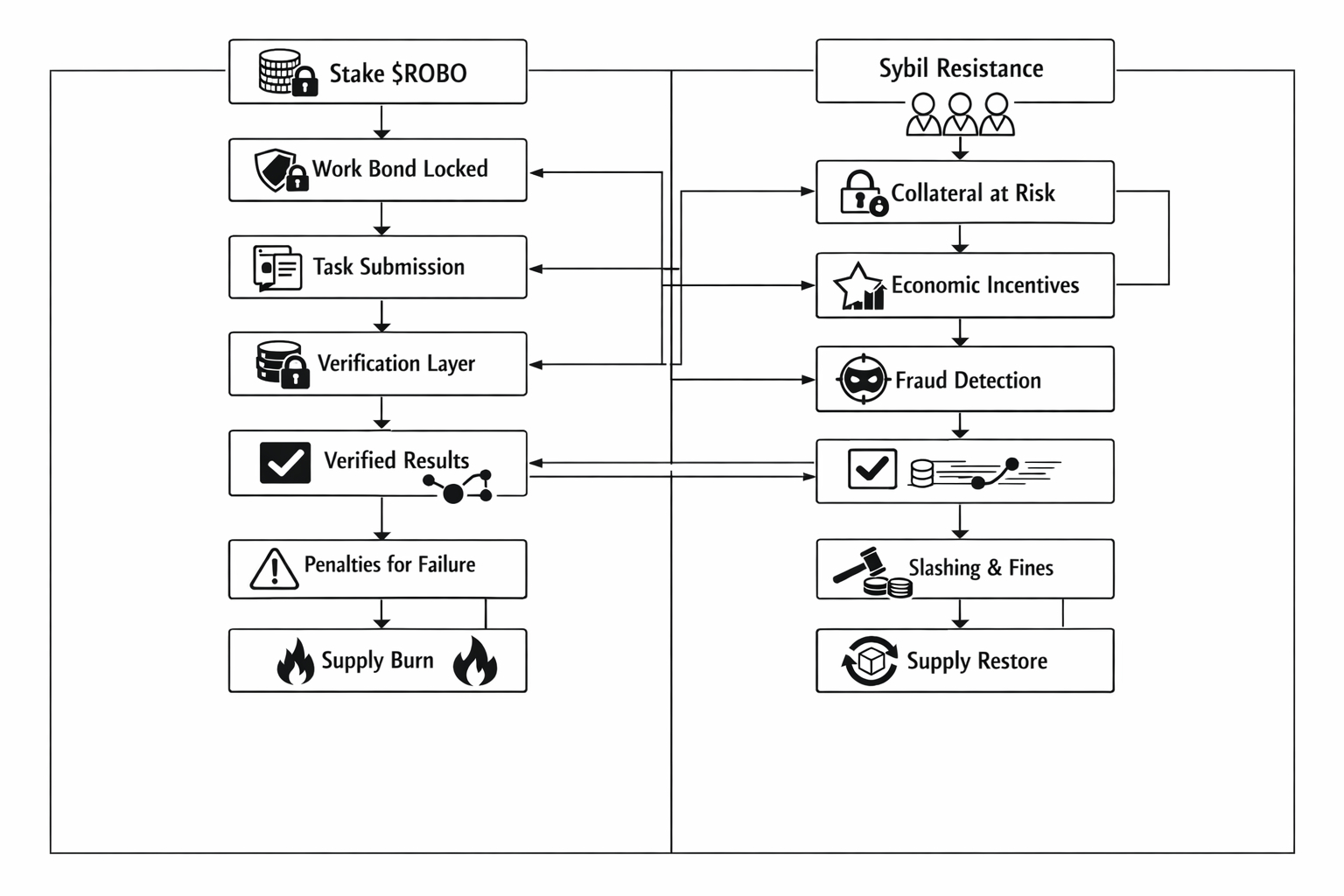
With Fabric Protocol and $ROBO, that question becomes particularly important because the system is trying to coordinate autonomous agents and robotic execution. When people ask whether staking secures robot validation, the honest answer is that staking doesn’t “validate robots” in the physical sense — it secures the economic layer that validates work claims.
In practice, staking acts as a bond behind participation. If a node operator, robot controller, or agent claims to have completed a task, the system needs a way to ensure that claim isn’t cheap to fake. Fees alone can’t do that. Anyone can pay a small transaction cost. What changes behavior is stake at risk. When participants must lock $ROBO to enter the coordination layer, they attach economic consequences to the quality of their work.
That’s where the infrastructure logic becomes more interesting than the token narrative. A lot of crypto projects rely on fee-based access — you pay a transaction cost, interact with the protocol, and move on. The protocol doesn’t really care who you are or how often you appear. That model works for payments, but it collapses when you’re trying to coordinate real work between autonomous systems.
Fabric approaches this differently. Entry into certain participation layers is stake-weighted. Operators commit ROBO As a work bond, which creates a measurable cost to misbehavior. If a participant attempts to spam tasks, falsify results, or operate multiple fake identities, that stake becomes a liability rather than an advantage.
This is where Sybil resistance stops being theoretical. In a fee-only environment, spinning up thousands of identities is just a matter of paying small costs repeatedly. In a bonded environment, every additional identity requires additional locked capital. The protocol doesn’t need to guess who is legitimate — it simply raises the economic barrier high enough that dishonest participation becomes irrational.
The difference between these models becomes clearer when you think about validation. In many decentralized systems, validation is loosely defined: submit data, pay a fee, receive a reward. But when the network coordinates robotic or agent-based tasks, validation requires stronger guarantees. The network must know that a result was produced, that it was performed by a committed participant, and that penalties exist if the work turns out to be fraudulent.
That is where staking secures the validation process. It doesn’t prove the work directly — that still depends on verification layers and off-chain signals — but it ensures that whoever submits the work has collateral at risk.
The second question that comes up often is whether $ROBO is inflationary or fixed supply. From the contract perspective, the token operates with a maximum supply cap, which means the system cannot inflate beyond that defined limit. However, the design includes burn mechanics and the ability to restore supply back toward the cap under controlled conditions.
That nuance matters. A fixed cap sets the outer boundary of issuance, but burn-and-restore mechanics introduce flexibility inside that boundary. In other words, the supply can contract temporarily through burns, and later be restored up to the maximum if the protocol’s rules allow it.
For infrastructure builders, this matters less as a trading narrative and more as a governance question. Who controls restoration authority? Under what conditions is supply reintroduced? Are these decisions automated by governance or controlled by privileged roles? These are the questions that determine whether a token system behaves like a decentralized economic layer or simply a centrally adjustable one.
The deeper you look into Fabric’s structure, the clearer it becomes that the token is not meant to function purely as a speculative asset. It sits inside a participation framework where staking determines access, influence, and accountability.
And that changes how you evaluate it.
When I look at systems like this, I don’t focus on adoption charts or token velocity. I focus on how the protocol enforces behavior when things go wrong. What happens when someone lies about completed work? What prevents a single actor from dominating the system? How expensive is it to attack participation?
These questions rarely appear in marketing threads, but they are the ones that decide whether a network survives real usage.
In the case of Fabric and $ROBO, the architecture points toward an enforcement-first philosophy: stake-weighted entry, bonded participation, and economic penalties tied to verifiable work claims. Those mechanisms are not glamorous, but they are the pieces that make autonomous coordination possible.
In my experience, the difference between infrastructure that survives and infrastructure that fades usually comes down to one thing.
Marketing can create narratives.
But only enforcement creates systems that people can actually trust.
@Fabric Foundation #robo #ROBO
