Most protocols talk about AI integration like it is a feature you add later. A checkbox. Something to mention in a press release.
Mira thinks about it differently.
For Mira, AI is not a product. It is a function. Something that makes the core protocol sharper, faster, and more accurate at doing the thing it was built to do: manage liquidity better than any human can.
Let me walk you through how each piece connects.
---
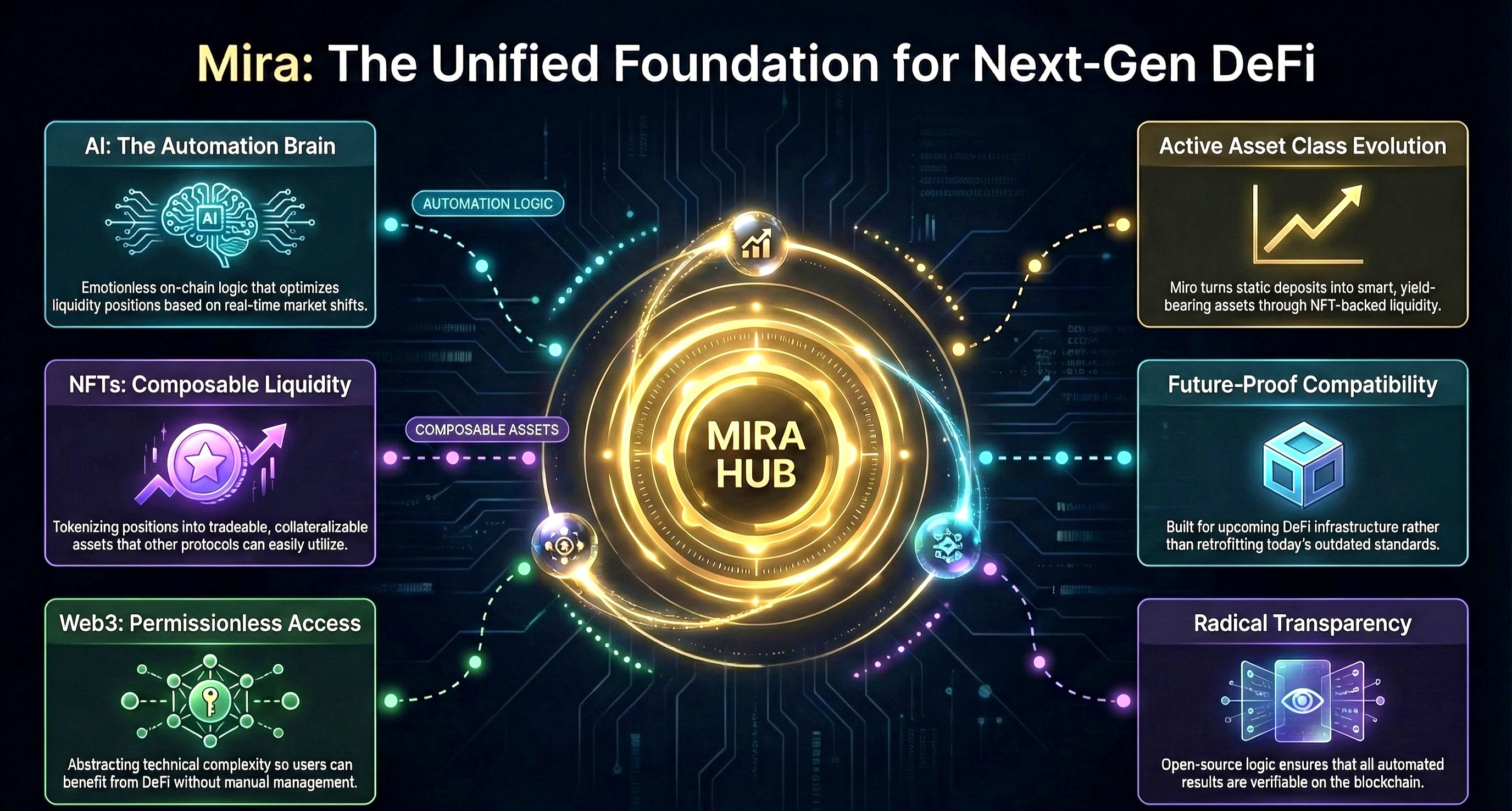
AI: The Brain Behind the Automation
Managing concentrated liquidity is not a simple job.
Price ranges shift. Fee tiers change. Gas costs spike. The optimal position at 9 AM is often the wrong position by noon.
Mira uses on-chain logic that works like a trained system. It reads conditions. It calculates outcomes. It acts only when the action is worth the cost. Every decision is made without emotion. Without delay. Without human error.
This is where AI-aligned architecture creates a real edge.
As machine learning tools become more embedded in DeFi infrastructure, protocols that already operate on clean logic and verifiable data are the ones that will integrate smoothly. Mira is building toward that compatibility intentionally. Not retrofitting it later.
The goal is simple. A protocol that gets smarter over time without requiring constant rebuilding.
---
NFTs: Beyond Collectibles
Most people still think of NFTs as pictures of monkeys or trading cards.
That framing is outdated.
The more interesting use case for NFTs in 2024 and beyond is representing real on-chain positions. Ownership stakes in liquidity pools. Fee rights tied to specific ranges. Composable assets that other protocols can read and interact with.
Mira's liquidity positions have the structural foundation to be treated exactly this way.
When a liquidity position is tokenized as an NFT, it becomes tradeable, collateralizable, and composable. Another protocol can accept it as collateral. A marketplace can list it. A yield aggregator can stack returns on top of it.
That turns a passive deposit into an active asset class.
Mira is not chasing the NFT trend. It is building the infrastructure layer that makes NFT-backed liquidity positions actually useful.
---
Web3: The Bigger Picture
Web3 promised a financial system where anyone could participate without asking permission.
The reality has been messier. Most DeFi protocols are still too complex for the average person to use well. Gas costs punish small positions. Manual management demands constant attention. The promise of permissionless finance only works if the tools are good enough to use.
Mira addresses this directly.
Automated liquidity management lowers the barrier to entry. A user does not need to understand price ranges or fee tiers to benefit from them. The protocol handles that layer. The user just deposits and earns.
As Web3 expands to new users on new chains, protocols that abstract complexity without hiding transparency will be the ones that survive and scale.
Mira is open source. The logic is readable by anyone. The results are visible on chain. That combination of accessibility and transparency is exactly what Web3 was supposed to be.
---
How It All Connects
Here is the simple version.
AI thinking shapes how Mira's automation logic gets smarter. NFT composability turns Mira positions into assets that other Web3 protocols can use. Web3 principles mean the whole system stays open, verifiable, and accessible.
These are not three separate features.
They are one connected approach to building a protocol that belongs in the next generation of decentralized finance.
Most DeFi protocols were built for the DeFi that exists today.
Mira is building for the DeFi that is coming.
---
Educational content. Not financial advice. Always do your own research.