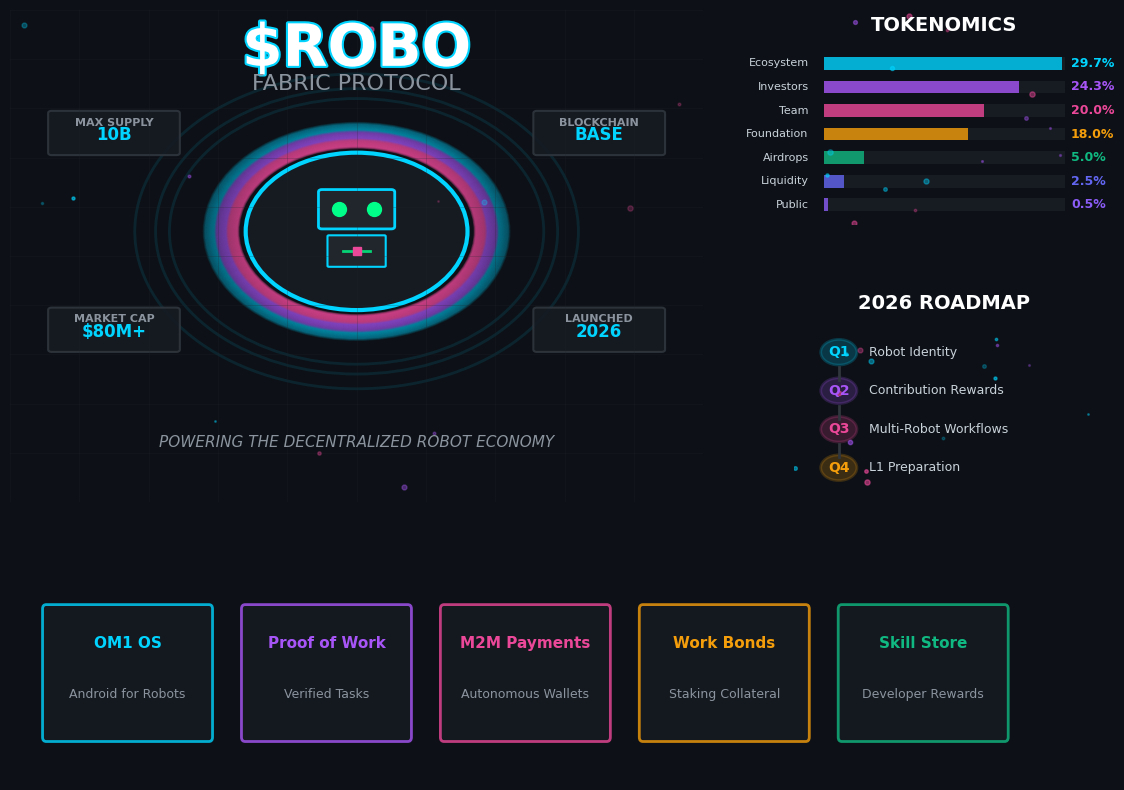
The Vision: Own the Robot Economy
Fabric Protocol is tackling one of the most fascinating problems in tech: how do we enable robots to become autonomous economic participants? Unlike humans, robots can't open bank accounts or hold passports—they need blockchain infrastructure to verify identity, settle payments, and coordinate work. That's where $ROBO comes in. It's not just another AI token riding the hype wave; it's attempting to build the foundational economic layer for physical robotics.
What Makes It Different
While projects like Bittensor (TAO) focus on distributed AI compute, Fabric is laser-focused on physical robot coordination. The protocol combines the OM1 operating system (essentially "Android for Robotics") with blockchain-native infrastructure, allowing robots from different manufacturers—like UBTech, AgiBot, and Fourier—to communicate, share skills, and transact autonomously. This addresses the "Isolation Problem" where robot fleets currently operate in closed, incompatible loops.
The Proof-of-Robotic-Work consensus is particularly interesting—it rewards verified real-world tasks rather than passive staking. Robot operators stake $ROBO as work bonds (collateral that gets slashed for fraud), while developers earn tokens for building skill modules that robots actually use. This creates genuine utility demand rather than speculative holding.
Tokenomics & Structure
With a fixed 10B supply, the distribution favors long-term sustainability: 29.7% to ecosystem/community (largest allocation), 24.3% to investors, and 20% to team—all with 12-month cliffs and 36-month vesting. No insider tokens unlock in year one, which is rare and reassuring. The Adaptive Emission Engine dynamically adjusts rewards based on network utilization and quality metrics, preventing the inflationary death spirals seen in other DePIN projects.
2026 Roadmap & Development Trajectory
The project is currently live on Base (EVM) with a clear migration path:
Q1 2026: Robot identity modules and task settlement live
Q2 2026: Contribution-based incentives for verified work
Q3 2026: Multi-robot coordination workflows
Q4 2026: Governance refinement and L1 technical groundwork
2027-2028: Robot Skill App Store launch for global developers
2029-2030+: Migration to Fabric Layer-1—a dedicated machine-native blockchain
This L1 transition is crucial. By moving from Base to their own chain, Fabric aims to capture economic value directly at the infrastructure level rather than paying rent to Ethereum L2s.
The Bull Case
The timing is compelling. We're entering an era where humanoid robots are transitioning from research curiosities to commercial deployments. Fabric has already raised 20M from Pantera Capital and secured listings on Binance, Coinbase, and Bybit. The revenue buyback mechanism (protocol revenue used to purchaseROBO on the open market) creates persistent demand pressure.
The Risks
Let's be real—this is ambitious tech with execution risk. Over 80% of supply is currently locked, meaning future vesting could create sell pressure. The project needs real robot fleets to generate meaningful fee revenue, and that adoption curve is uncertain. Plus, migrating to an L1 is technically complex.
Bottom Line
$ROBO represents a legitimate attempt to build infrastructure for the "Robot Economy" rather than just speculating on it. The focus on physical robotics (not just AI models), the non-profit foundation structure, and the work-based reward mechanism suggest a team thinking long-term. If autonomous robots become even half as ubiquitous as smartphones, the protocol coordinating them could be extremely valuable. But as with any early-stage infrastructure play, you're betting on execution over years, not months.