Introduction
The rapid evolution of artificial intelligence, robotics, and blockchain technology is creating a new digital economy where machines may eventually perform tasks, earn payments, and interact autonomously. One project aiming to build the infrastructure for this future is the @Fabric Foundation and its native cryptocurrency $ROBO
Fabric Protocol represents a new category of blockchain innovation that connects robots, AI systems, and decentralized finance. Instead of machines operating under centralized corporate control, Fabric aims to build an open network where robots can interact, verify work, and receive payments through blockchain technology.
This concept is often referred to as the “robot economy,” a decentralized system where intelligent machines participate in global economic activity.
What is the Fabric Foundation?
The Fabric Foundation is a nonprofit organization focused on developing the governance and economic infrastructure needed for a world where humans and intelligent machines collaborate safely and productively.
The foundation works closely with OpenMind, a robotics and AI infrastructure company that helps develop the protocol. OpenMind raised around $20 million in funding from major investors including Pantera Capital, Coinbase Ventures, and Digital Currency Group, demonstrating strong institutional interest in the project.
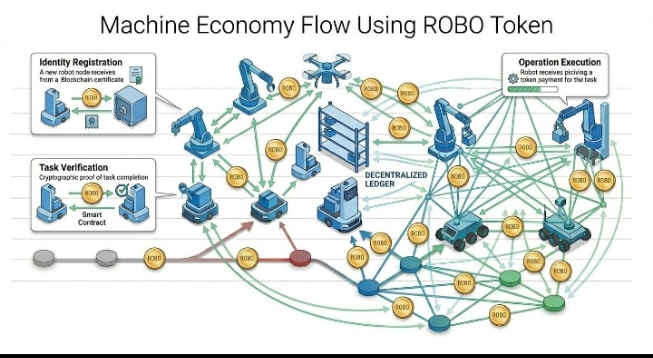
The main goal of Fabric is to create a decentralized network that allows robots to:
• Have verified digital identities
• Hold crypto wallets for payments
• Participate in autonomous work markets
• Communicate and coordinate with other machines
Through blockchain technology, Fabric attempts to solve the current problem where robotic systems operate in isolated environments controlled by individual companies.
What is the ROBO Token?
The ROBO token is the native cryptocurrency of the Fabric ecosystem. It acts as the utility, governance, and settlement asset for the network.
The token has a total supply of 10 billion tokens and is used for several important functions within the protocol.
Main Uses of ROBO
• Network Payments
Robots performing tasks or services within the Fabric ecosystem receive payments in ROBO.
• Identity Verification
Machines on the network require blockchain identities, and verification fees are paid in ROBO.
•Staking and Participation
Users and developers stake ROBO to access coordination functions and participate in network operations.
• Governance
Token holders can vote on protocol decisions such as fees, upgrades, and policies.
The token is also connected to a unique concept known as “Proof of Robotic Work.” This model distributes tokens based on real robotic activity rather than simple staking or mining, aligning incentives with real-world productivity.
Development and Ecosystem Growth
The ROBO token launched publicly in February 2026, with listings on several cryptocurrency exchanges and promotional campaigns that helped attract early users and liquidity.
The protocol currently operates on Base, an Ethereum Layer-2 network that provides lower fees and faster transactions. However, the project plans to eventually migrate to its own Layer-1 blockchain designed specifically for machine-to-machine interactions and robotic coordination.
Fabric also envisions building an ecosystem where developers can create applications that connect with robots performing tasks in industries such as:
• logistics and delivery
• manufacturing automation
• security monitoring
• agriculture and farming
• smart cities
In this system, robots could autonomously accept tasks, perform them, and receive payment through blockchain transactions.
Future Potential of Fabric and ROBO
The long-term vision of Fabric Protocol is to build what some researchers call the “Internet of Robots.” In this future scenario, machines could interact economically with humans and other machines using decentralized networks.
Several factors could drive the growth of this concept:
1. Growth of AI and Robotics
The robotics industry is expanding rapidly as AI systems become more capable of performing complex physical tasks.
2. Machine-to-Machine Payments
Blockchain enables automated payments between devices without intermediaries.
3. Decentralized Infrastructure
Open protocols allow developers and companies worldwide to build robotics services without relying on centralized platforms.
If these trends continue, Fabric Protocol could become a foundational layer connecting robotics, AI, and decentralized finance.
Risks and Challenges
Despite its ambitious vision, Fabric Protocol still faces several challenges:
• Early stage development
• Regulatory uncertainty
• Adoption by robotics companies
• volatility of new cryptocurrencies
Many of these factors will determine whether ROBO becomes a major infrastructure token or remains a niche project.
✅ Conclusion
Fabric Foundation and the ROBO token represent an ambitious attempt to combine AI, robotics, and blockchain technology into a decentralized economic system. By enabling robots to have digital identities, wallets, and autonomous economic participation, the project aims to create a global network where machines can collaborate and perform work in a transparent and decentralized way.
If the concept of a robot economy becomes reality in the coming decades, Fabric Protocol could potentially become one of the core infrastructures powering this new technological era.
#ROBO #MarketPullback #USJobsData #AltcoinSeasonTalkTwoYearLow #JobsDataShock