
For a long time, robotics felt like a show. You see clips of robots flipping in the air, running obstacle courses, balancing on two legs like humans. Drones dropping food. Machines dancing. It looks futuristic. It looks exciting.
I used to enjoy those videos too.
But after spending about five years deep in crypto, you start looking at technology a bit differently. Hype doesn’t impress you as easily anymore. You begin asking harder questions. How does this actually work? Who verifies it? What happens when something goes wrong?
That’s where things get interesting with robots.
Because the real problem isn’t always the robot itself. The real problem is proving what the robot actually did.
Imagine a delivery robot. It leaves a warehouse with a package and drives across town. Later the customer complains that nothing arrived. Now what? The company checks its logs. Maybe there are some screenshots or internal camera recordings. But those records are owned by the same company operating the robot. There’s no neutral record. No shared truth that everyone can rely on.
And the robot itself? It doesn’t really exist in any official sense.
No identity. No wallet. No history that other systems can trust.
Today most robot fleets live inside closed environments. One company owns the machines, runs the software, stores the data, and handles all payments internally. Everything stays within that company’s ecosystem. It works for internal operations. But the moment robots start interacting with the outside world, things become messy.
That gap is what caught my attention when I started looking into Fabric Protocol.
The project isn’t obsessed with making robots smarter or faster. Instead, it focuses on something more practical. Something that doesn’t get flashy headlines.
Proof of work. Not the blockchain kind. Real work.
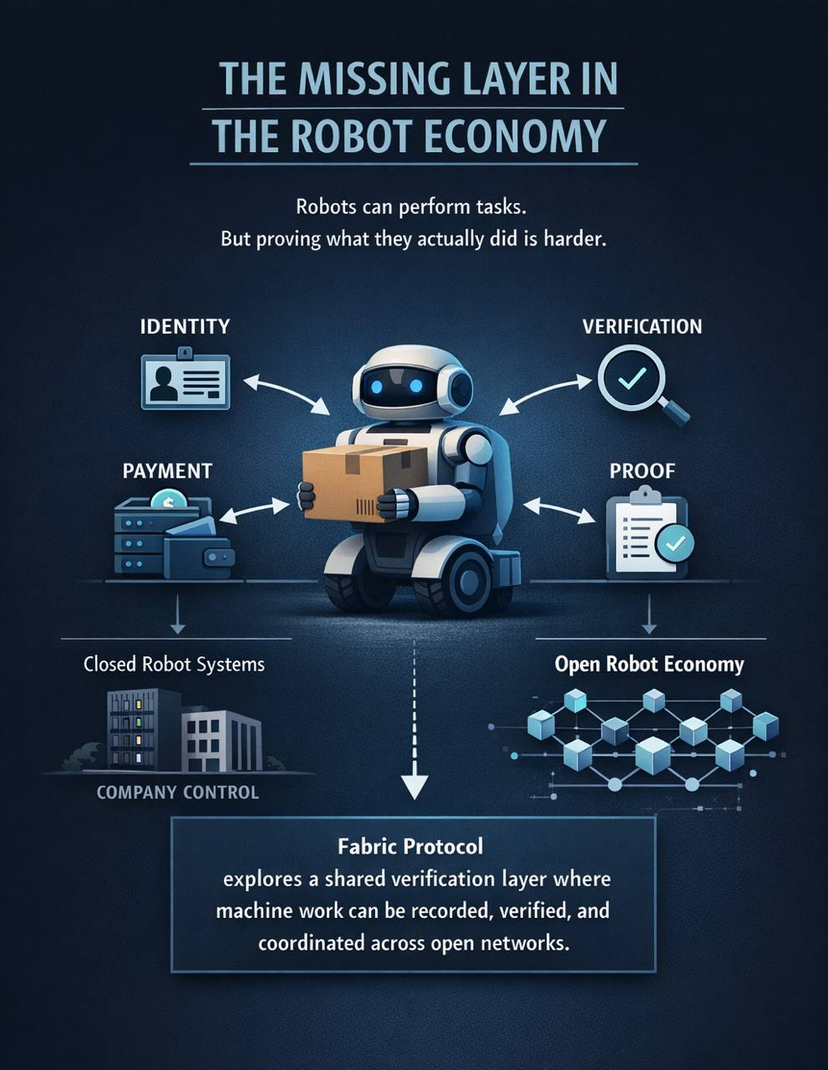
Fabric starts with a simple assumption. If machines are going to participate in economic activity, they need economic infrastructure. That means identity. Payments. Reputation. Verifiable records of what they’ve done.
Without those pieces, robots remain tools locked inside private systems.
With those pieces, they start behaving more like participants in a network.
So the first step in Fabric’s model is identity. Every robot gets a cryptographic identifier. Think of it like a digital passport. Once registered, that robot can sign actions, interact with the network, and prove that certain tasks came from it.
Over time something important happens. The robot builds a history.
Maybe it delivered ten packages. Then a hundred. Then ten thousand. Each job becomes part of its public record. Anyone interacting with that machine can see its track record. In a way, it becomes reputation for machines.
And reputation matters. Even for robots.
A delivery drone with thousands of successful deliveries will always be trusted more than a brand-new one with no history.
Fabric also introduces a marketplace for robotic work. Jobs can be posted on the network. Robots capable of doing the job can accept it. When the task is completed, proof is submitted and payment is handled automatically through smart contracts.
If you’ve spent time in crypto, this idea probably feels familiar.
Blockchains already allow strangers to coordinate without trusting each other directly. Smart contracts enforce rules. Payments settle automatically. Fabric simply pushes that model into the physical world where machines are doing the work.
The system itself started on Base, an Ethereum Layer-2 network. From a technical standpoint, that’s a practical decision. Ethereum already has security, wallets, developer tools, and a huge ecosystem. Launching there lets Fabric plug into infrastructure that already exists.
But long term, the vision goes further.
If robots start interacting heavily with the network, they could generate huge numbers of small transactions. Status updates. Task confirmations. Data logs. That kind of activity might eventually require a specialized blockchain built specifically for machine coordination.
At the center of the ecosystem sits the ROBO token.
It’s used for payments across the network. It’s also staked when robots register, which creates accountability. If a participant behaves badly, the economic cost is real.
One idea Fabric introduces is something called Proof of Robotic Work.
Instead of rewarding miners for solving puzzles or validators for locking tokens, rewards are tied to real-world actions performed by machines. A robot completes a verified task. The network recognizes that contribution. Tokens are issued accordingly.
It’s an attempt to connect digital incentives with physical productivity.
That sounds powerful. But it’s also where things get complicated.
Because verifying physical events is hard.
Blockchains are great at proving digital activity. A transaction either happened or it didn’t. The chain records it permanently. But the real world is messy. Sensors fail. Hardware can be tampered with. Data feeds can be manipulated.
So the entire system depends heavily on reliable hardware and secure reporting mechanisms.
Then there’s the adoption challenge.
Most robots today are controlled by companies that operate behind closed doors. They own the machines. They own the data. Opening that infrastructure to a shared network might not be attractive to everyone.
And regulation? That’s another unknown.
The idea of machines participating in financial systems raises legal questions that many governments haven’t even started addressing yet.
Then, of course, there’s the reality every crypto veteran understands.
Tokens attract speculation. Sometimes faster than real usage.
Fabric has already raised around twenty million dollars in funding and the ROBO token gained attention when it started trading on exchanges including Binance. That visibility helps. But from experience, listings don’t guarantee long-term success.
Only real adoption does.
Machines actually using the network. Robots completing tasks. Data being verified. Payments flowing through the system.
That’s the real test.
What makes Fabric interesting is where it sits in the broader technology landscape. Three massive trends are unfolding at the same time.
Artificial intelligence is making machines smarter. Robotics is giving them the ability to interact with the physical world. Blockchain technology is creating new ways to coordinate trust and value.
Fabric sits right in the middle of those three forces.
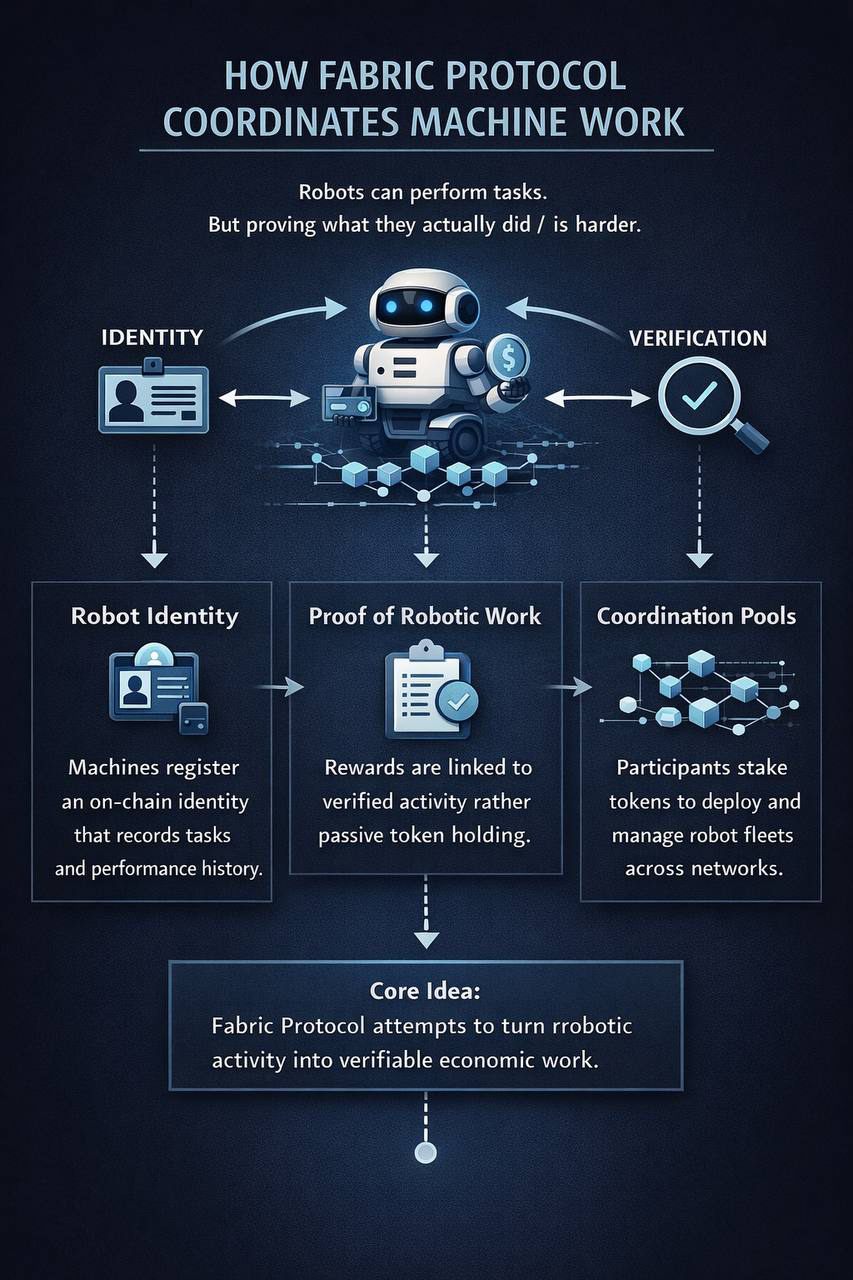
If the model works, robots could eventually operate in open networks instead of isolated company silos. A delivery drone could build a public track record of successful jobs. A warehouse robot could prove its maintenance history. Machines from different manufacturers could collaborate without needing a central authority to coordinate everything.
It’s an ambitious idea.
And like most ambitious ideas, it might take years before we know whether it truly works.
But one thing feels increasingly obvious. Machines are going to perform more and more tasks in the real economy. That shift is already happening.
The real question isn’t just whether robots can do the work.
The real question is whether we’ll have a system that proves they did it.
Fabric Protocol is trying to build that system. And if it succeeds, the relationship between machines and the global economy may end up looking very different from what we see today.